
From the Page to the Set: How Entertainment Journalist Andrew Bloomenthal Bridged the Gap Between Critiquing and Creating Film
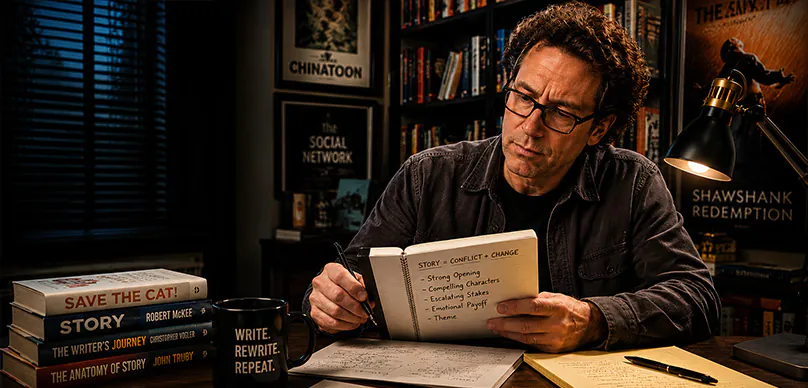
LOS ANGELES — There is a profound, often misunderstood chasm between loving movies and understanding the intricate mechanics of how they are actually made. While millions consume cinema as a passive weekend escape, only a handful transition from the audience to the editing room.
Andrew Bloomenthal is one of the rare practitioners who has spent years exploring that divide from both sides of the table. A seasoned entertainment writer, screenwriter, and independent filmmaker, Bloomenthal’s byline has graced the pages of industry heavyweights including Script Magazine, Creative Screenwriting Magazine, CNBC.com, and Variety.
His unusual professional trajectory has allowed him to sit across from some of the most accomplished screenwriters and directors in Hollywood. Yet, he simultaneously wrestles with the solitary, agonizing creative challenges familiar to every independent screenwriter. This dual existence has given Bloomenthal a rare, 360-degree perspective: he gets to study how professional filmmakers think while confronting those exact same hurdles in his own career.
Main Facts: The Intersection of Journalism and Filmmaking
Bloomenthal’s career is defined by synthesis. By day (or by assignment), he is the analytical observer—interviewing auteurs, dissecting script structures, and analyzing the business of Hollywood. By night, he is the creator—shaping characters, drafting dialogue, and coordinating the logistical nightmare of independent production.
Rather than viewing these two pursuits as competing interests, Bloomenthal has weaponized his journalistic access as a masterclass in screenwriting. Every interview with a veteran showrunner or Oscar-winning director doubles as a live-fire seminar in narrative architecture, pacing, and industry navigation.
Yet, his entry into entertainment journalism was entirely accidental. With a primary background in financial journalism, Bloomenthal initially resisted pressure from friends to combine his love for film with his writing career.
"I wanted to be the filmmaker being interviewed, not the journalist asking the questions," Bloomenthal recalls of his early hesitation.
Eventually, he relented. Armed with preliminary interview material featuring heavyweights like Oliver Stone and Michael Moore, he secured an opportunity with Creative Screenwriting. Journalism swiftly transformed from a detour into a gateway, granting him deep access to the creative processes, struggles, and victories of the very artists he sought to emulate.
Chronology: From Financial Markets to Hollywood Sets
To understand Bloomenthal’s unique perspective, it is necessary to trace the chronology of his career evolution.
- Phase I: The Financial Foundation. Bloomenthal began his professional writing life in financial journalism. This rigorous discipline instilled an early respect for factual precision, economy of language, and hard deadlines—skills that would later prove invaluable in the ruthless real estate of a screenplay page.
- Phase II: The Accidental Pivot. Pushed by peers to merge his day job with his lifelong passion for cinema, Bloomenthal began conducting high-profile interviews. Early conversations with counter-cultural icons like Oliver Stone and Michael Moore provided the momentum needed to break into specialized entertainment publications.
- Phase III: The Deep Dive. Over the next decade, Bloomenthal built a reputation as a meticulous, thoughtful interviewer for outlets like Variety and Script Magazine. Instead of pulling him away from his own art, these interactions served as an informal MFA program.
- Phase IV: The Transition to Production. Having absorbed the habits, mental frameworks, and technical insights of master filmmakers, Bloomenthal began applying those lessons to his own independent projects, culminating in the pre-production and execution of an ambitious musical short film.
Supporting Data and Core Philosophies
Throughout his transition from observer to creator, Bloomenthal has crystallized several core philosophies that serve as a practical blueprint for aspiring filmmakers and writers.
1. The Power of the "Calling Card"
One of Bloomenthal’s foundational lessons is the danger of dismissing minor professional assignments. Early in his entertainment-writing career, he made a conscious decision never to divide his workload into "important" pieces and "insignificant" filler. He approached every article—regardless of outlet size or subject matter—as if it were a major studio release.
He argues that screenwriters and independent filmmakers must adopt the exact same mindset. That low-budget commercial, micro-budget short film, or unproduced first screenplay may be the exact piece of work an executive uses to evaluate your readiness for a larger opportunity.
"Every story is going to serve as a calling card," Bloomenthal notes. While the industry may never see the years of agonizing rewrites hidden in your bottom drawer, it will ruthlessly judge what you choose to put out into the world.
2. Preparation Separates the Amateur from the Professional
Bloomenthal’s background as an interviewer gave him a front-row seat to the fatigue of the Hollywood press junket. Tired of watching directors and actors answer the same generic questions for the hundredth time, he adopted a hyper-prepared approach.
For example, while interviewing Ralph Fiennes about The Invisible Woman, Bloomenthal bypassed standard promotional talking points. Instead, he asked about the technical construction of a specific musical sequence—how live vocals, sound design, and editing were meticulously coordinated. Fiennes instantly lit up at the specificity of the query, a moment of genuine connection that later yielded an exclusive one-on-one interview.
This strategy applies directly to pitching, crew networking, and creative collaborations. Knowing a potential partner’s work inside and out demonstrates a level of respect and genuine interest that no generic compliment can replicate.
3. The Art of the "Zig and Zag"
Thorough preparation, however, must not curdle into rigidity. Bloomenthal advocates for a creative philosophy he calls being ready to "zig and zag."
During an interview, a filmmaker will often answer a question in an unexpected, sideways manner, opening a door to a far more fascinating thematic room. The professional instinct is not to blindly cling to a pre-written list of questions, but to recognize when abandoning the plan yields a superior result.
Screenwriting operates under the exact same physics. While outlining and structure provide necessary direction, characters and narratives frequently reveal organic possibilities during the writing process. The true skill lies in knowing your structural blueprint well enough to recognize when a detour makes the story better.
Official Insights: Craft, Economy, and Accountability
As Bloomenthal transitioned deeper into narrative writing, his journalistic background informed his technical approach to the page.
Economy of Words
Whether constructing an article, an interview, or a screenplay, Bloomenthal maintains a fierce commitment to concision. Clichés are excised; repetitive phrasing is purged; rhythm is carefully managed.
Because screenplays represent one of the most economical storytelling mediums in existence—where a single page theoretically equals one minute of screen time—every line of description and snippet of dialogue carries disproportionate weight. A screenplay does not reward purple prose; it rewards precise, deliberate choices.
The Tyranny of Deadlines
Perhaps the most seamless translation from journalism to screenwriting lies in deadline management. Bloomenthal describes himself as thriving under deadlines and being virtually "allergic" to missing them.
In professional journalism, accountability is forced upon the writer by editors and publishers. In independent screenwriting, however, that external pressure vanishes. Writers laboring on spec scripts face a far more dangerous enemy: absolute freedom.
Without a producer or editor hammering on the door, filmmakers must manufacture their own discipline. Bloomenthal stresses that an unfinished script can attract no actors, secure no financing, and move no audiences. At a certain point, the writer must step up as their own taskmaster and declare the work ready.
Implications: From the Keyboard to the Director’s Chair
The true culmination of Bloomenthal’s dual career arrives when the conversation shifts from analyzing other people’s art to manifesting his own.
At the time of his transition into active production, Bloomenthal prepared to helm a fifteen-minute musical short film based on a theatrical property that had haunted his imagination for years. The mechanics of production immediately transformed writing from an isolated, internal monologue into a high-stakes collaborative enterprise.
Suddenly, abstract ideas required real-world infrastructure: casting actors, recording four distinct vocal tracks, scouting physical locations, assembling props, and coordinating complex shooting schedules.
For many writers, the leap from the page to the director’s chair is paralyzed by self-doubt. Am I qualified? Do I have permission to direct? Bloomenthal’s experience suggests that much of this hesitation stems from fear rather than a genuine lack of capability.
Once collaborators step onto the set, a project takes on a kinetic, communal energy that a writer working alone in a quiet room can never replicate. Eventually, outlining ends. Preparation finishes. The actors stand ready on their marks, and the locations are locked.
At that precise moment, the theory of filmmaking evaporates, leaving only the reality that every aspiring creator must eventually face: taking a deep breath, raising your voice, and calling action.
