
Sonic Frontiers: How Composer Rob Simonsen Brought the ‘Communiverse’ to Life in Pixar’s Elio
The intersection of science fiction and emotional storytelling has long been a hallmark of the most enduring cinema. With his latest project, the Pixar animated feature Elio, composer Rob Simonsen—known for his work on Deadpool & Wolverine and Ghostbusters: Afterlife—has crafted a soundscape that balances the vast, icy silence of the cosmos with the fragile, pulsating heart of an eleven-year-old boy.
As Simonsen makes his animated scoring debut, he brings with him a lifelong obsession with space, UFO culture, and the technical mastery required to blend analog synthesis with orchestral grandeur. The result is a score that does not merely accompany the visual journey of its protagonist; it acts as a navigational system for the audience, mapping out the emotional arc of loneliness, displacement, and the ultimate search for belonging.
The Genesis of a Cosmic Vision
The journey began with an invitation to the Pixar campus in Emeryville. For a composer with a self-professed "alien and UFO nerd" sensibility, the pitch was more than just a job; it was an alignment of personal passion and professional opportunity.
"They brought me up to Pixar and I sat down and heard what the film was all about, and I was very moved, I felt very connected," Simonsen told IndieWire. "I think they were looking for a sound that they found in my work that had a lot of spaciousness and warm piano melodies, but with a sense of expansiveness."

Simonsen’s approach to the score was rooted in the concept of the "Major Seventh" chord. In music theory, the Major Seventh often evokes a sense of yearning or "reaching"—an aspirational quality that perfectly mirrored the protagonist’s desire to escape the confines of his daily life and reach for the stars. This became the foundation for the film’s central theme. "That Major Seventh just felt right," Simonsen noted, "and then figuring out how to support it with the chords underneath. I gravitate towards simple piano melodies with a big synth-fueled expansiveness around it."
A Seamless Transition of Directorial Vision
Elio underwent a unique developmental path, initially helmed by director Adrian Molina before transitioning to the collaborative leadership of Madeline Sharafian and Domee Shi. While such changes in leadership can often lead to a disjointed creative process, Simonsen describes the transition as remarkably fluid.
The introduction of Sharafian and Shi brought a sharpened focus to Elio’s emotional trajectory. Their direction provided a more profound motivation for the protagonist’s abduction, grounding his journey in a relatable, human sense of isolation. Despite these shifts in focus, the musical core remained stable.
"I think in a lot of ways they expanded the world, but they held onto the heart that I felt was there at the beginning, and carried it through in a really beautiful way," Simonsen reflected. "I wrote an ‘Elio’ theme after first seeing the film when I got hired and that stayed through, which was really nice. Musically, we weren’t having to mess around with a lot of things. It was a fairly straight shot with ‘Elio’s’ theme, and it drives the beginning to the end."

The Anatomy of the Score: Signal and Response
Simonsen’s process was highly technical, involving the creation of bespoke sounds designed to mimic the concept of cosmic communication. A pivotal moment in the film—the scene at the planetarium where Elio observes the Golden Record Voyager departing Earth—serves as the primary catalyst for the musical narrative.
To underscore this moment, Simonsen engineered a specific "signal sound" using custom-built synthesizers. This one-note motif is designed to "reach out" into the void. As the film progresses, this signal undergoes a transformation. When the universe responds to Elio’s call, the music evolves into a more complex, multi-note motif. This "call and response" structure serves as a recurring motif throughout the runtime, reinforcing the theme of connection across vast distances.
The emotional precision of the Pixar animation team played a vital role in how this music was deployed. Simonsen noted that the animators possess an almost uncanny instinct for human emotion, allowing them to time the release of a theme to the exact frame where a character’s internal world shifts. "They’re very deep studies of human emotion," he said, "so they know exactly the frame to release a theme and have the music turn."
The "Robot Choir" and Technical Innovation
Perhaps the most ambitious aspect of the score was the creation of the sound for the "Communiverse"—the gargantuan, heavenly intergalactic space station where Elio finds himself mistaken for Earth’s leader. While a typical film might rely on a massive human choir for such a scene, Simonsen opted for a more avant-garde approach.

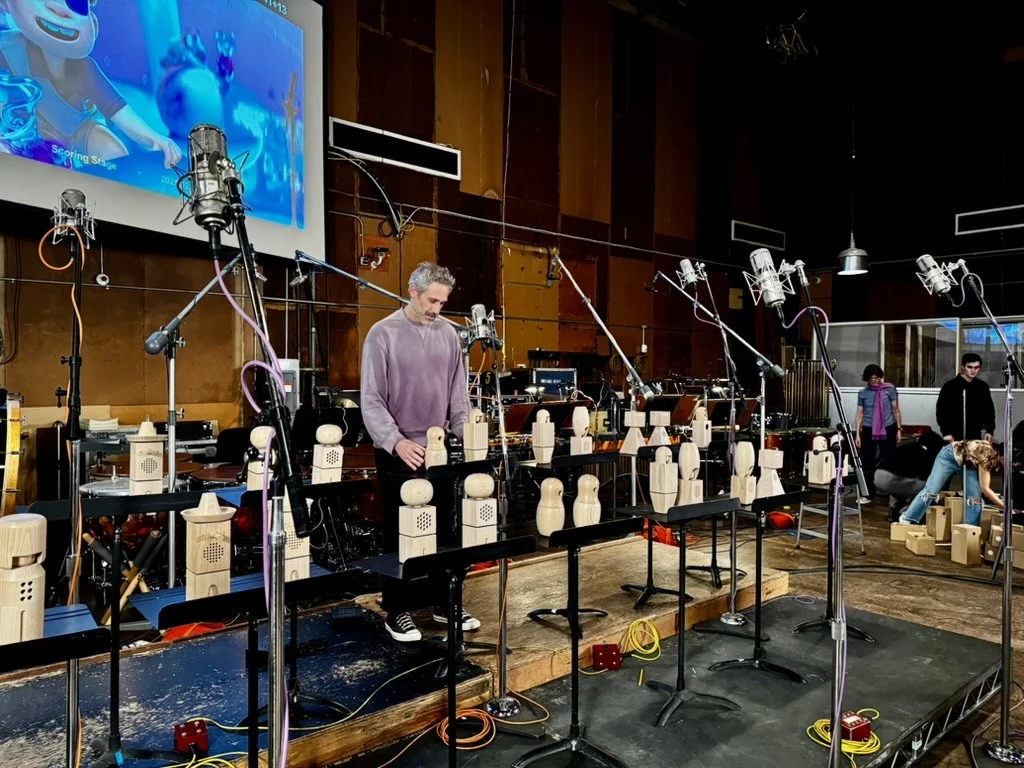
He utilized a collection of "choir dolls" from the Swedish firm Teenage Engineering. These are not standard musical instruments; they are small, wooden-bodied speakers designed to output a distinct, synthesized vocal texture. "These little choir dolls have this very unique sound that I’ve never heard," Simonsen explained. "They sound human, but clearly not human. The shape of the wood gives a shape for their voice, and they function like a choir."
However, using them in a traditional orchestral setting presented a challenge. The dolls had "limited functionality" by design. To overcome this, Simonsen turned to his assistant, a coding specialist named Tiger Lily, who used Python to hack the dolls. By rewriting their code, they were able to expand the functionality of the units, eventually sourcing enough dolls to create a 30-voice robotic choir.
The sight and sound of these tiny, wooden, digital-vocal entities singing on a cavernous Sony scoring stage created a juxtaposition of the intimate and the epic. It was, in Simonsen’s words, the perfect way to achieve an "otherworldly texture" that felt both alien and strangely, touchingly human.
Implications for Future Animation Scoring
The success of the Elio score highlights a growing trend in film music: the marriage of traditional orchestral composition with hyper-specialized, DIY sound design. By refusing to rely on standard digital orchestral libraries, Simonsen has created a sonic identity that feels unique to this specific film.

The implications for the industry are clear: audiences are increasingly responding to scores that feel "authored" rather than "manufactured." The use of custom-coded hardware and experimental synthesis represents a new frontier for composers working within the constraints of high-budget studio animation.
Furthermore, the stability of the score throughout the film’s complex production timeline speaks to the power of a strong, central melodic hook. By establishing an "Elio theme" early in the process—a theme that survives the changes in directors and the evolution of the narrative—Simonsen ensured that the film maintained its emotional north star from the opening Disney logo to the final credits.
Conclusion
As Elio prepares for its June 20, 2025, theatrical release, it arrives with a score that is both a technical marvel and an emotional powerhouse. Rob Simonsen has successfully navigated the vast, intimidating space of a Pixar production, bringing a blend of curiosity, technical ingenuity, and genuine heart to the project.
From the simple, yearning melody of a Major Seventh chord to the haunting, hacked harmonies of a 30-voice robot choir, the music of Elio proves that while space may be infinite and cold, the stories we tell within it—and the sounds we use to tell them—are deeply, undeniably human. Whether through the lens of an eleven-year-old space fanatic or the complex, intergalactic politics of the Communiverse, Simonsen has ensured that the audience’s journey is one worth listening to.
