Forging the Underground: How Don Barris and Windy City Heat Shattered Hollywood’s Rules
HOLLYWOOD — For over a century, the cinematic capital of the world has operated on a singular, intoxicating myth: the fantasy of being “discovered.” The narrative is as old as the studio system itself—an aspiring writer hammers out a flawless screenplay, a fresh-faced performer slays at an open-mic night, or a struggling artist happens to share an elevator with the right studio executive. Suddenly, the gates swing open, and validation is granted in the form of a green light, a contract, and a career.
Yet, for every success story born from this traditional pipeline, thousands of creators languish in perpetual development hell, waiting for permission that never arrives.
Comedian, filmmaker, producer, and podcaster Don Barris chose a vastly different trajectory. A fixture of the legendary Comedy Store in West Hollywood, Barris built his decades-long career on a counter-intuitive yet vital industry truth: if no one is coming to hand you a career, you must build something so undeniably distinct that the industry cannot ignore it.
His journey—from sleeping in his car to orchestrating one of the most brilliant, subversive pranks in comedy history with the cult classic Windy City Heat—serves as a masterclass for modern creators. It is a testament to the power of self-reliance, endurance, and the cultivation of raw, unvarnished human eccentricity over manufactured studio polish.
Chronology of an Underdog: From Homelessness to Cult Stardom
To understand Barris’s philosophy on independent art, one must examine the grueling timeline that forged it. His entry into the entertainment ecosystem was far from linear.
The Michigan-to-California Leap
Barris’s migration from Michigan to Southern California was fueled by ambition, but it was sustained by sheer stubbornness. Upon arrival, he encountered the harsh economic realities familiar to many creative transplants. There were prolonged stretches where his career flatlined entirely. Matters worsened when he was temporarily ousted from the Comedy Store—the very crucible where he was honing his craft. For more than six months, Barris lived out of his car, navigating the precarious intersection of destitution and creative obsession.
The Crucible of the Comedy Store
While performing and hosting potluck nights at the Comedy Store, Barris made a critical observation about human psychology and live entertainment. He noticed that the biggest laughs in the room were rarely being harvested by slick, perfectly polished stand-up comedians delivering calculated premises. Instead, the most explosive reactions were triggered by genuine, unscripted, and eccentric personalities—unpredictable figures who defied standard social norms.
Recognizing this untapped well of organic comedy, Barris began gathering these singular personalities into his own live showcase, initially titled Simply Don. Rather than waiting for a television network to build a vehicle for his unique comedic sensibilities, he began constructing the vehicle himself.
The Eleven-Year Incubation
What audiences rarely witness in the entertainment industry is the invisible decade of experimentation. Barris notes that it took 11 years from the initial conception of this underground comedic universe until Windy City Heat finally materialized as a feature-length film. While the public sees festival premieres, red carpets, and distribution deals, they seldom see the ten years of false starts, financial strain, and iterative chaos that preceded them.
Anatomy of a Masterpiece: The Making of Windy City Heat
The turning point arrived when late-night host and producer Jimmy Kimmel recognized the subversive genius of what Barris and his collaborators had engineered. Kimmel saw the potential to scale Barris’s underground aesthetic into a feature film, culminating in the 2003 cult classic Windy City Heat.
+-----------------------------------------------------------------+
|               THE INVERSION OF ANDY KAUFMAN                     |
|                                                                 |
|  Traditional Stunt: One performer fools an entire audience.     |
|  "Windy City Heat": An entire audience/crew knows the joke—     |
|                    except for one unwitting subject (Perry).    |
+-----------------------------------------------------------------+
The Concept
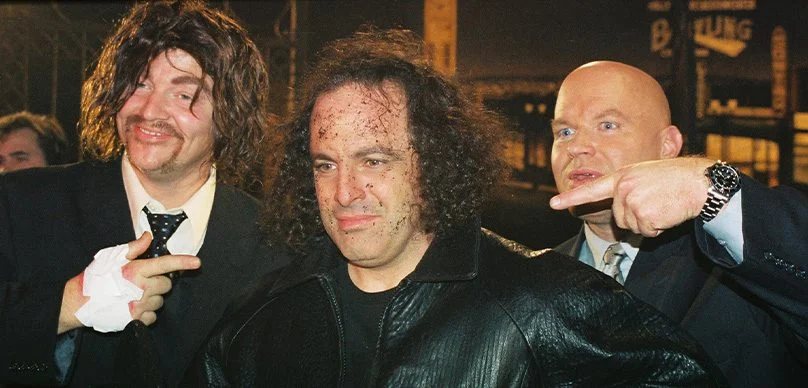
The premise of Windy City Heat represents a brilliant inversion of performance art. The production placed performer Perry Caravello into a fictional movie called Leathernecks, making him believe he was starring in a legitimate Hollywood motion picture. In reality, the entire production—from the director to the crew, co-stars, and script—was an elaborate, continuous prank orchestrated at Caravello’s expense.
Because Caravello believed the film was real, the cameras captured his genuine reactions without the self-consciousness typical of reality television or hidden-camera shows. Additional footage was easily justified under the guise of an Electronic Press Kit (EPK) or behind-the-scenes documentary coverage.
Barris often describes the dynamic as the reverse of Andy Kaufman. Instead of a single performer pulling a prank on an unsuspecting public, practically everyone involved understood the joke—leaving a single, bewildered individual to react to an increasingly surreal world. The final product defies easy categorization, sitting comfortably at the intersection of a feature comedy, a mockumentary, a hidden-camera social experiment, and real-world performance art.
One-Take Filmmaking and Controlled Chaos
From a technical and production standpoint, Windy City Heat introduced a high-wire logistical challenge: many pivotal moments effectively relied on a single take.
When orchestrating a multi-layered prank involving an unaware subject, directors cannot simply shout "cut" and ask the cast to reset the scene if a line is fumbled. Barris highlights sequences like the infamous snack-table argument as high-stakes gambles. If Caravello had suddenly pieced together the deception or walked off the set in genuine rage, the entire cinematic house of cards would have collapsed instantly.
Rather than tightly controlling every micro-performance in the traditional directorial style, the creators built the framework, positioned hidden and open cameras, established the fictional world, and then stepped back to let raw reality dictate the narrative.
Supporting Data & Cultural Impact: The Power of Word-of-Mouth
While Windy City Heat did not receive a massive traditional theatrical rollout, its footprint grew exponentially through an organic, grass-roots distribution network that modern independent filmmakers would do well to study.
Jimmy Kimmel’s Grassroots Campaign
Jimmy Kimmel became one of the film’s earliest and most fervent champions. According to Barris, Kimmel would regularly purchase cases of the DVD out of his own pocket, handing them directly to industry peers, actors, and comedians whom he believed possessed the specific comedic palate required to appreciate its chaotic brilliance.
Industry Adoption
This peer-to-peer marketing strategy birthed a legendary cult following. The film eventually filtered through the upper echelons of Hollywood by word of mouth:
- Quentin Tarantino became an enthusiastic evangelist for the movie, passionately breaking down its mechanics to fellow filmmakers.
- Tarantino famously introduced Barris to Eli Roth backstage at Jimmy Kimmel Live.
- Comedian and actor Jack Black emerged as a vocal supporter of Barris and the "Big Three" comedy collective.
The trajectory of Windy City Heat provides a timeless lesson for independent creators: a project does not always need to find its ultimate audience during its initial release window. When a work possesses genuine originality, passionate viewers can organically evolve into its marketing department, breathing life into a project long after traditional marketing budgets have dried up.
Official Perspectives and Industry Evolution
Reflecting on the shifting sands of the entertainment landscape, Barris points out how dramatically the democratization of media has leveled the playing field for independent artists.
Watching pioneers like Adam Carolla and Joe Rogan build direct, unmediated relationships with massive global audiences through podcasting opened Barris’s eyes to the potential of digital infrastructure.
"The internet represents something filmmakers and performers previously didn’t have: their own distribution and promotional infrastructure," Barris notes.
In the pre-digital era, an artist had to shoot a television pilot, hand it over to gatekeepers, and pray that a network executive chose to champion it. Today, creators can independently produce shows, podcasts, digital sketches, and feature films. These self-funded properties aggregate audiences, and those audiences, in turn, provide the leverage required to scale up to larger artistic endeavors.
The Currency of Relationships
This self-starting ethos informs Barris’s current ambition: the creation of an independent entertainment network designed to produce everything from podcasts and short-form digital clips to full-scale pilots and feature films.
Crucially, Barris emphasizes that decades in the comedy trenches have forged deep relationships with top-tier performers. In the traditional studio system, hiring these talents would require astronomical budgets. However, because of mutual trust, shared history, and personal connections, these artists are often willing to participate in independent ventures for a fraction of their standard quote.
This yields a vital, frequently overlooked production principle: Relationships are production value. The collaborators you have supported, worked alongside, and built trust with over a career can grant an independent production access to talent, locations, and resources that a modest cash budget could never otherwise secure.
Broader Implications for Modern Creators
The career of Don Barris challenges the traditional industry roadmap. He did not matriculate through prestigious film schools, log years as a low-level agency mailroom assistant, or wait for a studio script-writing assignment.
Instead, he:
- Cultivated original comedy in underground live venues.
- Identified and embraced unusual, authentic collaborators.
- Incubated a singular creative concept over eleven years of trial and error.
- Forged strategic alliances with industry heavyweights like Jimmy Kimmel.
- Transformed a high-risk prank into an enduring cult classic.
- Continuously adapted to emerging distribution models like podcasting and digital video.
The Takeaway
For screenwriters, comedians, and independent filmmakers staring down the barrel of industry gatekeepers, Barris’s philosophy boils down to a single imperative: Make your own opportunities.
Shoot the micro-budget short. Record the podcast. Build the digital audience. Nurture genuine industry relationships. Continue producing work even when the surrounding culture appears entirely indifferent.
In an industry obsessed with the illusion of the overnight discovery, the creators who ultimately endure are usually the ones who spent a decade quietly building the door that the rest of the world eventually walked through.
