How Blender, Vaporwave, and a MacBook Built "Boys Go to Jupiter": Inside Julian Glander’s Lo-Fi Masterpiece
Main Facts
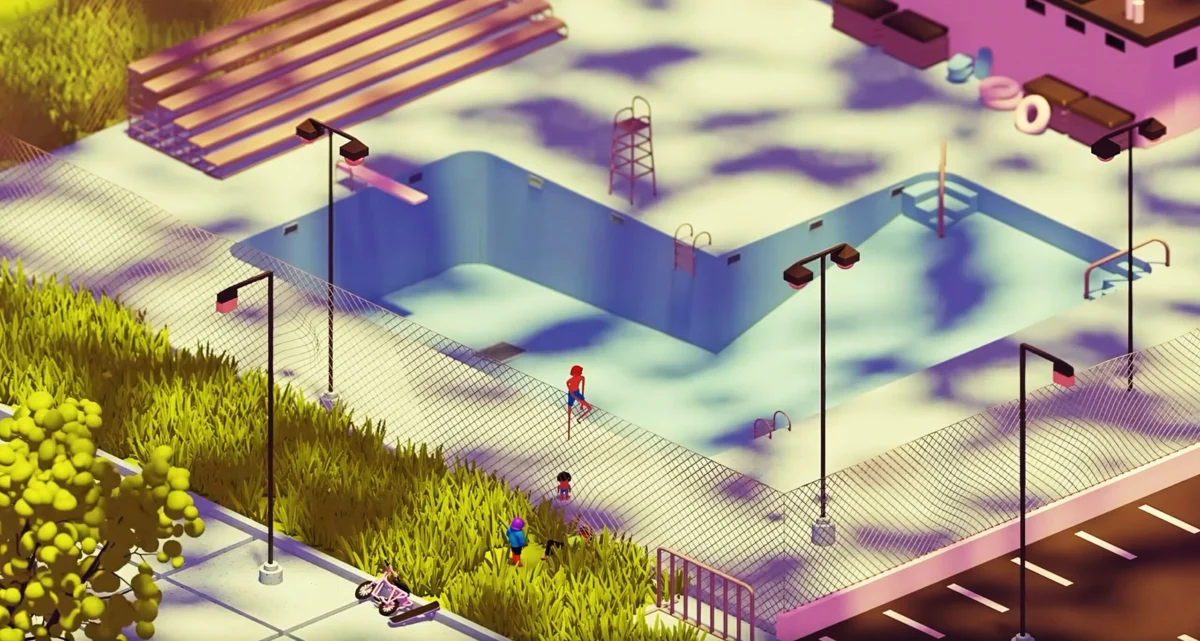
The indie animation landscape is undergoing a quiet, radical democratization, and free open-source software is leading the charge. While films like Gints Zilbalodis’s Oscar-winning Flow have demonstrated the breathtaking, cinematic potential of Blender on an international stage, director JulianGlander’s upcoming feature Boys Go to Jupiter proves that the same software can be harnessed for something radically different: a lo-fi, pastel-drenched, vaporwave coming-of-age odyssey set against the uncanny backdrop of a decaying Florida.
Slated for a theatrical release by Cartuna and Irony Point, Boys Go to Jupiter follows Billy 5000, an intensely sleep-deprived teenage deliverista voiced by Jack Corbett. Billy is hustling desperately to scrape together $5,000—the sum he believes will finally purchase his elusive independence—while navigating an environment overflowing with absurd miracles, surreal corporate structures (including an orange juice factory run by Janeane Garofalo and Julio Torres), and a general sense of internet-era malaise.
Remarkably, despite the lush world-building characteristic of modern 3D cinema, Glander constructed the entire feature utilizing standard hardware—a regular MacBook—and the free-to-download 3D creation suite Blender. Rather than treating technical limitations as roadblocks, Glander transformed logistical hurdles into defining stylistic choices, championing an aesthetic that bridges the timeless alienation of youth with the modern realities of digital "enshittification."
Chronology: From Tumblr’s Golden Age to the Silver Screen
To understand the genesis of Boys Go to Jupiter, one must trace Julian Glander’s trajectory through the evolving landscape of digital art and internet culture.
The Early Digital Era: Glander began his career during what he identifies as a golden age of creative expression on platforms like Tumblr, a time when spending hours online and navigating early internet subcultures felt vibrant, community-driven, and intrinsically tied to identity.
Decade of 3D Illustration: Over the past ten years, Glander built a robust career as a 3D illustrator, continuously refining a distinct visual language dictated by the constraints of working on minimal hardware.
Development and Production: Utilizing Blender exclusively on his MacBook, Glander engineered the world of Boys Go to Jupiter, deliberately leaning into isometric perspectives and static character placements to bypass the prohibitive costs and technical complexities of traditional 3D camera movements and intricate walk cycles.
The Festival Circuit & Distribution Announcement: Following its development and subsequent completion, the film caught the attention of distributors Cartuna and Irony Point, culminating in an official theatrical release date set for Friday, August 8.
Supporting Data and Technical Breakdown
The production of Boys Go to Jupiter offers a fascinating case study in low-budget, high-concept independent animation. By treating software constraints as creative catalysts, Glander achieved a distinct look that separates his work from high-end studio pipelines.
The Economics of Animation Constraints
In traditional 3D animation, the most financially draining elements are fluid camera movements and complex character locomotion. Walk cycles, in particular, require immense labor-hours; if a walk cycle looks unnatural, it immediately breaks the viewer’s immersion.
Glander navigated this by fundamentally altering how characters interact with their environment:
Stationary Interactions: Characters frequently appear behind fences, inside doorways, or anchored to specific set pieces.
Wheeled Mobility: Rather than walking, the protagonist Billy 5000 spends the majority of the film navigating on a "swagway" (hoverboard).
Thematic Resonance of the Swagway: Beyond being a logistical shortcut for animation, the swagway mirrors Billy’s psychological state—he is an aimless, ghostly young man floating listlessly through life, attempting to remain unobserved and unnoticed in a world moving too fast for comfort.
Aesthetic Influences
The Florida Petri Dish: Glander describes Florida not merely as a geographic location, but as "America’s hell" and a cultural Petri dish born out of the commercialization of swamp ecosystems by entities like Disney World 75 years ago. The film captures the sun-drenched, acid-pastel decay of that fantasy.
Isometric Framing: Utilizing an isometric point-of-view from a distance establishes a sense of emotional and physical detachment, symbolizing how modern digital systems have isolated and dehumanized individuals.
Official Responses and Creator Insights
In an exclusive interview with IndieWire, Julian Glander opened up about the philosophy driving his work, the democratization of creative tools, and the socioeconomic commentary woven into the film’s pastel aesthetic.
Reflecting on the democratization of software, Glander compared the current state of independent animation to the paradigm shift live-action cinema experienced fifteen years ago:
"To me, it feels like we’re at the same moment live-action films had 15 years ago, when all of a sudden everyone had iPhones and everyone started being born with some camera literacy. I think the same thing is happening in animation now. The tools are definitely there — and beyond the tools, the educational resources are there and the communities are there."
Discussing the psychological undertones of the film’s setting and the distinct isolation of contemporary youth culture, Glander noted how the tech industry’s gamified promises have fundamentally restructured human interaction:
"Billy’s point of view in that scene is like he’s in a world that’s too big for him; and the billboards that he walks past — I think one of them is for the lottery, one of them is saying you’re gonna die and go to hell, and that just sort of hangs over the movie… Part of being a teenager is finding a way to have a beautiful life or see the beauty in the world when you basically have no good options."
Highlighting a pivotal sequence where Billy’s phone and swagway die, forcing him to take a long, reflective walk home in the dark, Glander explained how scale manipulation serves the narrative:
"This is something people talk about a lot in urban development — when you live in car-centric America, the scale of everything is off. It’s not done at human scale. I really like that scene because it takes place at night, and so we get to see everything we just saw in a different light, and it’s new again."
Implications for the Future of Independent Animation
The success and methodology behind Boys Go to Jupiter signal broader implications for the entertainment industry:
The Democratization of Production: As demonstrated by both Flow and Glander’s work, the barrier to entry for feature-length animation is lowering drastically. Creators no longer require massive render farms or millions of dollars in proprietary software licenses to produce visually striking, emotionally resonant feature films.
Hardware Accessibility: Proving that a feature film can be rendered and assembled on a standard MacBook empowers a new generation of bedroom animators and digital artists to bypass traditional gatekeepers.
Aesthetic Shifts in Indie Cinema: Just as the "mumblecore" movement embraced lo-fi digital video aesthetics out of financial necessity, contemporary animation is seeing the rise of a vaporwave, low-polygon, and minimalist aesthetic that uses technical constraints to make pointed cultural critiques about internet culture, alienation, and late-stage consumerism.
As Boys Go to Jupiter prepares for its August 8 release via Cartuna and Irony Point, it stands as proof that the radical promise of the internet—open tools, accessible education, and unbridled creative expression—is still capable of yielding remarkable art, even if the digital landscape surrounding it has changed.