
Bridging the Gap: Autodesk Flow Studio’s 3D Editor + Canvas Redefines Directable AI Filmmaking
Main Facts
The landscape of generative artificial intelligence in media production has long been plagued by a fundamental paradox: while algorithms can synthesize strikingly photorealistic characters, intricate environments, and sweeping video sequences with remarkable ease, achieving micro-level control over these elements remains an elusive pursuit. Creators are frequently left at the mercy of the "black box" nature of text prompts and reference images, struggling to dictate precise camera trajectories, character blocking, and temporal consistency from shot to shot.
In a decisive move to solve this industry-wide bottleneck, Autodesk has announced a major expansion of Flow Studio, introducing a transformative workflow known as 3D Editor + Canvas. This hybrid environment effectively merges the structural precision of traditional 3D scene control with the boundless visual experimentation of AI-powered 2D generation and refinement.
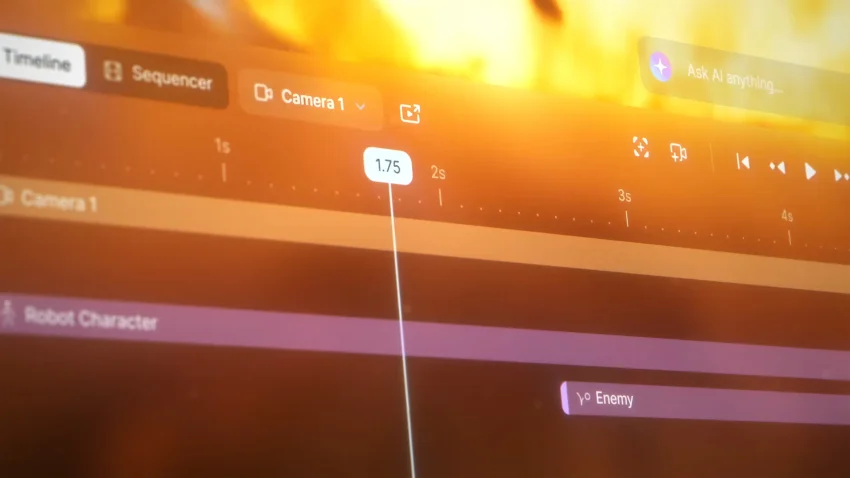
Rather than forcing artists to rely exclusively on prompt engineering to imply depth, movement, and composition, Flow Studio now allows creators to lay out their scenes within a fully realized 3D workspace. Characters, animations, camera tracks, and AI motion-capture data are synthesized into a single, cohesive ecosystem. Once the foundational geometry, blocking, and cinematography are locked down, powerful image and video AI models take over to render the final visual treatment.
The update comprises two core pillars:
- The 3D Editor: A robust hub where filmmakers can orchestrate characters, assets, camera movements, and environmental setups using traditional spatial rules. This workspace can also ingest external assets, such as AI-generated worlds from specialized tools like World Labs Marble.
- Canvas: A flexible, node-based 2D environment dedicated to generating, exploring, iterating, and refining the final visual aesthetic using state-of-the-art image and video models.
By keeping these two methodologies in dialogue, Autodesk is offering a production-proven philosophy rooted in decades of industry dominance with software like Maya, 3ds Max, and Arnold, scaling those foundational pipelines directly into the era of generative AI storytelling.

Chronology
To understand the weight of Autodesk’s latest announcement, it is helpful to trace the rapid evolution of generative video tools and Autodesk’s strategic positioning within the digital content creation (DCC) market.
Phase 1: The Wild West of Prompt-Based Generation (2022–2024)
During the initial boom of generative AI video models, the industry was captivated by novelty. Platforms emerged that could produce breathtaking 4-second clips from simple text prompts. However, professional creators quickly hit a brick wall. While these tools could generate visually appealing frames, they lacked continuity, spatial awareness, and directability. A character might change clothing between cuts, or a camera pan might warp unpredictably, rendering the tech largely impractical for narrative filmmaking, where continuity and intent are paramount.
Phase 2: The Integration of Control Nets and Reference Imagery (2024–2025)
As the technology matured, developers introduced control mechanisms—such as depth maps, skeleton poses (OpenPose), and reference style prompts—to wrestle back some control over AI outputs. While these iterations bridged part of the divide, they remained disjointed hacks layered on top of fundamentally 2D architectures. Artists found themselves juggling external plugins, manual rotoscoping, and trial-and-error prompting just to keep a virtual camera pointed at the right subject.
Phase 3: Autodesk’s Strategic Pivot and the Rise of Flow (2025–Present)
Recognizing that Hollywood studios and independent artists alike would reject tools that compromised creative control, Autodesk began restructuring its cloud and collaborative infrastructure under the "Flow" ecosystem. Flow was designed to break down silos between disparate production departments.
The unveiling of the 3D Editor + Canvas workflow in Flow Studio marks the culmination of this strategy. By building a native bridge between 3D spatial direction and 2D generative models, Autodesk is effectively establishing a new paradigm: AI should serve the director’s vision, rather than dictating it.

Supporting Data
While generative AI promises unprecedented efficiency, adoption rates in professional pipelines have been hindered by a lack of predictability. The numbers and structural metrics surrounding Autodesk’s Flow Studio update highlight its focus on enterprise-grade reliability over fleeting trends:
- Dual-Environment Architecture: The platform bridges 100% of spatial 3D control data (focal lengths, camera rigs, skeletal rigging) with variable 2D generative nodes, eliminating the need to export and convert files across disconnected third-party software suites.
- Cross-Platform Interoperability: Flow Studio’s architecture natively supports asset ingestion not just from internal Autodesk libraries, but also from cutting-edge external environmental engines like World Labs Marble, allowing for infinite world-building capabilities.
- Scalable Creative Control: Autodesk’s telemetry and user research indicate that professional creators spend upwards of 60% of their pre-production time locking down composition, blocking, and camera pacing. By handling these metrics in 3D first, Flow Studio drastically reduces the iteration loops traditionally wasted on regenerating faulty AI video clips.
- Heritage Foundation: The underlying technology benefits from decades of engineering refinement derived from industry standards like Maya (used in virtually every major VFX-heavy blockbuster), 3ds Max, and the Arnold renderer.
Official Responses and Industry Perspectives
Autodesk’s leadership has consistently framed the integration of generative artificial intelligence not as a replacement for human artistry, but as an amplifier of intent.
In statements accompanying the Flow Studio rollout, Autodesk representatives emphasized that the core crisis of generative AI is not its rendering quality, but its lack of directability. A spokesperson noted that while generating a striking single frame is an interesting technical feat, professional filmmaking relies on deliberate choices—performance, timing, blocking, and camera consistency—that must remain uncompromised from shot to shot.
Industry analysts and early preview participants have similarly praised the approach. For years, the digital art community has voiced concerns that AI tools would de-skill the creative process, turning directors into mere prompt jockeys. By anchoring AI generation inside a familiar 3D spatial editor, Autodesk has signaled to veteran artists that their traditional spatial training—knowing where to place a camera, how to frame a subject, and how to stage a scene—remains the most valuable asset in the room.
Independent filmmakers and small studio supervisors have also responded enthusiastically to the Canvas node-based workflow. The ability to seamlessly dial in how much control is needed for a specific shot—staying entirely within a fast 2D exploratory mode for background vignettes, or dropping down into rigorous 3D mode for hero character sequences—provides a scalable pipeline that was previously restricted to multi-million-dollar VFX houses.

Implications
The introduction of Flow Studio’s 3D Editor + Canvas workflow carries profound implications for the future of entertainment, visual effects, and independent digital creation.
1. The Death of the "Prompt-and-Pray" Workflow
As generative video models become more ubiquitous, the novelty of random AI generation is wearing off. Studios cannot afford to gamble on models that hallucinate camera angles or warp character anatomy mid-scene. Autodesk’s hybrid approach forces an industry-wide pivot: future AI tools must be built to conform to the established laws of 3D space, physics, and cinematography, rather than expecting human creators to adapt to chaotic algorithmic outputs.
2. Democratization of High-End Pre-visualization (Pre-vis)
Pre-visualization has historically been an expensive, time-consuming phase of film production, requiring dedicated layout artists to block out scenes before principal photography or full animation begins. By combining 3D scene construction with instant, AI-driven visual development on the Canvas, independent filmmakers and boutique creative agencies can now generate pitch-ready, stylistically rich pre-vis material in a fraction of the time and at a fraction of the cost.
3. A Roadmap for Future AI Integration
Autodesk has positioned this release as the foundational baseline for an even more ambitious future. The company’s roadmap hints at expanded integrations with Autodesk Maya and other Digital Content Creation (DCC) tools, advanced asset-import pipelines, AI-assisted scene construction, and eventually, agent-driven directing workflows. Should Autodesk successfully deliver on these future capabilities, Flow Studio could evolve from a specialized cloud utility into the central nervous system of modern digital filmmaking, seamlessly mediating between human creative vision and autonomous machine execution.
Conclusion
Autodesk’s 3D Editor + Canvas update represents a maturing of the generative AI conversation. The race to build the flashiest text-to-video model is taking a backseat to the much harder, much more necessary work of building tools that artists can actually direct. By marrying the structural rigor of 3D spatial editing with the fluid creativity of node-based 2D generation, Autodesk has provided a vital blueprint for how professional pipelines can safely and productively embrace the AI revolution without losing their artistic soul.
