
Aaron Sorkin’s ‘The Social Reckoning’ Fails to Capture the Digital Age: A Critical Analysis
Main Facts: The Return to Silicon Valley
More than a decade after Aaron Sorkin penned The Social Network—the cinematic masterwork directed by David Fincher that explored the morally murky genesis of Facebook—the Academy Award-winning screenwriter has returned to the digital battleground. His latest directorial venture, The Social Reckoning, positions itself as a spiritual sequel and a fact-based tribute to the whistleblowers, journalists, and modern-day foot soldiers of democracy who attempted to hold big tech accountable for the events leading up to the January 6, 2021, Capitol riots.
However, rather than galvanizing cinematic emotion around the seismic algorithmic shifts that reshaped modern politics, The Social Reckoning struggles under the weight of its own theatricality. The film stars Mikey Madison—fresh off her own Oscar-winning turn in Sean Baker’s Anora—as Frances Haugen, the former Facebook data engineer who famously leaked internal documents exposing how the platform’s engagement-driven mechanics exacerbated societal polarization.
Yet, as Sorkin’s fourth feature behind the camera demonstrates, his signature rat-a-tat dialogue and aggressively nostalgic framing increasingly feel out of step with contemporary realities. The film arrives in theaters via Sony Pictures on Friday, October 9, carrying immense expectations that it ultimately fails to fulfill. Critics have pointed to a distinct lack of narrative urgency, questioning whether Sorkin’s theatrical sensibilities are equipped to handle the sprawling, deeply unsettling complexities of 21st-century algorithmic radicalization.
Chronology: From the Facebook Files to the Big Screen
To understand the narrative framework of The Social Reckoning, one must trace the timeline of the real-world events it attempts to dramatize—and where the film’s chronology takes creative liberties.

- 2018: Mark Zuckerberg unveils the controversial "Meaningful Social Interactions" (MSIs) ranking system, an algorithmic pivot designed to prioritize content that generated high emotional engagement, inadvertently favoring hyper-partisan outrage and shifting traffic away from reputable journalism.
- Early 2020 (The Lockdown Era): Frances Haugen begins working as a data manager and content moderator at Facebook, growing increasingly alarmed by internal metrics showing how platform algorithms radicalize vulnerable users, direct teenagers toward self-harm content, and facilitate dangerous networks.
- Late 2020 to Early 2021: Haugen compiles thousands of internal documents—dubbed the "Facebook Files"—and covertly reaches out to Wall Street Journal investigative reporter Jeff Horwitz.
- January 6, 2021: The attack on the U.S. Capitol occurs, an event heavily scrutinized in public discourse for its roots in digital radicalization and misinformation campaigns amplified by social media feeds.
- Fall 2021: Frances Haugen steps forward publicly as the Facebook whistleblower, testifying before Congress and cementing her place in contemporary media history.
- October 2026: The Social Reckoning premieres during the fall festival circuit, landing in theaters just as competing tech-satires, such as Luca Guadagnino’s OpenAI-focused feature Artificial, begin shifting the cultural conversation around artificial intelligence and digital existentialism.
Supporting Data and Production Details: A Chemistry Void
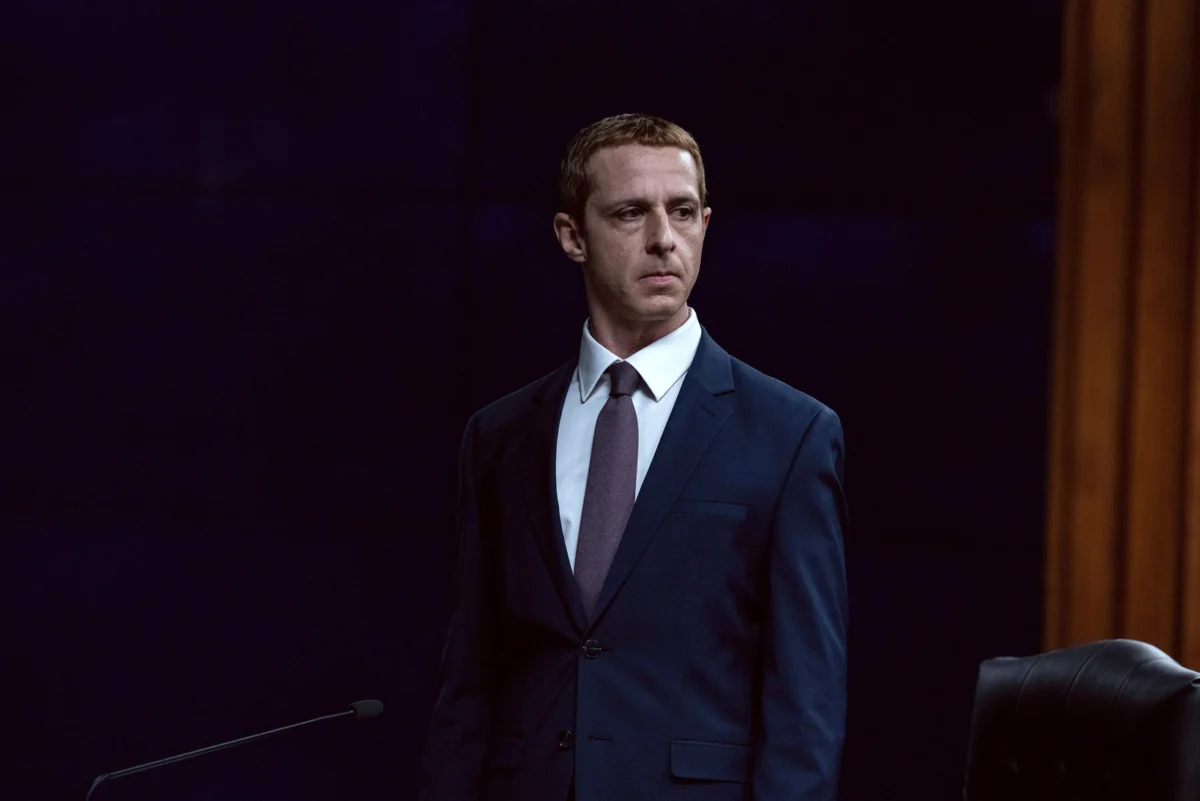
Despite a marquee ensemble cast, The Social Reckoning struggles to generate authentic human connection on screen. Jeremy Strong adopts a rigorous Method-acting approach to portray Mark Zuckerberg, sporting a rigid Caesar cut and maintaining his character’s intense posture throughout production. The film features simulated rehearsal sessions for congressional hearings, highlighting the algorithmic laundering of messaging by bad actors, drug cartels, and human traffickers.
Alongside Strong, Jeremy Allen White steps into the role of Wall Street Journal investigative reporter Jeff Horwitz. The dynamic between Madison’s Haugen and White’s Horwitz is heavily colored by Sorkin’s trademark fast-talking banter, frequently gesturing toward classic screwball romantic comedies and even directly referencing filmmaker Frank Capra. Unfortunately, the dialogue often feels stiff and overly rehearsed, functioning less like natural human conversation and more like a political mouthpiece delivering lectures.
Additional cast members—including a sharp Betty Gilpin as Horwitz’s editor and Bill Burr as a fictionalized composite figure representing a Zuckerberg ally—are frequently sidelined by Sorkin’s relentless focus on stylized rhetoric. Furthermore, the film’s release timing places it in direct competition with Luca Guadagnino’s Artificial, starring Andrew Garfield. Premiering around the same window, Guadagnino’s dynamically unsettling satire has cast a long shadow over Sorkin’s conventional, retro-styled approach to modern technological anxieties.
Official Responses and Industry Reception
Critical reception to The Social Reckoning has been largely tepid, marked by discussions regarding the viability of Sorkin’s directorial style. Industry analysts and reviewers have noted a growing disconnect between the filmmaker’s nostalgic aesthetic and the cold, unyielding reality of modern media consumption.

While representatives for Sony Pictures have championed the film as a vital look at modern whistleblowing and institutional courage, early festival screenings have generated considerable debate. Reviewers have argued that Sorkin’s direction exhibits an undue reverence for his own text, showing an unwillingness to cut superfluous scenes or modernize his rhythmic dialogue patterns.
Moreover, cultural commentators have questioned the film’s optimistic framing of complex geopolitical crises. By treating complex structural failures as obstacles that can be neatly solved through heroic journalism and dramatic congressional testimony, the film has faced scrutiny for oversimplifying the mechanics of digital radicalization.
Implications: How Did We Get Here, and How Do We Get Out?
The broader implications of The Social Reckoning stretch far beyond the box office, tapping into a profound cultural fatigue regarding stories about technology, ethics, and political polarization.
Sorkin’s narrative concludes on a notably triumphant note, featuring Haugen riding off toward a metaphorical horizon of institutional victory, complete with a triumphant fist-bump. Yet, critics note that this rose-colored perspective clashes sharply with the contemporary sociopolitical landscape. Living in the mid-2020s, audiences are acutely aware that the explosive revelations of the Facebook Files did not fundamentally dismantle the architecture of surveillance capitalism. Political shifts have seen the return of figures like Donald Trump to power, numerous January 6 participants have received pardons, and algorithmic misinformation remains deeply embedded in the digital ecosystem.

Where films like Alan J. Pakula’s All the President’s Men captured a defining moment of institutional reckoning with a sense of grim, investigative precision, The Social Reckoning feels like a retrospective relic of a past decade’s optimism. It attempts to answer "how we got here," but leaves viewers hungering for a cinematic vocabulary that addresses the far more urgent question: how do we get out?
