
Plaintiffs, Pianos, and Portals: How Coyote vs. Acme Brought Looney Tunes Physics into the Real World
Main Facts: The Legal Battle of the Century Hits the Big Screen
After decades of perpetual humiliation, catastrophic product failure, and countless plummeting anvils, Wile E. Coyote has finally found a remedy in a court of law. In the much-discussed hybrid feature film Coyote vs. Acme, the iconic, perpetually famished cartoon genius takes the multi-trillion-dollar ACME Corporation to court.
The case brings together an unlikely legal team: Will Forte stars as Kevin Avery, a struggling human personal injury attorney who takes on the case of a lifetime. His client is none other than Wile Ethelbert Coyote, whose medical history is an extensive catalogue of explosive malfunctions, defective rocketry, and gravity-defying trauma directly attributable to ACME merchandise. Standing in their way is corporate legal titan Buddy Crane, played with corporate bravado by John Cena. Assisting Avery is his sharp-witted niece and legal intern, Paige, played by Lana Condor.
Behind the camera, the film is directed by Dave Green, working from a screenplay by Samy Burch based on a story crafted by Burch, James Gunn, and Jeremy Slater. The cinematic premise traces its lineage back to Ian Frazier’s celebrated 1990 New Yorker satirical article of the same name, which first imagined the legal brief of a coyote suing a monopolistic supplier of faulty goods.
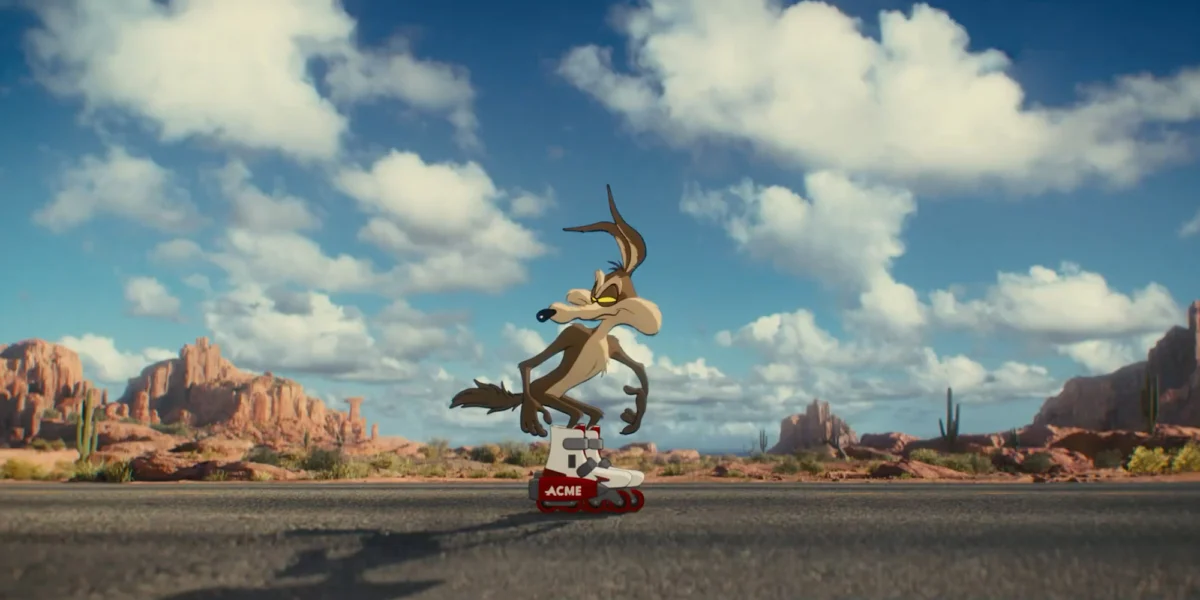
However, the real-world trial of Coyote vs. Acme extends far beyond the courtroom drama scripted for the screen. On a recent episode of the VFXShow podcast, visual effects veterans Matt Wallin, Jason Diamond, and Mike Seymour convened a cinematic court to examine the staggering technical challenges of the production. Translating a 2D animated icon famous for impossible physics into a live-action world required an unprecedented blend of cutting-edge computer graphics, traditional hand-drawn animation principles, and old-school on-set puppetry.
Chronology: From Satirical Short Story to Hybrid Cinematic Triumph
To understand how Coyote vs. Acme made it to the screen—and into the technical scrutiny of VFX experts—one must look back at the timeline of its development, evolution, and eventual realization.
- 1990: Author Ian Frazier publishes his now-classic satirical article in The New Yorker, titled "Coyote v. Acme." Written entirely in the formal, legalese language of a product liability brief, the document details the myriad injuries sustained by Wile E. Coyote due to malfunctioning "Giant Rubber Bands," "Iron Pellets," and "ACME Jet Propelled Tennis Shoes."
- Decades Prior to Production: Warner Bros. attempts various iterations of Looney Tunes adaptations, realizing that while characters like Bugs Bunny and Daffy Duck have successfully anchored hybrid projects (most notably Space Jam and Looney Tunes: Back in Action), crafting a narrative centred squarely on the silent, frantic desperation of Wile E. Coyote poses unique storytelling hurdles.
- The Development Era: Screenwriter Samy Burch develops a script based on Frazier’s premise, which catches the attention of producers including James Gunn. Director Dave Green signs on to helm the project, envisioning a blend of live-action courtroom drama and high-energy cartoon slapstick.
- Principal Photography: Filming begins with human actors Will Forte, John Cena, and Lana Condor interacting with the environment. To ensure realistic eyelines, physical blocking, and authentic comedic timing, veteran puppeteer Dave Barclay is brought to set with a life-size physical puppet of Wile E. Coyote.
- Post-Production & VFX Pipeline: Visual effects powerhouse DNEG takes on the massive challenge of rendering the CG character. The team implements innovative workflows, combining digital character work with traditional 2D hand-drawn animation techniques—including illustrated "SketchViz"—to preserve the classic Looney Tunes aesthetic.
- The VFXShow Breakdown: Industry specialists Matt Wallin, Jason Diamond, and Mike Seymour take the film "to court" on their podcast, dissecting the compositing, asset design, and the delicate balance required to turn a silent cartoon gag-artist into the emotional anchor of a feature film.
Supporting Data: The Mechanics of Animation and Visual Effects
Bringing a character as stylized as Wile E. Coyote into a physical, live-action environment is one of the most formidable tasks a visual effects studio can undertake. According to the insights shared on the VFXShow, the production relied on a multi-layered approach to bridge the gap between cartoon abstraction and photorealism.

1. The "SketchViz" Pipeline
Before a single digital frame was fully rendered in 3D, the production utilized illustrated storyboards and animatics known as "SketchViz." This technique allowed the creative team to establish the timing, poses, and exaggerated gags of traditional hand-drawn animation early in the pipeline. By locking down the comedic beats through sketching, the animators ensured that the eventual computer-generated models did not lose the signature "squash and stretch" physics mandated by the Looney Tunes legacy.
2. Practical On-Set Puppetry
Acting opposite empty space is a notorious hurdle for performers in visual effects-heavy films. To solve this, the production enlisted puppeteer Dave Barclay. By operating a life-size physical puppet of Wile E. Coyote on set, Barclay gave actors Will Forte and Lana Condor a tangible focal point. This practical interaction dictated accurate eyelines, naturalistic blocking, and genuine emotional reactions that translated seamlessly when the digital character was inserted during post-production.
3. DNEG’s Hybrid CG Work
Rendering Wile E. Coyote meant solving a distinct texture and lighting problem. The character had to look like he belonged in the real world—possessing individual fur strands, realistic weight, and interactions with physical debris (such as exploding dynamite or crumbling canyon walls)—while simultaneously retaining the iconic silhouette, expressive eyes, and elastic physical logic that fans have recognized for nearly a century. DNEG’s artists balanced photorealistic shading with non-photorealistic animation principles, ensuring the character never looked out of place next to flesh-and-blood actors like John Cena and Will Forte.
Official Responses and Expert Analysis
The legal and technical merits of Coyote vs. Acme were thoroughly tried during the recent session of the VFXShow. Convening the metaphorical court, the panel broke down the collaborative efforts required to pull off the ambitious hybrid project:
- Matt Wallin (Counsel for the Coyote): Serving as the lead voice dissecting the digital artistry on mattwallin.com, Wallin emphasized the immense pressure placed on animators to honor the character’s rich history. "You aren’t just animating a CG animal; you are handling a sacred text of American animation," Wallin noted, pointing out that any deviation from the classic timing immediately breaks the audience’s suspension of disbelief.
- Jason Diamond (Expert Witness): Representing the visual effects expertise of thediamondbros.com, Diamond focused heavily on the integration of live-action elements with digital environments. He praised the use of practical aids like Dave Barclay’s on-set puppet, explaining that physical touchpoints ground the digital animation in reality, making the unbelievable destruction feel remarkably tangible.
- Mike Seymour (ACME Product Tester): Bringing his extensive analytical eye from fxguide, Seymour explored the broader technological implications of blending 2D cartoon heritage with modern 3D pipelines. He highlighted how the "SketchViz" phase served as an essential bridge, allowing modern CGI studios to respect the classical hand-drawn timing pioneered by Warner Bros. legends like Chuck Jones.
Implications: The Future of Hybrid Animation and IP Adaptation
The release and technical dissection of Coyote vs. Acme carry significant implications for the entertainment industry, particularly regarding how major studios handle legacy intellectual property (IP) and hybrid filmmaking.
Redefining Character-Driven Hybrid Films
For decades, live-action/animation hybrids have often leaned heavily on self-aware comedy or fast-paced corporate crossovers. Coyote vs. Acme, however, attempts something much riskier: making an inherently silent, cartoonish antagonist the emotional center of a narrative feature. By grounding Wile E. Coyote in a legitimate legal dispute—complete with a public defender, a corporate adversary, and genuine stakes—the filmmakers prove that animated icons can carry narrative weight beyond traditional short-form gags.

The Evolution of VFX Workflows
The film’s reliance on a hybrid pipeline—merging illustrated SketchViz, practical puppetry, and advanced DNEG CG rendering—provides a blueprint for future productions dealing with stylized characters in realistic worlds. As audiences grow increasingly sophisticated, the old methods of simply dropping a shiny 3D model into live-action footage no longer suffice. Productions must invest in tactile on-set references and pre-visualization techniques that preserve the "soul" of 2D art forms within 3D environments.
The Ever-Present Legacy of ACME
Beyond its technical achievements, the film serves as a cultural reckoning for the fictional ACME Corporation. For generations, viewers accepted ACME as an omnipotent, malicious monopoly of defective goods. By dragging the corporation into a court of law, Coyote vs. Acme flips the script on consumer rights, corporate accountability, and the eternal struggle of the underdog (or under-coyote).
As the legal proceedings on the VFXShow conclude, one thing remains certain: whether you are analyzing the aerodynamics of a falling anvil or the complex compositing of a desert explosion, the world of Wile E. Coyote continues to expand in ways that are nothing short of explosive.
All rise. And remember to check for falling anvils before exiting the courtroom.
