
Wicker Review: Olivia Colman and Alexander Skarsgård Lead an Unabashedly Bizarre, Horny Folk Tale
By Staff Reviewer
Published January 25, 2026 (Updated)
Main Facts
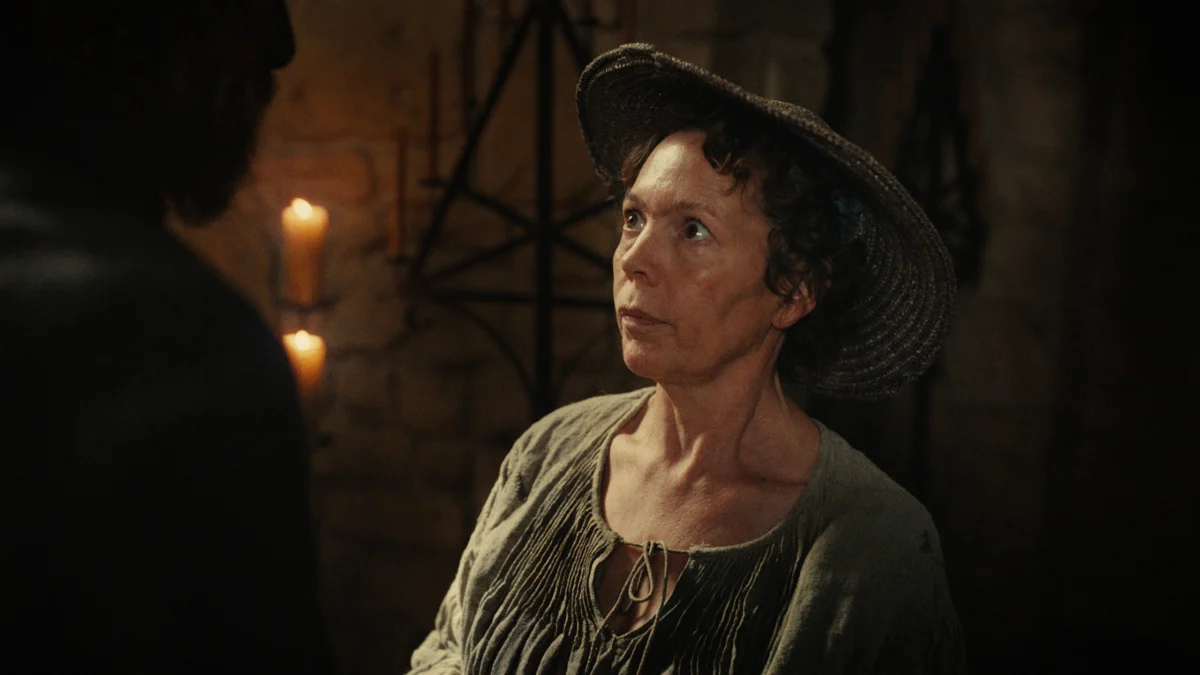
The 2026 Sundance Film Festival served as the launchpad for Wicker, a whimsical, raunchy, and relentlessly eccentric folk-tale feature directed and written by the filmmaking duo Eleanor Wilson and Alex Huston Fischer. Adapted from Ursula Wills-Jones’s short story "The Wicker Husband," the film stars Academy Award winner Olivia Colman as a prickly, socially alienated fisherwoman living on the margins of an unnamed, timeless seaside village. When she approaches a local basketmaker—played by Peter Dinklage—to weave her a bespoke husband, she sets off a chain reaction of absurdity, romance, and untamed desire.
That woven husband is brought to life by Alexander Skarsgård, whose deadpan performance casts him as a man fashioned entirely out of wicker fibers, complete with a visage resembling a stretched-out woven espadrille perched atop a human skull. Backed by Black Bear, the film is scheduled for a limited theatrical release on Friday, October 23, 2026, followed by a wider expansion on October 30. Cinematographer Lol Crawley (The Brutalist) provides a crisp, Academy-ratioed visual palette that clothes the film’s high-concept schlock in prestigious, A24-ready cinematic framing.
Despite its high-minded aesthetic and star-studded cast—which also features Elizabeth Debicki, Nabhaan Rizwan, and Richard E. Grant—Wicker operates primarily as an uninhibited, Monty Python-esque romp through repressed sexuality, earning a solid Grade: B out of Sundance.
Chronology of Production and Release
The journey of Wicker to the big screen began with the acquisition and adaptation of Ursula Wills-Jones’s imaginative short story, The Wicker Husband. Filmmakers Eleanor Wilson and Alex Huston Fischer sought to build upon the momentum of their 2020 twee science-fiction debut, Save Yourselves!, by pivoting toward a coarser, more earthy brand of historical absurdity.

- January 25, 2026: Wicker holds its world premiere at the 2026 Sundance Film Festival, instantly generating widespread buzz for its premise, its bold tonal swings, and its deeply committed lead performances.
- Fall 2026: Following critical reception out of Park City, distribution partner Black Bear locks in a theatrical rollout strategy, slated to begin with a limited release on October 23, 2026, before widening its footprint on October 30.
The production leaned heavily on practical craftsmanship, period-adjacent world-building, and meticulous sound design to sell the illusion of a man made entirely of woven wood engaging in an intensely physical romance with a human woman.
Supporting Data and Creative Execution
To evaluate Wicker is to examine a delicate tightrope walk between high art and lowbrow farce. The film’s production design and cinematography ground the narrative in a nebulous historical epoch—somewhere loosely evocative of the 1600s or 1800s, yet distinctly operating within its own mythic logic.
+-------------------------------------------------------------+
|                     PRODUCTION METRICS                      |
+--------------------------+----------------------------------+
| Directors/Writers        | Eleanor Wilson, Alex Huston      |
|                          | Fischer                          |
+--------------------------+----------------------------------+
| Source Material          | "The Wicker Husband" by Ursula   |
|                          | Wills-Jones                      |
+--------------------------+----------------------------------+
| Cinematographer          | Lol Crawley                      |
+--------------------------+----------------------------------+
| Distributor              | Black Bear                       |
+--------------------------+----------------------------------+
| Theatrical Release Dates | October 23 (Limited) /           |
|                          | October 30 (Expansion), 2026     |
+--------------------------+----------------------------------+
The Ensemble Cast
While Colman and Skarsgård command the narrative anchor, Wilson and Huston Fischer populate the seaside village with an eccentric, deeply repressed ensemble:
- Elizabeth Debicki commands the screen as a miserable yet radiantly magnetic local "tradwife."
- Nabhaan Rizwan portrays her husband, a beleaguered tailor.
- Marli Siu takes on the role of the tradwife’s prudish sister.
- Richard E. Grant delivers delightfully unhinged moments as a wildly incompetent village doctor.
- Peter Dinklage grounds his scenes as the hovel-dwelling basket wizard tasked with crafting the titular protagonist.
Sound Design and Practical Humor
The film’s humor relies on a barrage of bodily fluids, flesh wounds, and ribald puns. Sound designer Andy Neil plays a crucial role, utilizing offscreen audio cues—such as the creaking, shifting, and growing tumescence of Skarsgård’s wicker anatomy—to construct the comedic and romantic chemistry between the man of straw and his human bride.
Official Responses and Critical Reception
Reactions out of the Sundance Film Festival highlighted the polarizing yet magnetic nature of Wicker. Critics noted that the picture plays like an X-rated, cinematic descendant of Geoffrey Chaucer’s Canterbury Tales, channeling a medieval love of bawdy misadventures while maintaining a distinctly modern satirical edge.

Industry analysts have pointed out that casting an actor of Alexander Skarsgård’s caliber—fresh off acclaimed turns in Succession, Pillion, and The Moment—as "fuckable furniture" represents a brilliant subversion of his usual on-screen persona. Despite wearing elaborate prostheses that limit facial mobility opposite real human actors, Skarsgård manages to imbue his wooden character with a surprisingly tender, soothing romance.
Meanwhile, Olivia Colman continues her cinematic streak of playing socially abrasive, blowzy women—a trope reminiscent of her work in The Favourite and Empire of Light. Critics praised Colman for grounding the film’s wild premise in genuine, piercing pathos, particularly when a late-act tragedy strikes and punctures the movie’s whimsical veneer.
Implications for Modern Indie Cinema
The commercial and critical trajectory of Wicker points to several broader trends within the contemporary independent film landscape:
- The Appetite for High-Concept Originality: As franchise fatigue grips mainstream studios, indie distributors like Black Bear are increasingly betting on original, high-concept premises that merge arthouse aesthetics with audacious, barrier-pushing premises.
- Prestigious Schlock: By pairing A-list talent (Colman, Skarsgård, Debicki, Dinklage) and top-tier technical craft (cinematographer Lol Crawley) with material that flirts with lowbrow comedy, Wicker proves that elevated genre filmmaking can successfully bridge the gap between festival prestige and midnight-movie lunacy.
- The Short-Story-to-Feature Stretch: One recurring critique of Wicker is its tendency to feel like a brilliant short-story logline stretched to accommodate a feature runtime. How audiences respond to its meandering subplots during its October theatrical rollout will likely influence how future literary adaptations of magical realism are structured for the screen.
Ultimately, Wicker stands as an irresistibly weird, visually striking, and audaciously horny experiment—one anchored entirely by the fearless, magnetic chemistry of its two leads.
