
James Gray’s Paper Tiger Ignites the New York Film Festival: A Homecoming, a Masterclass, and a Long-Overdue Oscar Push
Main Facts
The 64th annual New York Film Festival (NYFF) opened on a wave of profound emotion and critical acclaim at Lincoln Center’s Alice Tully Hall on Friday evening, hosting the North American premiere of James Gray’s deeply personal crime-drama Paper Tiger. Introduced by NYFF Artistic Director Dennis Lim as “one of the great living American filmmakers,” Gray commanded the room with a palpable sense of triumph.
Distributed by Neon, Paper Tiger boasts a powerhouse ensemble cast led by Miles Teller, Adam Driver, and Scarlett Johansson. Set against the gritty backdrop of 1986 Queens—just a few miles from where Gray grew up—the film follows brothers Irwin and Gary Pearl (played by Teller and Driver, respectively) as they become entangled in a dangerous criminal enterprise that threatens to upend their family. Johansson stars as Hester, Irwin’s wife, whose grounded resilience and internal crisis anchor the narrative’s emotional core.
Presented on a gorgeous 35mm print, the screening marked the film’s first public showing since its celebrated world premiere at the Cannes Film Festival. While Cannes juries notoriously overlooked the feature, Neon is positioning Paper Tiger as a major player in the upcoming awards season. The studio has confirmed its major category campaigns: Teller will contest the lead actor race, carrying the film’s perspective, while past Oscar nominees Driver and Johansson will mount formidable supporting campaigns.
The high-profile launch at NYFF is designed to rewrite the historical narrative surrounding Gray’s career: despite a string of universally lauded, classical masterpieces, the Queens-born auteur has historically struggled to break through into the Academy Awards race. With Neon’s backing, a stellar cast, and rapturous early momentum, Paper Tiger represents a miraculous triumph for independent American filmmaking and a potential turning point for its director.
Chronology of Events
The journey of Paper Tiger to the opening night of the New York Film Festival has been defined by deliberate artistic vision, international festival acclaim, and strategic domestic positioning.
- The Formative Years: Long before the accolades, James Gray grew up in Queens, New York, harboring ambitions of becoming a filmmaker—a dream met with skepticism by his parents, who famously asked, “How are you ever going to do that?”
- The Cannes World Premiere: Paper Tiger made its global debut at the Cannes Film Festival on the French Riviera. The film drew widespread critical acclaim for its blend of classical Hollywood framing and raw, memoiristic storytelling. Despite winning over critics on the Croisette, it was bypassed by the official festival jury—continuing a frustrating historical pattern for Gray’s films on the international festival circuit.
- The Neon Acquisition and Strategy: Following Cannes, distributor Neon stepped in to prime the film for an autumn awards run. Recognizing the shifting tides of the cinematic landscape, Neon strategically mapped out the awards categories, positioning Teller as a lead and Driver and Johansson in supporting roles.
- Early September 2026: NYFF Artistic Director Dennis Lim previewed the festival in an interview with The Hollywood Reporter, describing Paper Tiger as a “miraculous” achievement in an era increasingly hostile to mid-budget, personal American dramas.
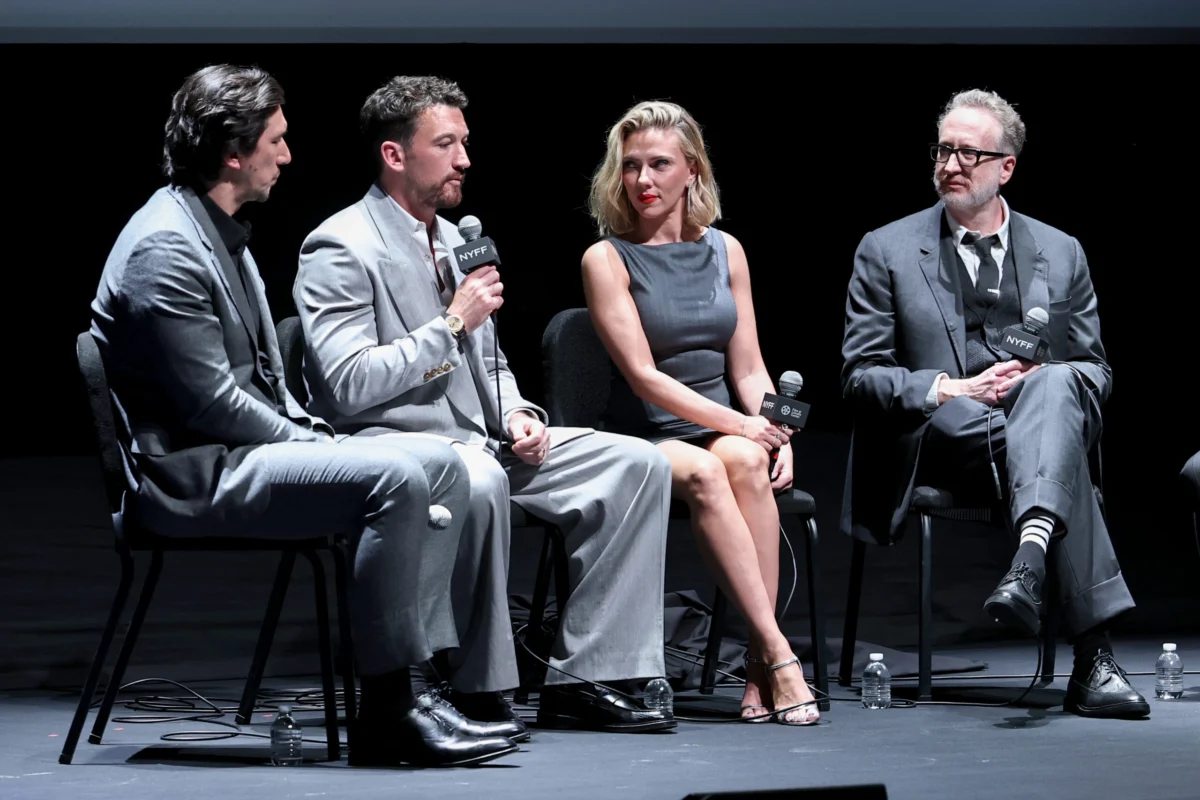
- Friday Night Opening at Lincoln Center: The film made its highly anticipated North American debut at Alice Tully Hall. Screened on 35mm, the event brought out the core creative team, including Gray, Teller, Driver, and Johansson. Following the screening, the cast participated in an intimate Q&A detailing the grueling, collaborative nature of the production, officially kicking off the film’s domestic awards campaign.
Supporting Data and Production Details
To understand the weight of Paper Tiger, one must examine the distinct production elements and talent configurations that set it apart within James Gray’s filmography:
- The Setting and Era: The film unfolds in 1986 Queens, a time and place intimately understood by the director. The specific socio-economic textures of outer-borough New York provide the crucible for the Pearl family’s downward spiral.
- The Cast Breakdown:
- Miles Teller as Irwin Pearl: Serves as the narrative’s entry and exit point. Teller’s character drives the central plot mechanics and anchors the primary perspective of the film.
- Adam Driver as Gary Pearl: Plays the co-lead brother alongside Teller, bringing a volatile, transformational intensity to the screen.
- Scarlett Johansson as Hester Pearl: Plays Irwin’s wife, navigating a high-stakes personal crisis while attempting to shield her sons from the fallout of the brothers’ illicit scheme.
- Technical Presentation: Eschewing digital projection where possible, the North American premiere was exhibited on a physical 35mm film print, underscoring Gray’s commitment to classical cinematic craftsmanship.
- Awards Campaign Strategy:
- Lead Actor: Miles Teller
- Supporting Actor: Adam Driver
- Supporting Actress: Scarlett Johansson
- Historical Context within NYFF: Gray is no stranger to the festival. He previously closed NYFF with The Lost City of Z and celebrated a career milestone with a special retrospective screening of Armageddon Time. However, the opening-night slot for Paper Tiger carries unprecedented cultural and industrial weight.
Official Responses and Perspectives
The atmosphere at Alice Tully Hall was charged with reverence, nostalgia, and candid reflections on the harsh realities of independent filmmaking.
In his opening remarks, Dennis Lim paid homage to the director, introducing him simply as “one of the great living American filmmakers.” Lim’s remarks highlighted the rarity of Gray’s achievement, noting earlier this month that creating such deeply personal, uncompromising American cinema in the current market environment is nothing short of a miracle.

Visibly moved by the reception and standing before a packed house just miles from his childhood home, Gray reflected on his journey:
"When I told my parents I wanted to become a movie director, their skeptical reply was, ‘How are you ever going to do that?’ Well, here I am."
The collaborative spirit and grueling physical reality of the shoot were central themes during the post-screening Q&A panel. Scarlett Johansson elaborated on the intimate, high-pressure environment of the set, offering a glimpse into the camaraderie required to bring the film to life:
"We were on such a small set… and also it was extremely hot, and when you have a group of actors hanging around with everybody on top of each other — honestly, that’s a labor of love. You do it because you love to do it. You end up hanging out and talking and sharing stories and feeling closer… You have to survive the day, and it’s hard making movies, and it’s very hard making movies [like this]."
Implications for the Industry and Awards Season
The opening night of the 64th New York Film Festival with Paper Tiger reverberates far beyond a single evening in Manhattan, carrying significant implications for independent cinema, the distributor Neon, and James Gray’s long-delayed Oscar prospects.
1. A Lifeline for Mid-Budget, Personal American Cinema
In an industry increasingly dominated by international co-productions, intellectual property franchises, and algorithmic streaming content, Paper Tiger stands as an outlier. As Dennis Lim pointed out, the film’s existence is a miracle of tenacity. By championing a gritty, character-driven crime drama rooted in specific geographical and cultural history, Gray and Neon are proving that audiences and critics still hunger for classically constructed, memoir-infused storytelling.
2. Redefining the Narrative for James Gray
Despite commanding global respect from cinephiles and fellow directors, Gray has long occupied an anomalous space in Hollywood: universally recognized as a master craftsman, yet perpetually shut out of the Academy Awards conversation. By launching Paper Tiger with the full institutional backing of NYFF and a calculated campaign from Neon, the industry machine is actively working to correct this historical oversight. The critical raves for Driver and Johansson, combined with Teller’s emotive anchoring of the narrative, provide the exact ammunition needed to break down the doors of the Dolby Theatre.
3. Neon’s Awards Dominance Strategy
Distributor Neon continues to cement its reputation as a premier home for daring, auteur-driven cinema. Following past triumphs, the studio’s deliberate category positioning—pushing Teller as a sole lead while leveraging the powerhouse supporting weight of Driver and Johansson—demonstrates tactical mastery of the modern awards race. If the warm reception on the 35mm circuit at Lincoln Center is any indication, Paper Tiger is poised to roar through the fall festival circuit, transforming from an acclaimed European festival title into an undeniable domestic awards heavyweight.
