
From VHS Nightmares to Box Office Gold: How Casper Kelly’s Buddy Conquered the Horror World

Main Facts: The Low-Budget Phenomenon Heading to Your Living Room
Horror cinema has always thrived on the unexpected, but few films in recent memory have captured the zeitgeist quite like Buddy. Directed by visionary oddball auteur Casper Kelly—the creative mind behind viral television masterworks like Too Many Cooks and the delightfully deranged Cheddar Goblin sequence in Panos Cosmatos’s Mandy—this twisted meta-horror triumph is officially making its way to home media.
Made on a surprisingly modest production budget of just $3 million, Buddy became one of the undisputed box office success stories of the year, hauling in an impressive $27 million globally. After striking a chord with hardcore horror enthusiasts and mainstream audiences alike through its bizarre, nostalgia-drenched marketing campaign, the film is finally preparing for its domestic living room invasion.
According to a formal press release from distributors Roadside Attractions and Saban Films, Buddy will debut on digital platforms on October 13, 2026. Physical media collectors won’t have to wait much longer, with standard DVD and Blu-ray editions scheduled to hit shelves on December 8, 2026. In a stroke of brilliant cross-promotional marketing that directly nods to the film’s diegetic 1990s analog aesthetic, boutique home video purveyors Witter Entertainment will open pre-orders for a strictly limited-edition VHS cassette on November 24, available directly via the Witter Entertainment website.
The film stars Cristin Milioti as a real-world mother who shares an uncanny, psychological connection to a parallel universe populated by a nightmarish, live-action children’s television program from 1997. Alongside Milioti, the film features performances from Topher Grace, Delaney Quinn, and Caleb Williams, with vocal and physical creature work courtesy of Keegan-Michael Key, Sergey Zhuravsky, Patton Oswalt, and a carefully guarded cameo surprise voiced by Michael Shannon. Genre legend Clint Howard also makes a memorable appearance as an eerie drifter haunting the periphery of the frame.

Chronology: The Evolution of a Cult Classic
To understand the cultural footprint of Buddy, one must trace its journey from a bizarre conceptual pitch to a theatrical juggernaut and, ultimately, a treasured collector’s item.
- The Conceptual Roots: Casper Kelly built his reputation on subverting wholesome, familiar media formats into existential psychological funhouses. His work on Adult Swim—most notably the viral sensation Too Many Cooks—established his unique talent for blending the comfort of classic broadcast television with sudden, unbridled terror.
- August 2026: Buddy opened in theaters with a remarkably minimalist marketing push. Rather than relying on traditional trailers that explained the plot, the film’s ad campaign leaned into jarring juxtaposition: placid, brightly lit, VHS-fuzzed astroturf children’s television sets contrasted with moments of characters screaming in sheer, bloody terror.
- Late Summer 2026: Fueled by strong word-of-mouth and viral social media traction, the $3 million film defied box office expectations. It steadily accumulated ticket sales, eventually crossing the $27 million threshold and cementing itself alongside modern indie horror anomalies like Terrifier 2.
- October 13, 2026: Buddy officially becomes available for digital purchase and rental across major streaming storefronts, allowing home audiences to experience its hallucinatory world on demand.
- November 24, 2026: Nostalgia collectors and physical media die-hards can secure a piece of the nightmare when Witter Entertainment opens pre-orders for the limited-edition VHS release.
- December 8, 2026: The physical home video release arrives in stores nationwide, bringing standard DVD and Blu-ray editions to shelves, complete with anticipated bonus content.
Supporting Data: Box Office Performance and Critical Reception
The financial trajectory of Buddy invites direct comparison to other contemporary low-budget horror milestones. In 2022, Damien Leone’s micro-budget splatter film Terrifier 2—produced for a mere $250,000—shocked the industry by pulling in $15.8 million at the box office. That unprecedented commercial victory laid the groundwork for Terrifier 3, which expanded its budget to an estimated $2 million and ultimately grossed a staggering $90.3 million. While Buddy operated on a slightly larger initial budget of $3 million, its sixfold return on investment proves that modern audiences have an insatiable appetite for distinct, creator-driven outsider horror that refuses to play by conventional studio rules.
Critical consensus has proven equally enthusiastic. Buddy currently holds an impressive 88% approval rating on Rotten Tomatoes based on 138 reviews. Critics have widely praised the film’s willingness to lean into uncomfortable, surreal territory without sacrificing narrative coherence.
Writing for the Los Angeles Times, critic Robert Abele lauded the film’s meta sensibilities, noting that its "horror soul [is] in line with the creepypasta ethos of something undefined yet eternal." Meanwhile, Tomris Laffly of RogerEbert.com awarded the film three-and-a-half out of four stars, writing:

"It all comes together more seamlessly than you can imagine, while ‘Buddy’ remains committed to its outrageous bit by dialing up the violence and carnage to both squeamish and uproarious effect across Buddy’s monstrous transformations and painful injuries. It’s a trippy, ballsy, and genuinely entertaining package that shouldn’t work at all. But it does, and I can’t believe it exists."
Official Responses and Behind-the-Scenes Insights
The world inside Buddy is anchored around a fictional 1990s children’s program titled It’s Buddy!, where the lawns are aggressively green astroturf, domestic appliances possess sentient life (such as Mr. Mailbox and Mr. Trash Can), and human children exist solely to learn moral lessons from talking animals. The titular character, Buddy, begins each episode as an innocent plush toy before transforming into a towering, imagination-fueled bright orange unicorn whenever summoned.
However, the idyllic facade quickly rots. The children trapped within the broadcast universe quickly realize they must play strictly by Buddy’s rules. Deviating from the script results in sudden disappearance, with the vanished child seamlessly replaced by a smiling new face in the next broadcast "episode." The children understand the chilling reality: It’s Buddy! is nothing less than a VHS-fuzzed purgatory, and Buddy himself is a murderous psychopath.
In exclusive interviews following the film’s theatrical run, director Casper Kelly discussed the delicate balancing act required to keep the film tonally cohesive. Discussing the creative process with industry press, Kelly revealed that certain conceptual ideas were deemed "a bridge too far" by nervous producers, leading to the excision of at least one particularly extreme sequence. While distributors have yet to confirm the full suite of bonus features for the upcoming December Blu-ray and DVD releases, fans and film historians are eagerly speculating whether this famously scrapped scene might find a second life as an archival extra on the physical discs.
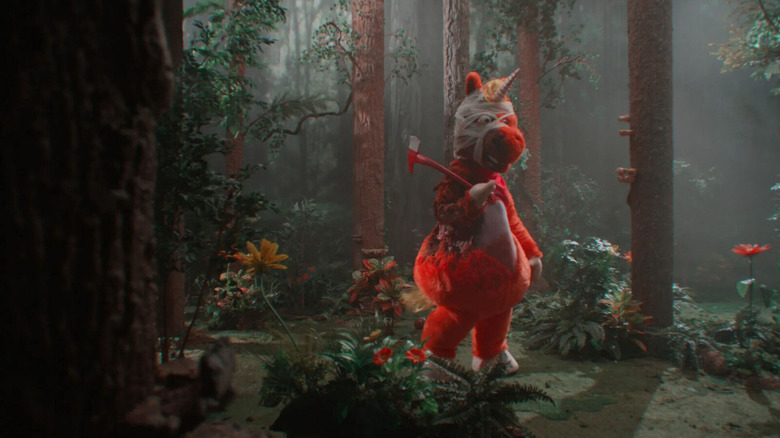
Collaborations with boutique physical media labels like Witter Entertainment—known for crafting VHS editions for modern horror titles like In a Violent Nature, Mandy, and the Terrifier franchise—underscore a growing industry movement. For a generation of cinephiles who still maintain functional VCR hardware, owning a film whose aesthetic directly mimics analog tape degradation on actual magnetic tape is the ultimate collector’s coup.
Implications: What Buddy Means for the Future of Indie Horror
The runaway success of Buddy signals a broader, highly encouraging shift in the contemporary cinematic landscape. In an era dominated by sprawling intellectual property franchises, shared universes, and risk-averse studio greenlights, Casper Kelly’s film proves that original, high-concept, auteur-driven horror can still capture the public imagination on the strength of pure originality.
By leaning into an aesthetic that feels simultaneously nostalgic and deeply transgressive, Buddy taps into the psychological unease of childhood media consumption—a thematic cousin to internet "creepypastas" and analog horror web series. Its triumph at the box office, combined with its enthusiastic critical reception and upcoming multi-format home release strategy, establishes a blueprint for independent filmmakers working outside the traditional studio apparatus.
As Buddy transitions from theatrical screens to digital storefronts on October 13, and eventually onto physical shelves and magnetic tape this winter, its legacy is already secure. It stands as a testament to the fact that audiences are hungry for bold, bizarre, and uncompromising visions—and that sometimes, the scariest monsters are the ones hiding in plain sight behind a bright, synthetic smile.
