
A Century of Grace: Remembering Hollywood Icon Eva Marie Saint (1924–2026)
Main Facts
Eva Marie Saint, one of the last incandescent beacons of Hollywood’s Golden Age and a master of quiet, intelligent screen performance, has died at the age of 101. According to her publicist, Saint passed away peacefully from natural causes at her home in Los Angeles, surrounded by her family and loved ones.
Possessing a rare, luminous screen presence defined by poise without arrogance and emotional transparency without sentimentality, Saint achieved a cinematic feat matched by few in history: she won an Academy Award for her very first feature film role in 1954’s On the Waterfront. Rather than riding the relentless wave of major studio stardom that followed, she spent the next seven decades deliberately balancing selective cinematic masterpieces with steady television work, a prolific stage and radio career, and—most importantly to her—a devoted family life.
At the time of her passing, Saint held a unique place in entertainment history: she was one of only four Oscar winners to reach the centenarian milestone and the oldest living Academy Award nominee or winner. Her death marks the closing chapter of an era when cinematic acting was shaped not by bombast, but by the subtle, telling shift of a gaze, the cadence of a voice, and an unwavering, quiet sincerity.
Chronology: A Life in Art
The Early Years and Television Beginnings (1924–1953)
Born on the Fourth of July in 1924 in Newark, New Jersey, Saint grew up with a grounded sensibility that would anchor her throughout her life. She studied acting at Bowling Green State University in Ohio before returning to the East Coast. In the mid-1940s, she worked as an NBC page, absorbing the inner workings of the entertainment industry while actively pursuing performance opportunities.
The early 1950s marked the dawn of the Golden Age of television, and Saint quickly established herself as a dramatic powerhouse in live TV anthologies. Working in New York City, she starred in foundational broadcasts for programs such as Kraft Theatre, The Prudential Family Playhouse, and Goodyear Playhouse. Her facility for live performance—where there were no second takes or digital corrections—honed her ability to convey complex inner emotions with breathtaking economy. Her work in the medium earned her consecutive Emmy nominations in 1955 for The Philco Television Playhouse and in 1956 for Producers’ Showcase.
The Breakthrough and Oscar Glory (1954)
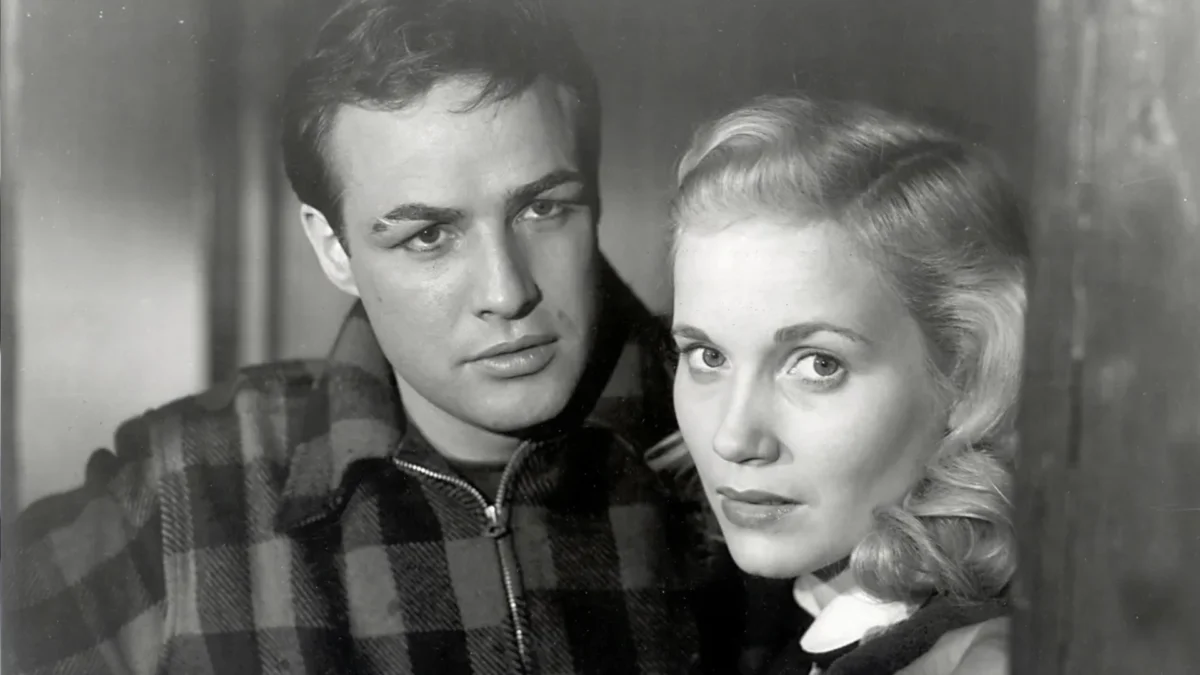
Saint’s cinematic debut remains the stuff of Hollywood legend. Director Elia Kazan cast her as Edie Doyle in On the Waterfront, starring opposite Marlon Brando. As the grieving, morally awakened sister of a murdered dockworker, Saint brought an aching vulnerability and steel-spined resolve to the screen.

The production process itself was famously unorthodox. In a 2000 interview with Premiere magazine, Saint recalled Kazan’s psychological framing of the shoot:
"Kazan put me in a room with Marlon Brando. He said, ‘Brando is the boyfriend of your sister. You’re not used to being with a young man. Don’t let him in the door under any circumstances.’ I don’t know what he told Marlon. … He came in and started teasing me. He put me off balance, and I remained off balance for the whole shoot."
That palpable, unvarnished tension translated into pure cinematic magic. On March 30, 1955, just nine months pregnant and hours away from the delivery of her first child, Saint accepted the Academy Award for Best Supporting Actress. On the Waterfront swept the ceremony, capturing eight Oscars in total, including Best Picture and Best Actor for Brando.
Navigating Stardom and Hitchcock’s Masterpiece (1955–1960s)
Following her historic win, Saint refused to be typecast by Hollywood studios. She gravitated toward gritty, challenging material, such as 1957’s A Hatful of Rain, portraying the anguished wife of a Korean War veteran struggling with morphine addiction—a performance that garnered both BAFTA and Golden Globe nominations.
Demonstrating her fierce independence, she turned down the lead role in The Three Faces of Eve (a role that ultimately won Joanne Woodward an Oscar) to pursue other creative endeavors. Soon after, she landed the role that would cement her status as a global pop-culture icon: the cool, witty, and sophisticated femme fatale Eve Kendall in Alfred Hitchcock’s 1959 suspense masterpiece, North by Northwest, starring opposite Cary Grant.
Reflecting on the master of suspense later in life, Saint noted:

"My experience with Hitch was one of utter respect, warmth, friendliness, and humor, and North by Northwest was a glorious time in my life."
During the 1960s, she continued to choose eclectic, high-profile projects. She starred alongside Paul Newman in Otto Preminger’s Exodus (1960), Vincente Minnelli’s melodrama The Sandpiper (1965), the Cold War satire The Russians Are Coming the Russians Are Coming (1966), and John Frankenheimer’s high-octane racing drama Grand Prix (1966).
Television Resurgence and Late-Career Longevity (1970s–2020s)
In an era when many Golden Age stars found their opportunities drying up, Saint seamlessly transitioned back to television and television movies, earning renewed critical acclaim. She scored Emmy nominations for the epic miniseries How the West Was Won (1977) and the TV movie Taxi!! (1978). In 1990, she finally captured her competitive Primetime Emmy Award for her standout work in the drama TV movie People Like Us. Younger television audiences also embraced her during a memorable six-episode arc on the hit 1980s series Moonlighting, where she played Maddie Hayes’ mother.
True to her passion for the craft, Saint continued performing deep into her nineties. She lent her voice to sophisticated radio plays and audio productions, starring alongside contemporary stars in projects such as Jenny and Mrs. Brown with Sarah Jessica Parker (mid-90s), The Christmas Letter with Matthew Broderick and Annette Bening (2021), and The Bus Ride with Marisa Tomei (2022). She also appeared in Edith Wharton’s Xingu for the Radio Play Revival podcast directed by Patti LuPone in 2022, proving that her artistic curiosity was truly ageless.
Supporting Data and Career Accolades
Saint’s impressive resume is backed by a rare tier of industry recognition and statistics that underscore her enduring legacy:
- Academy Awards: 1 win out of 1 nomination (Best Supporting Actress, On the Waterfront, 1954).
- Emmy Awards: 1 win out of 5 nominations (Won in 1990 for People Like Us; nominated in 1955, 1956, 1977, and 1978).
- BAFTA Awards: 2 nominations (Most Promising Newcomer for On the Waterfront; Best Foreign Actress for A Hatful of Rain).
- Golden Globe Awards: 1 nomination (Best Actress in a Motion Picture – Drama for A Hatful of Rain).
- Hollywood Walk of Fame: A rare holder of two stars—one for motion pictures and one for television.
- Centenarian Status: One of only four Oscar winners in film history to live to the age of 100 or beyond (alongside Olivia de Havilland, Luise Rainer, and Kirk Douglas).
Official Responses and Tributes
Following the announcement of her passing, tributes from across the entertainment industry poured in, celebrating not only her immense talent on screen but her exceptional character off it.

Film historians, critics, and contemporaries noted the profound grace with which she navigated fame. The Academy of Motion Picture Arts and Sciences issued a statement honoring her as "a foundational pillar of cinematic realism whose naturalism redefined what was possible on the American screen."
Patti LuPone, who directed Saint in her late-career radio revival projects, praised her ferocious work ethic and boundless creativity: "Eva didn’t just act; she inhabited language with a musicality and intelligence that humbled everyone in the room. She was a working actress to her core, right up until the end."
Implications: The Legacy of a Reluctant Star
Eva Marie Saint’s passing marks the end of an irreplaceable lineage in American culture. She exits the stage as a living link to a time when Hollywood cinema was undergoing a seismic shift away from theatrical artifice toward psychological truth.
Yet, perhaps Saint’s most enduring legacy is the blueprint she provided for balancing artistic excellence with a personal life outside the fishtank of celebrity. At a time when career momentum was treated by studios as an absolute dictator of priorities, Saint made the conscious choice to step back, turning down high-profile scripts to raise her children with her late husband, producer-director Jeffrey Hayden.
She proved that an actor does not need to saturate the cultural landscape to achieve immortality. Through a carefully curated selection of timeless performances—from the bruised docks of Hoboken to the windswept heights of Mount Rushmore—Eva Marie Saint demonstrated that quiet intelligence, fierce integrity, and unyielding grace can build a career that outlasts generations.
