
In Conversation | American Pachuco: The Legend of Luis Valdez
Introduction: A Cultural Titan Finally Captured on Film
The landscape of American cinema and theater was irrevocably altered by a man who started his career on the backs of flatbed trucks, performing for striking farmworkers. Luis Valdez, the visionary playwright and director often heralded as the "father of Chicano theater," has long been a foundational figure in the cultural tapestry of the United States. Yet, until recently, his definitive biography remained untold on the big screen.
American Pachuco: The Legend of Luis Valdez—the critically acclaimed documentary directed by David Alvarado—has arrived to fill that void. After a triumphant festival run, including dual victories at the 2026 Sundance Film Festival (the U.S. Documentary Audience Award and the Festival Favorite Award), the film is set for a national broadcast premiere on PBS’s American Masters on October 6.
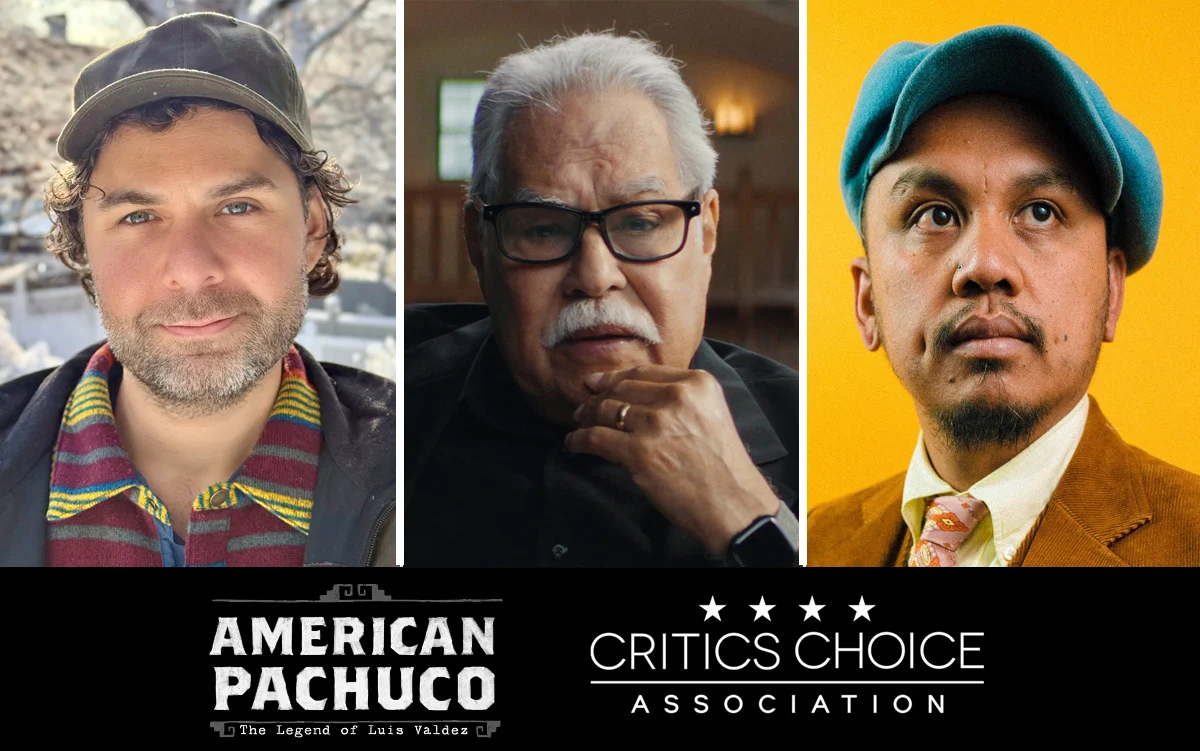
To mark the occasion, CCA member Tim Cogshell sat down with Valdez, director David Alvarado, and producer Everett Katigbak to unpack the arduous process of documenting a legacy that spans decades of political struggle, creative innovation, and the persistent fight for representation.
The Chronology of a Movement: From Fields to Hollywood
The narrative arc of American Pachuco is as much about the evolution of the Chicano movement as it is about the man at its center. To understand the film, one must understand the timeline of Valdez’s trajectory.
The Teatro Campesino Years (1965–1970)
Valdez’s origin story is inextricably linked to the United Farm Workers (UFW) movement. In 1965, he founded El Teatro Campesino in the fields of Delano, California. These were not traditional stage plays; they were actos—short, punchy, satirical vignettes performed on picket lines to educate and inspire workers. The film utilizes newly restored footage from this era, a treasure trove of cultural history that had been languishing in storage.
The Crossover Success (1978–1987)
The film highlights the critical juncture when Valdez pivoted toward mainstream success without compromising his cultural integrity. His play Zoot Suit (1978) became the first Chicano play on Broadway, and his subsequent 1987 film La Bamba became a global phenomenon. American Pachuco chronicles the skepticism he faced from Hollywood executives who doubted that "niche" Chicano stories could hold mass appeal. Valdez’s success shattered these barriers, proving that the American experience was incomplete without the Chicano voice.
The Archival Rescue (2024–2026)
One of the most fascinating aspects of the documentary’s production was the "archival rescue." The production team recovered 80,000 feet of endangered 16mm film documenting the early years of El Teatro Campesino. Much of this footage was at risk of chemical decomposition. Through a painstaking digitization process, the filmmakers preserved a visual history that serves as the backbone of the documentary’s narrative.
Supporting Data and Production Insights
The production of American Pachuco was not merely a biographical sketch; it was a feat of technical and narrative engineering.
The "Fictional Narrator" Strategy
One of the most provocative creative choices discussed by David Alvarado and Everett Katigbak is the inclusion of a fictionalized narrator. By weaving in a voice that reflects the "Pachuco" archetype—the rebellious, stylish, and defiant character made famous by Valdez’s work—the filmmakers avoid the dry, encyclopedic tone common in many documentaries.
"We didn’t want to just talk about Luis," Alvarado explained during the conversation. "We wanted the film to feel like a Luis Valdez production. That meant incorporating the surrealism, the political bite, and the theatricality that defined his career."
Archival Preservation Metrics
- Total Footage Recovered: 80,000 feet of original 16mm film.
- Condition: High risk of "vinegar syndrome" (chemical degradation).
- Restoration Impact: The restoration allowed for the first high-definition public viewing of the original 1960s actos, providing scholars and audiences with primary source evidence of the birth of Chicano political theater.
Official Responses and Creative Perspectives
During the panel discussion with Tim Cogshell, the creative team offered deep insights into the motivations behind the project.
Luis Valdez on the Nature of Legacy
When asked about his reaction to being the subject of such a definitive film, Valdez remained humble yet focused on the collective movement. "This isn’t just my story," he noted. "It is the story of a generation that refused to be silent. The film acts as a mirror; it shows us where we came from, but it also challenges us to look at where we are going. If this film does anything, I hope it encourages the next generation of storytellers to claim their space, just as we did."
David Alvarado and Everett Katigbak on the "American Master" Status
Director David Alvarado emphasized the importance of the American Masters platform. "For years, the industry treated Chicano history as a sub-genre. By bringing this to PBS, we are stating clearly that this is not ‘Chicano history’—it is American history. It is the story of how our national identity is negotiated through art."
Producer Everett Katigbak added, "The hardest part was the editing. We had decades of brilliance to choose from. We had to make the difficult choice to focus on the spirit of the Pachuco as a symbol of resistance. That allowed us to move beyond a chronological list of accomplishments and into the soul of his work."
Implications: The Impact of American Pachuco
The release of this documentary carries significant implications for film studies, cultural history, and the future of minority representation in American media.
Expanding the Canon
For decades, the standard curriculum of American theater and cinema has often sidelined the contributions of Latino artists. American Pachuco serves as a corrective to this erasure. By documenting the technical innovations of Valdez—such as his fusion of Brechtian theater with Indigenous spiritualism—the film provides a new academic lens through which to view American dramatic history.
The Future of Archival Documentaries
The success of the 80,000-foot restoration project sets a new precedent for the preservation of cultural artifacts. It demonstrates that there is a viable market and an intellectual appetite for high-quality restoration of minority-led artistic movements. This could lead to a wave of similar projects, encouraging institutions to invest in the preservation of other "endangered" cultural histories.
A Call to Action
The film’s 40-city theatrical run, followed by its prime-time broadcast, signals a shift in audience demographics. It confirms that stories of cultural identity are not niche—they are universally resonant. The "Legend of Luis Valdez" is no longer confined to the theaters of California or the annals of theater history; it is now part of the national discourse.
Conclusion: The Pachuco Lives On
As American Pachuco: The Legend of Luis Valdez reaches a wider audience this October, its legacy is already solidified. It is a work that captures the essence of a man who dared to challenge the status quo, who turned the fields into a stage, and who taught America that the "Pachuco"—the figure long stigmatized and misunderstood—was actually the heartbeat of a new American consciousness.
Through the masterful direction of Alvarado, the commitment of his producers, and the enduring vitality of Luis Valdez himself, this documentary succeeds in doing what only the best art can: it makes the past feel urgently, vibrantly present.
As viewers tune into PBS on October 6, they will not just be watching a biography; they will be witnessing the reclamation of a narrative that has shaped the United States for over half a century. Whether you are a scholar of theater, a lover of documentary film, or a student of American culture, American Pachuco is a vital addition to the essential viewing list of our time.
The story of Luis Valdez is a testament to the power of art to define, divide, and ultimately unify a nation. And as the final credits roll, one thing remains clear: the legend is only just beginning.
