
The Undead Across the Eras: A Chronological Survey of Historical Zombie Fiction
While the modern concept of the zombie—a mindless, shuffling reanimated corpse—is a relatively recent invention of 20th-century pop culture, the fascination with the dead returning to plague the living is as old as human storytelling. From the ancient folklore of draugr in Norse sagas to the Haitian roots of the zombi, the archetype has always haunted the periphery of our cultural consciousness.
However, there is a distinct trend in contemporary media to transplant these modern, viral, or supernatural horrors into the past. By stripping away the convenience of smartphones, automatic weapons, and global infrastructure, storytellers are finding that the "zombie apocalypse" is an ideal vehicle for exploring historical trauma, class conflict, and the fragility of early civilizations.
Below, we examine five significant works—spanning from the primordial prehistoric era to the blood-soaked fields of the Second World War—that prove the undead are just as terrifying in a corset or a loincloth as they are in a modern shopping mall.
Chronology of the Shambling Past
The following entries are organized by their historical setting, demonstrating the evolution of the zombie threat across the human (and pre-human) timeline.
1. The Prehistoric Anachronism: Primal – "Plague of Madness" (2020)
Genndy Tartakovsky’s Primal is a masterclass in visual storytelling, stripping away dialogue to focus on pure, visceral emotion and survival. Set in a stylized, anachronistic prehistoric world where Neanderthals and dinosaurs coexist, the series follows Spear, a caveman, and Fang, a T-Rex.
In the episode "Plague of Madness," the narrative introduces a horror element that elevates the stakes beyond simple predator-prey dynamics. When a massive Argentinosaurus—a sauropod of mountainous proportions—is infected by a mysterious, rabies-like pathogen, it becomes an unstoppable "zombie" juggernaut. Unlike the typical human zombie, this creature is a walking, rampaging disaster. The implications here are existential: when nature itself is corrupted by an insatiable hunger, even the apex predators of the prehistoric world find themselves at the bottom of the food chain. The episode serves as a chilling reminder that, in the ancient world, survival was not just about strength, but about avoiding the "madness" of the unknown.
2. The Feudal Scourge: Kingdom (2019–2021)
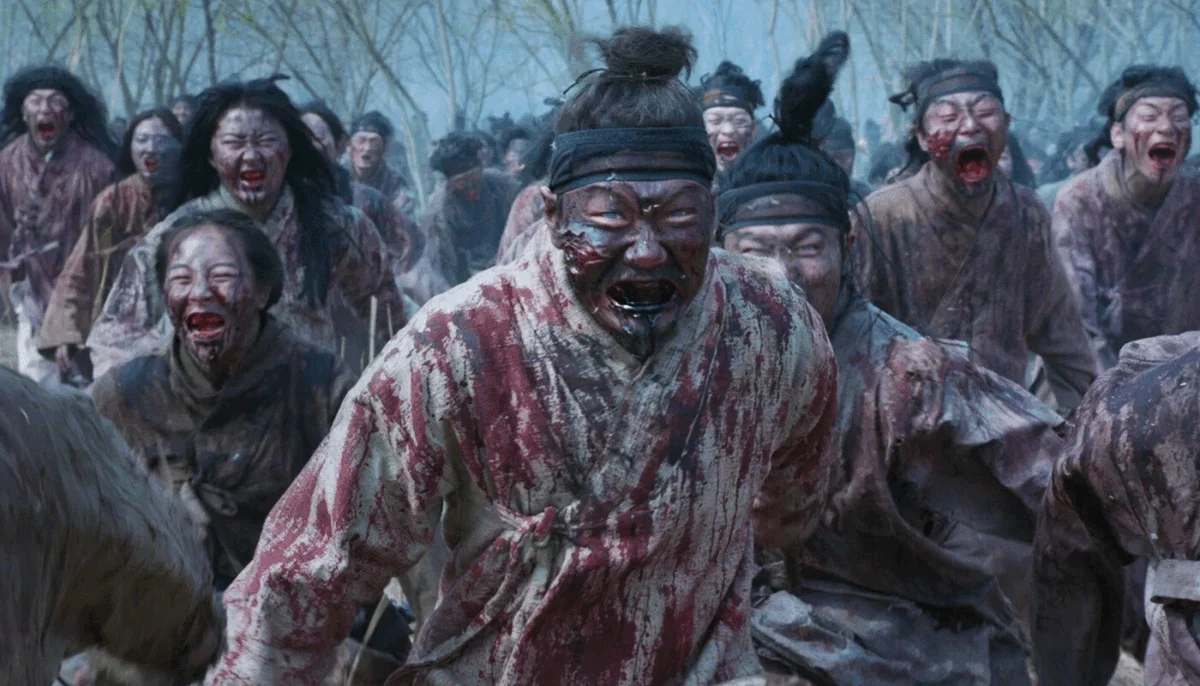
Netflix’s Kingdom stands as arguably the most sophisticated integration of zombie horror and historical period drama. Set during Korea’s Joseon Dynasty in the early 17th century, the show masterfully grafts the high-octane terror of modern zombie films onto the rigid, suffocating social hierarchy of feudal Korea.
The premise follows Crown Prince Lee Chang as he navigates a court coup while a plague of the undead ravages the countryside. The brilliance of Kingdom lies in its socio-political commentary. The zombies are not just monsters; they are a manifestation of the starving populace, abandoned by a corrupt and indifferent aristocracy. By limiting the protagonists to swords, spears, and limited ammunition, the series forces the characters to rely on ingenuity and tactical maneuvering, turning every encounter into a desperate struggle for survival that highlights the stark divide between the ruling class and the commoners.
3. The Colonial Nightmare: "Bad Newes from New England" (2015)
In Moaner T. Lawrence’s epistolary short story, the horror of the zombie genre is used to recontextualize the foundational mythology of the United States. Written as a letter from Governor William Bradford in 1621, the narrative details the collapse of the New Plymouth colony.
This story excels in the "slow burn" approach. By utilizing the language and cultural anxieties of the 17th-century Pilgrims, Lawrence creates a claustrophobic atmosphere of impending doom. Beyond the supernatural terror of the reanimated dead, the story provides a harsh critique of colonial expansion. It forces the reader to confront the real-world atrocities committed during the era, suggesting that the "monsters" of the New World were, in many ways, an extension of the violence the settlers brought with them.

4. The Civil War Reimagined: Dread Nation (2018)
Justina Ireland’s Dread Nation presents an alternate history where the American Civil War was abruptly halted in 1863—not by diplomacy, but by the reanimation of the dead on the fields of Gettysburg.
Seventeen years later, the United States is a nation defined by its struggle against the undead. The story follows Jane McKeene, a girl trained at a combat school for Black youth, who finds herself embroiled in a far-reaching conspiracy. Ireland uses the zombie genre to explore the systemic racism of the post-Civil War era. The "Attendants," tasked with protecting the white elite from the undead, serve as a biting metaphor for how the marginalized are expected to clean up the messes of the powerful, even in the face of an apocalypse. The shift from the urban environment of Baltimore to the lawless Wild West allows for a wide-ranging examination of how human society fractures when the dead will not stay buried.
5. The Wartime Horror: Overlord (2018)
Overlord is a genre-bending exercise that begins as a gritty, Saving Private Ryan-esque war film before diving headlong into biological horror. On the eve of D-Day, a squad of Allied paratroopers is dropped behind enemy lines to sabotage a German radio tower, only to discover that the Nazis are using human subjects to create a serum that raises the dead.
The film serves as a synthesis of war-torn reality and B-movie fantasy. The implications of the Nazi experiments provide a thematic weight to the carnage, exploring the dangers of unchecked scientific ambition and the inhumanity of the regime. The "zombies" in Overlord are not just mindless drones; they are products of sadistic design, making the horror both physical and moral.
Supporting Data: Why the Past?
Sociologists and film historians often point to the "historical pivot" in horror as a reaction to modern anxieties. By placing zombies in the past, creators are able to:
- Remove Technological Safety Nets: In modern settings, zombies are often defeated by modern military might or technological warnings. In the past, the lack of instant communication and rapid transport heightens the isolation and fear.
- Explore Historical Trauma: As seen in Dread Nation and Kingdom, zombies serve as a proxy for real-world historical grievances, from slavery to class warfare.
- Aesthetic Versatility: The contrast between period costumes—corsets, tunics, chainmail—and the visceral gore of the undead provides a striking visual juxtaposition that modern settings often lack.
Official Responses and Cultural Impact
Critical reception for these works has been overwhelmingly positive, particularly in how they leverage the "shambling" horror trope to tell more complex stories. Netflix’s Kingdom, for example, was praised by the Korean Film Council for its ability to revive interest in historical period dramas among a younger, global demographic. Similarly, Dread Nation has become a staple in academic discussions regarding "Speculative Black Fiction," proving that the genre is capable of profound intellectual heavy-lifting.
In interviews, creators like Genndy Tartakovsky have noted that the goal is not merely to "scare" the audience, but to evoke a primal sense of danger. "The undead are a constant," Tartakovsky noted in a 2020 press panel. "Whether it’s a caveman facing a diseased beast or a soldier in France, the fear of losing one’s humanity to an endless hunger is a universal anxiety."
Implications for the Future of the Genre
As the zombie genre continues to evolve, the trend of historical settings shows no sign of slowing. The success of these titles suggests that audiences are becoming weary of the "modern outbreak" narrative, which has become increasingly formulaic.
The future of the genre lies in its ability to adapt to different temporal landscapes. We are likely to see more "historical zombie" narratives that venture into other eras—perhaps the fall of Rome, the Napoleonic Wars, or the industrial revolution. By digging into the past, writers are finding that the most effective way to reinvent the monster is to bury it in the soil of history and wait for it to claw its way back out.
For fans of the subgenre, the lesson is clear: if you are looking for the next great horror story, stop looking at the present. Look back, into the shadows of our shared history, where the dead have been waiting to tell their stories all along.
