
The Universal Language of Dread: A Deep Dive Into the Global Horror Renaissance
Horror is a singular, primal phenomenon—a shared human language articulated through the distinct, blood-soaked dialects of culture, history, and trauma. While the skeletal structures of fear—dread, suspense, the uncanny—remain relatively consistent across borders, the flesh hung upon those bones varies wildly. It is defined by the unique vantage points of its creators, shaped by the political landscapes they inhabit and the specific ghosts that haunt their collective pasts.
In recent years, the literary world has seen an unprecedented influx of horror in translation. This movement does more than simply offer new scares; it serves as a portal. By engaging with translated works, readers are forced to step outside the familiar comfort zones of Western gothic or slasher tropes, encountering narrative structures and metaphors that mirror the complexities of a globalized, yet fractured, reality. To understand the current state of international genre fiction, we must look at seven seminal works that demonstrate the vast, terrifying range of horror in translation.
I. The Mechanical Abyss: Thousands of Eyes by Maximiliano Barrientos
Translated by Thomas Bunstead
At the intersection of cosmic nihilism and automotive fetishism lies Maximiliano Barrientos’s Thousands of Eyes. This is a disorienting, high-octane descent into a Bolivia transformed by a speed-worshipping cult. Spanning from the 1970s to a desolate, post-apocalyptic future, the novel utilizes three distinct narrators to chart the rise of a society where mechanical devotion has replaced religious sanctity.

Barrientos constructs a world where the surreal is mundane: spark plugs sprout like flora, human brains are harvested and preserved in jars, and the ultimate act of ritualistic fervor involves high-speed collisions into colossal celestial trees. At its core, however, the book is a poignant exploration of grief and intergenerational trauma. The titular "thousand-eyed ghost fish" serves as a haunting metaphor for a past that refuses to stay buried, incubating itself within the spiritual and physical wounds of the characters. With a narrative rhythm dictated by the roar of engines and the aggressive distortion of black metal, Thousands of Eyes is a masterclass in atmospheric, genre-bending storytelling.
II. The Pinball Demon: Asmodeus by Rita Indiana
Translated by Achy Obejas
Rita Indiana, a master of Caribbean Gothic, returns with Asmodeus, a riotous and deeply unsettling exploration of demonic possession in the wake of a brutal dictatorship. The story follows the titular demon, a bored, ancient entity currently inhabiting the rotting husk of an aging rock star named Rudy. Seeking a reprieve from the monotony of decay, Asmodeus embarks on a "safety route"—a frantic, destructive migration through a series of human hosts.
As the demon pinballs between an occultist daughter of a former torturer, a queer goth woman, and various underground criminals, Indiana explores the scars left on a society by authoritarianism. Each host is described with a distinct, visceral clarity—one is a "waiting room," another a prison—providing a harrowing look at power dynamics and the way trauma is stored within the body. Indiana’s prose, characterized by its acerbic wit and gift for visual poetry, elevates Asmodeus from a simple possession story into a biting critique of survival and identity.

III. The Suburban Realist Nightmare: Don’t Leave Her Alone by Desirée de Fez
Translated by Lizzie Davis
Spanish author Desirée de Fez opts for a more grounded, yet equally suffocating, approach to horror. Don’t Leave Her Alone is a triptych of narratives focusing on three women—Diana, the desperate-for-normalcy sister; Alba, the codependent sibling; and their mother, Carmen—as they navigate the social pressures of Christmas Eve.
What makes this novel particularly disturbing is its pacing. De Fez masterfully builds a "suburban realist nightmare," where the most acute terrors are not supernatural, but the quiet, venomous violence of interpersonal interactions. The gory, inevitable climax serves merely as the punctuation mark on a sentence already written in the blood of family secrets and emotional abuse. It is a testament to the idea that the most effective horror often hides behind the veneer of domestic normalcy.
IV. Gothic Pulp and the Sanitarium: The Eye of Goliath by Diego Muzzio
Translated by Rahul Bery

Diego Muzzio’s The Eye of Goliath functions as a high-art, high-pulp reimagining of the classic Dr. Jekyll and Mr. Hyde archetype. Set within a Scottish sanitarium for WWI veterans suffering from what we now recognize as PTSD, the narrative begins with the arrival of a man named Stevenson, who brings with him the harrowing journals of an engineer named David Bradley.
Bradley’s descent from a man of logic and science to a "psychotic swimmer"—a man driven by a compulsive, self-destructive need to stay submerged—is a haunting metaphor for the fracturing of the post-war psyche. His journey leads him to a lighthouse known as "The Eye of Goliath," situated in a region locals simply call "Hell." Muzzio’s work is deeply indebted to the gothic traditions of the past, yet it feels entirely contemporary in its interrogation of the human cost of industrial and total war.
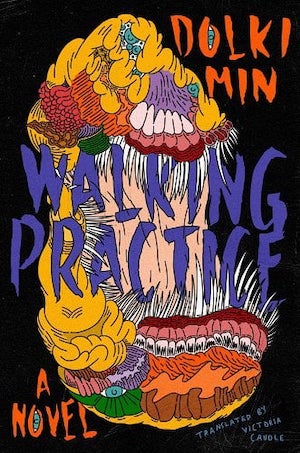
V. The Claustrophobia of Form: Walking Practice by Dolki Min
Translated by Victoria Caudle
Dolki Min’s Walking Practice offers perhaps the most unique entry on this list: a work of sci-fi body horror centered on a stranded alien. The narrator, struggling to survive on Earth, must expend an immense, exhausting amount of mental and physical energy just to maintain a human appearance.

The horror here is sensory and claustrophobic. Min provides clinical, stomach-turning descriptions of the alien’s physical state—sweat congealing into a sticky membrane as the creature struggles to unstick itself from the floor. Combined with the narrator’s darkly comic, cynical observations of human behavior and a plot that involves the necessity of consuming humans to facilitate an off-world escape, the novel is a brilliant, squirm-inducing subversion of the "fish out of water" trope. It asks uncomfortable questions about the performance of gender and humanity itself.
VI. The Intimate Ghost: A Sunny Place for Shady People by Mariana Enriquez
Translated by Megan McDowell
Mariana Enriquez remains the undisputed titan of modern Argentine gothic, and her latest collection, A Sunny Place for Shady People, cements her reputation for turning the domestic into the demonic. Enriquez’s brilliance lies in her ability to marry the supernatural with the hyper-personal.
Whether she is writing about the erasure of women’s faces as a generational curse or the encroachment of ghosts into a suburban marriage, the focus never drifts from the human heart. Each story functions as a whispered threat in a darkened room. Standout pieces like "Julie" and "The Refrigerator Cemetery" showcase her talent for finding the "shady" underbelly of society, proving that the most lingering hauntings are those that feel deeply, inextricably earned by the characters themselves.

VII. The Mundanity of Terror: This’ll Make Things a Little Easier by Attila Veres
Translated by Sean Gasper Bye
Attila Veres possesses the rare ability to make the reader accept the most absurd premises with a shrug. In his latest collection, the horror is treated with a profound, almost annoying, sense of mundanity. A man finds a human tooth in the mail and reacts with irritation rather than panic; a corporate satire features a protagonist having his identity stripped away to better serve a soda brand, and he complies out of simple bureaucratic habit.
Veres is interested in the intersection of cosmic horror and late-stage capitalism. By framing his monsters and existential dread as minor inconveniences that disrupt the daily grind, he makes the eventual, darker shifts in his narratives all the more jarring. This’ll Make Things a Little Easier is a collection that forces the reader to acknowledge the horror in our own complacency.
Implications of the Global Horror Shift
The rise of these translated works is not merely a trend; it is an evolution of the genre. As we move away from the monocultural dominance of the "haunted house" or the "serial killer" narrative, we are seeing a shift toward localized, specific anxieties.
The primary implication of this shift is a democratization of fear. When a reader in the United States engages with the work of an Argentine or Hungarian author, they are not just consuming a story; they are participating in a cross-cultural dialogue about what it means to live in a world defined by the "aftermath"—whether that aftermath is a war, a dictatorship, or an environmental collapse.
These authors use the tools of horror—distortion, fear, and the supernatural—to address issues that mainstream realist fiction often struggles to capture. By removing the safety net of their own cultural context, readers are better equipped to analyze the "otherness" that horror seeks to exploit, ultimately finding that our shared fears are the most potent bridge between disparate human experiences. As this literary movement continues to grow, we can expect to see even more radical shifts in how the world tells its stories of the night.
