
The Analog Echo in a Digital Age: Why Aaron Sorkin’s ‘The Social Reckoning’ Feels Like a Relic
In the landscape of contemporary prestige cinema, few names carry the rhythmic, rat-a-tat-tat weight of Aaron Sorkin. A writer-director whose pedigree is etched into the very foundation of modern dialogue, Sorkin has long been the gold standard for the "smart" mid-budget drama. However, with the release of his latest film, The Social Reckoning, that legacy finds itself at a curious, and perhaps uncomfortable, crossroads. While the film is competently assembled and features a powerhouse ensemble, it arrives in a cinematic climate that has moved on, leaving Sorkin’s latest effort feeling less like a cutting-edge drama and more like a high-end relic from a bygone era of television-inflected filmmaking.
The Premise: A Process-Driven Procedural
On its own merits, The Social Reckoning is far from a disaster. It is a sleek, polished, and articulate production that bears the unmistakable fingerprints of its creator: the rapid-fire banter, the intellectual posturing, and the obsessive focus on institutional mechanics. Yet, to judge the film as a standalone work is to ignore the elephant in the room—or, more accurately, the social media giant in the room.
The film is being marketed, both implicitly and explicitly, as a spiritual successor to David Fincher’s 2010 masterpiece, The Social Network. That film, which earned Sorkin an Academy Award for Best Adapted Screenplay, defined an era of digital anxiety. However, The Social Reckoning opts for a vastly different tonal register. Where Fincher’s film was a cold, clinical, and kinetic dissection of ego and innovation, Sorkin’s new project functions as a procedural "process film."
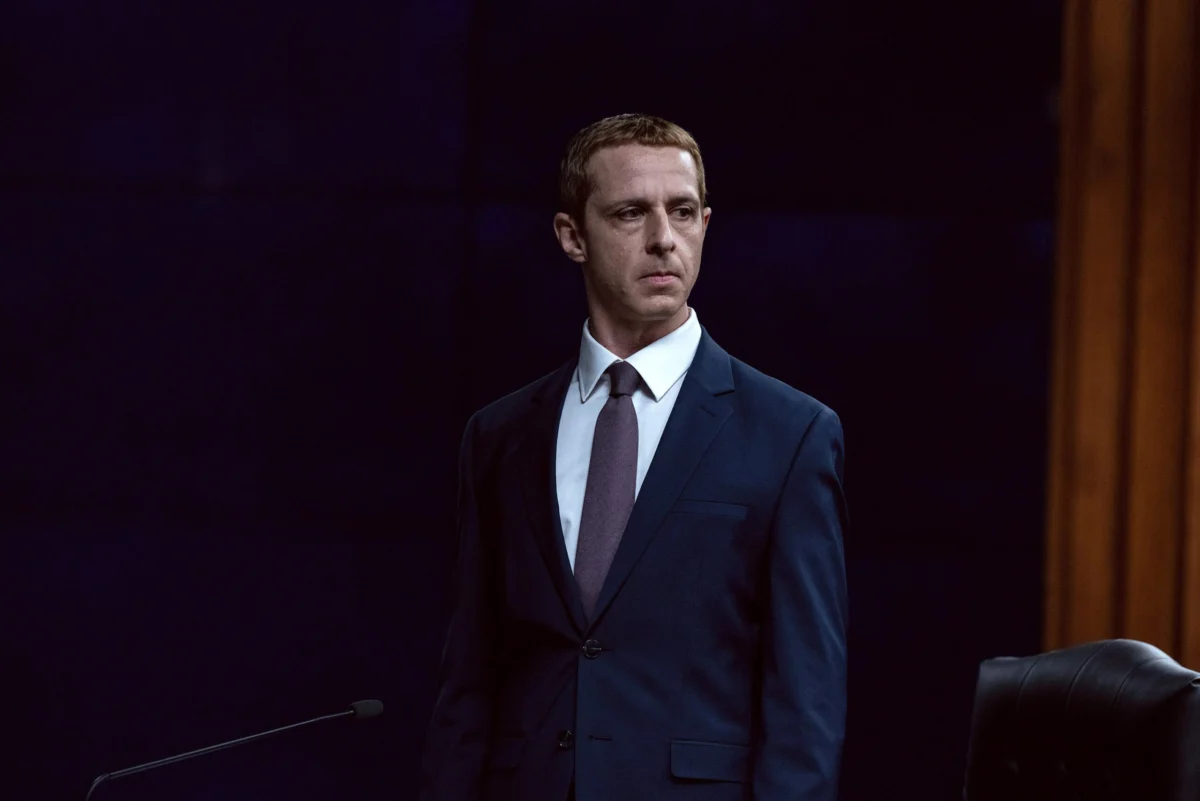
The narrative structure mirrors the dual-timeline approach of its predecessor, shifting between the high-stakes investigative work of Facebook whistleblower Frances Haugen (played with quiet intensity by Oscar winner Mikey Madison) and Wall Street Journal reporter Jeff Horwitz (Jeremy Allen White), and the defensive maneuvering of Facebook CEO Mark Zuckerberg (Jeremy Strong) as he prepares for a grueling congressional hearing.

Chronology of the Conflict
The film’s architecture is built upon the "Facebook Files" investigation, a real-world series of reports that exposed the internal rot within the social media behemoth. By focusing on the mechanics of journalism and whistleblowing, Sorkin pivots away from the psychological character study of a founder and toward the bureaucratic machinery of accountability.
- Phase One: The Discovery. We witness Madison’s Haugen navigating the labyrinthine internal culture of the company. Sorkin leans into his strengths here, utilizing the "walk-and-talk" tropes that have defined his career to illustrate the claustrophobia of corporate secrecy.
- Phase Two: The Investigation. The film tracks the collaboration between the whistleblower and the press. This is where the A Few Good Men comparisons become impossible to ignore. White and Madison serve as the legalistic crusaders, building a case against an entrenched power structure, while Strong’s Zuckerberg acts as the stoic, impenetrable antagonist.
- Phase Three: The Reckoning. The narrative culminates not in a courtroom shouting match, but in a somewhat stylized resolution. Departing from the biting cynicism of The Social Network, Sorkin opts for a more sentimental, almost John Hughes-esque climax, where the triumph of the individual is punctuated by a fist-pump moment that feels decidedly out of sync with the gravity of the subject matter.
Supporting Data: The Casting Paradox
The casting of The Social Reckoning is a deliberate nod to the "prestige" cycle. In 2010, Sorkin and Fincher helped turn Jesse Eisenberg, Andrew Garfield, and Rooney Mara into global stars. Today, Sorkin has tapped into the current zeitgeist by casting three of television’s most celebrated performers: Madison, White, and Strong.
While their individual performances are beyond reproach, the collective effect is a strange sense of déjà vu. Because all three actors are so inextricably linked to their breakthrough television roles, and because Sorkin’s directing style remains rooted in a television-centric sensibility, the film feels like an extended, high-budget cable drama. It carries the weight of a prestige TNT programming block from two decades ago, rather than the innovative, medium-pushing work one expects from a theatrical event in 2026.
Official Perspectives and Industry Reception
In recent interviews, including a notable sit-down with IndieWire, star Mikey Madison noted that she specifically sought out the "restraint" required by Sorkin’s script. This desire for containment is evident in the film’s pacing; it is methodical, measured, and consistently polite in its delivery of information.

However, industry analysts point to a fundamental shift in what the Academy—and audiences—are looking for. The "mid-budget drama" is a dying species. The current race for awards is dominated by two extremes: the massive, epic scope of films like The Odyssey or Project Hail Mary, or the high-risk, low-budget "indie" experiments that push the boundaries of form. The Social Reckoning occupies a middle ground that is increasingly difficult to market.
Even conventional films, such as Being Heumann, manage to find oxygen in the modern market because they engage with urgent, underrepresented social narratives. By comparison, The Social Reckoning feels like a "prestige" film made for a voter base that no longer exists in the same capacity.
Implications: The Death of the "Prestige" Mid-Budgeter?
The implications for Sorkin’s career are profound. Every film he has directed to date has garnered Academy Award attention. Yet, two of his most recent features were consumed primarily on streaming platforms during the pandemic, shielded from the harsh realities of the theatrical box office. Now that the market has fully replenished, the competition for both theatrical real estate and critical mindshare is fiercer than ever.
The fundamental issue is one of evolution. The cinematic landscape is being pushed forward by directors who are experimenting with new visual languages, fragmented narratives, and diverse perspectives. In this context, The Social Reckoning acts as a static point. It is a well-crafted, articulate, and historically conscious film, but it is also a throwback.

Conclusion: A Window into the Past
Ultimately, The Social Reckoning is a film that will undoubtedly find an audience. There remains a significant demographic of filmgoers who crave the precise, dialogue-driven dramas that Sorkin perfected in the late 90s and early 2000s. The film is technically proficient, acted with immense skill, and features a screenplay that hits every intended beat with surgical precision.
But for the modern viewer—and, more importantly, for the modern Academy voter—the film suffers from a lack of urgency. It is a "social" film that feels disconnected from the chaotic, rapidly evolving social landscape it attempts to critique. By sticking to the established playbook, Sorkin has created a film that is safe, respectable, and entirely dated. The Social Reckoning may well be a triumph of craft, but it serves as a stark reminder that in the fast-moving world of digital-age cinema, standing still is, in many ways, moving backward. The "truth" Sorkin is looking for is no longer hidden in a courtroom or a boardroom; it is in the chaotic, unscripted noise of the world outside—a place this film seems hesitant to visit.
