
Simplifying Optics: The New Free Speed Booster Effective Aperture Calculator Eliminates Manual Math for Filmmakers
By Matthew Allard ACS
Published by Newsshooter
Main Facts: A Game-Changer for Lens Adaptation and Focal Reduction
In the fast-paced world of cinematography and digital photography, precision is everything. Whether rigging up a camera for a high-end commercial, an indie feature film, or a run-and-gun documentary, understanding the complex interplay between sensor sizes, focal lengths, and light transmission is critical. Enter the newly launched Speed Booster Effective Aperture Calculator—a completely free, web-based utility designed to instantly compute effective aperture, light transmission gains (measured in stops), and equivalent focal lengths for focal reducers without requiring any manual math.
For decades, using full-frame lenses on crop-sensor (APS-C or Micro Four Thirds) cameras via optical adapters—commonly known as "speed boosters" or focal reducers—has been a popular strategy for filmmakers. These adapters not only widen the field of view to better match the native focal length of the lens but also concentrate the incoming light, effectively increasing the maximum aperture by one or more stops.
However, calculating the exact math behind these conversions has traditionally been a tedious process. Photographers and cinematographers often found themselves wrestling with multiplication factors, crop factor equivalents, and logarithmic formulas to understand their true depth of field and exposure parameters. The new online calculator removes this friction entirely, providing instant, accurate metrics that help creators make split-second decisions on set.
Chronology: The Evolution of Lens Adapters and the Need for Digital Tools
The Mechanical Era of Lens Adaptation
To understand why the Speed Booster Effective Aperture Calculator is such a welcome addition to a filmmaker’s toolkit, it helps to look at the historical context of lens adaptation. In the early days of digital filmmaking and mirrorless hybrid cameras, lens adapters were purely mechanical. They acted as simple metal spacers that allowed legacy glass—such as Canon FD, Nikon F, or Leica M lenses—to mount onto modern digital bodies like Sony E-mount or Micro Four Thirds.
While these mechanical adapters allowed shooters to repurpose cherished vintage glass, they came with a major optical compromise: the crop factor. Putting a 50mm full-frame lens onto a Micro Four Thirds sensor, for instance, resulted in a narrow, cropped field of view equivalent to a 100mm lens. Furthermore, the light hitting the smaller sensor was effectively a fraction of the total image circle projected by the lens, leading to lost potential in low-light performance.
The Optical Revolution: The Birth of Focal Reducers
The landscape changed dramatically with the introduction of optical focal reducers, pioneered by companies like Metabones with their legendary "Speed Booster" line. Unlike simple metal tubes, these adapters incorporate a complex array of multi-element glass designed to shrink the image circle of a full-frame lens down to fit a smaller sensor.
This optical compression achieved two major feats:
- It restored the original field of view (or close to it) of the lens relative to full-frame standards.
- It gathered the light that would normally fall outside the smaller sensor and concentrated it onto the active imaging area, increasing exposure brightness by up to a full stop or more.
While these tools revolutionized budget-friendly cinematic setups, they complicated the math. A 0.71x or 0.64x focal reducer fundamentally changes how a lens behaves in terms of both focal length and effective exposure value.
The Digital Shift and the Creation of the Calculator
As hybrid shooting became dominant and filmmakers began mixing and matching cinema cameras, drones, and mirrorless bodies across multiple sensor sizes (Full Frame, Super35/APS-C, and Micro Four Thirds), the margin for error narrowed. Technical directors, camera operators, and focus pullers needed a fast, reliable way to verify specifications on set.
The launch of the Speed Booster Effective Aperture Calculator addresses this modern workflow bottleneck. By shifting the burden of complex mathematical calculations from the human brain to an instantaneous web script, the tool bridges the gap between complex optical physics and practical, on-set execution.
Supporting Data: Understanding the Optics and Formulas
To appreciate how the calculator operates behind the scenes, it is essential to examine the underlying physics and mathematical models that govern focal reducers.
The Core Mathematical Principles
The utility relies on a precise set of variables. The primary multiplier—often referred to as the "booster factor"—is the specific optical ratio printed on the adapter housing, such as 0.71× or 0.64×.
The mechanics of the calculator are powered by a standardized sequence of mathematical operations involving four key multiplications and one logarithmic equation. While users do not need to memorize these formulas to use the tool, understanding them sheds light on why manual calculations are so prone to human error:

- Equivalent Focal Length Calculation:
$$textEquivalent Focal Length = textBase Lens Focal Length times textBooster Factor times textSensor Crop Factor$$ - Effective Aperture Calculation:
$$textEffective Aperture = fractextBase Lens Focal LengthtextBase Lens F-Number times left(frac1textBooster Factorright)$$ - Light Transmission Gain (Stops):
Calculated using a logarithmic formula to determine the exact increase in exposure value (EV) based on the concentration of light across the reduced image circle.
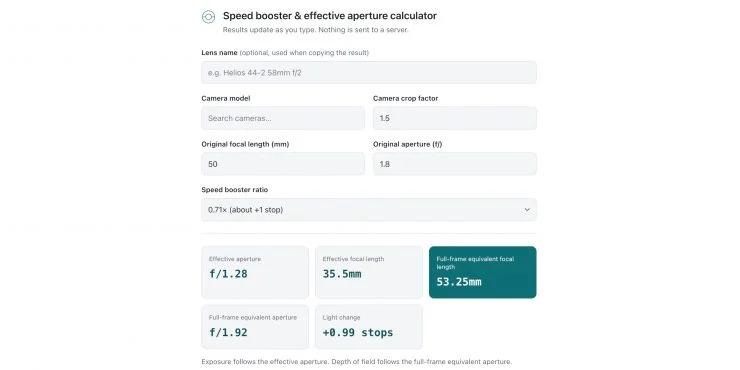
Working Example: Analyzing a 50mm f/1.8 on APS-C with a 0.71× Speed Booster
To see the tool in action, consider a common real-world scenario often encountered by independent filmmakers:
- Base Lens: 50mm f/1.8
- Camera Sensor: APS-C (typically featuring an approximate 1.5× crop factor)
- Optical Adapter: 0.71× Speed Booster
Without the Speed Booster:
- Focal Length: When mounted directly to an APS-C camera via a standard dumb adapter, the 50mm lens yields a narrow field of view equivalent to a 75mm lens ($50textmm times 1.5$).
- Aperture & Exposure: The physical aperture remains at f/1.8. However, in terms of full-frame equivalency regarding depth of field and background blur, it behaves closer to an f/2.7 lens ($1.8 times 1.5$).
With the 0.71× Speed Booster:
When you run these exact parameters through the Speed Booster Effective Aperture Calculator, the software instantly computes the revised specifications:
- New Equivalent Focal Length: The 50mm focal length is multiplied by the 0.71 factor, bringing it down to 35.5mm. When factored against the APS-C sensor, the resulting field of view closely mimics a traditional 53mm lens on a full-frame camera—restoring a standard "nifty fifty" perspective.
- Light Transmission Gain & Effective Aperture: The optical compression concentrates the light, boosting the transmission by roughly one stop. The effective aperture becomes brighter—dropping down to approximately f/1.25 in terms of light gathering capabilities.
As demonstrated by this working example, the booster delivers a dual benefit: a significantly wider, more versatile field of view and a much "faster" lens capable of capturing clean images in challenging, low-light environments without forcing the camera operator to push ISO levels into noisy territories.
Official Responses and Industry Reception
The release of dedicated digital utilities like the Speed Booster Effective Aperture Calculator has drawn quiet praise from working cinematographers, camera technicians, and rental house operators alike. While hardware manufacturers like Metabones, Viltrox, and Kipon have long provided technical specifications for their respective focal reducers, user-friendly computational tools that bridge multiple variables in real-time have historically been scarce or restricted to complex spreadsheet templates.
Industry Feedback from Camera Operators and DPs
Professional Directors of Photography have emphasized that tools eliminating mental math during high-stress production days are invaluable.
"When you are moving quickly on a documentary shoot or managing multiple lens swaps on a narrative set, the last thing you want to do is second-guess your focal length equivalencies or stop-loss calculations," notes a seasoned AC (Assistant Camera) working within the television sector. "Having a clean, web-based utility that gives you the exact effective aperture instantly saves time and prevents catastrophic exposure mismatches when changing camera packages."
Lens Manufacturers and Optical Engineers
Optical engineers point out that while focal reducers are marvels of modern engineering, they introduce variables that many novice shooters misunderstand. By democratizing access to precise calculation models, free utilities help educate newer filmmakers on the nuanced relationship between physical aperture settings, light concentration, and equivalent depth of field. This transparency helps users manage client expectations regarding bokeh, exposure, and field-of-view coverage long before rolling camera on location.

Implications for Filmmakers, Educators, and Equipment Rental Houses
The introduction and widespread adoption of tools like the Speed Booster Effective Aperture Calculator carry several long-term implications for the broader filmmaking community.
1. Democratization of Advanced Cinematography Gear
By making complex optical mathematics accessible to anyone with a smartphone or laptop browser, the utility empowers budget-conscious creators to maximize their existing gear investments. Filmmakers no longer need to invest heavily in dedicated native glass for every single sensor format they own. Instead, they can intelligently adapt full-frame DSLR and mirrorless lenses across diverse cinema camera bodies with absolute confidence in their technical readouts.
2. Streamlining Pre-Production and Camera Prep
For camera assistants and DPs conducting camera tests during pre-production, calculating exact equivalencies is a vital part of building camera logs, lens charts, and exposure reference sheets. Integrating a fast, reliable web calculator into the prep workflow reduces human calculation errors. This ensures that data passed along to the digital imaging technician (DIT) and colorist accurately reflects the optical behavior of the rig on set.
3. Educational Value in Film Schools
Film and media arts institutions frequently struggle to teach the complexities of crop factors, focal reduction, and photometric light transmission to students. Traditional textbook formulas can often feel abstract and disconnected from practical application. Interactive calculators provide an intuitive, hands-on digital sandbox where students can experiment with different sensor sizes, focal lengths, and adapter ratios, instantly visualizing how optical changes impact their final image.
4. Minimizing On-Set Mistakes
Perhaps the most practical implication is error reduction. On a commercial or narrative set, a miscalculated exposure stop or an unexpected shift in field of view can ruin a take or force costly reshoots. By standardizing the calculation process through an accessible, universally available tool, production teams can verify technical specifications in seconds, maintaining high professional standards regardless of budget scale.
Conclusion
The Speed Booster Effective Aperture Calculator is much more than a simple web utility; it is a practical digital bridge connecting complex optical physics with the day-to-day realities of modern filmmaking. By eliminating manual math and providing instant calculations for effective aperture, light transmission gains, and equivalent focal lengths, the tool empowers everyone from student creators to veteran Directors of Photography to push their gear further. As digital workflows continue to evolve, simple, frictionless utilities like this will remain indispensable assets in the modern filmmaker’s digital toolbox.
