Breaking Boundaries in Immersive Filmmaking: Main Course Films Unveils the World’s First Full Downconversion of an Apple Immersive Video Project
As the motion picture industry navigates an increasingly fragmented ecosystem of viewing devices, one central hurdle has persisted for modern cinematographers: the challenge of cross-format adaptability. Ensuring that high-end footage captured in advanced, non-traditional specifications can seamlessly translate to the diverse delivery formats of contemporary cinema has long tested the limits of both hardware and software. This is especially true for spatial and immersive media. Until recently, options for reformatting footage natively captured in Apple Immersive Video (AIV) were severely limited, often restricting wider distribution.
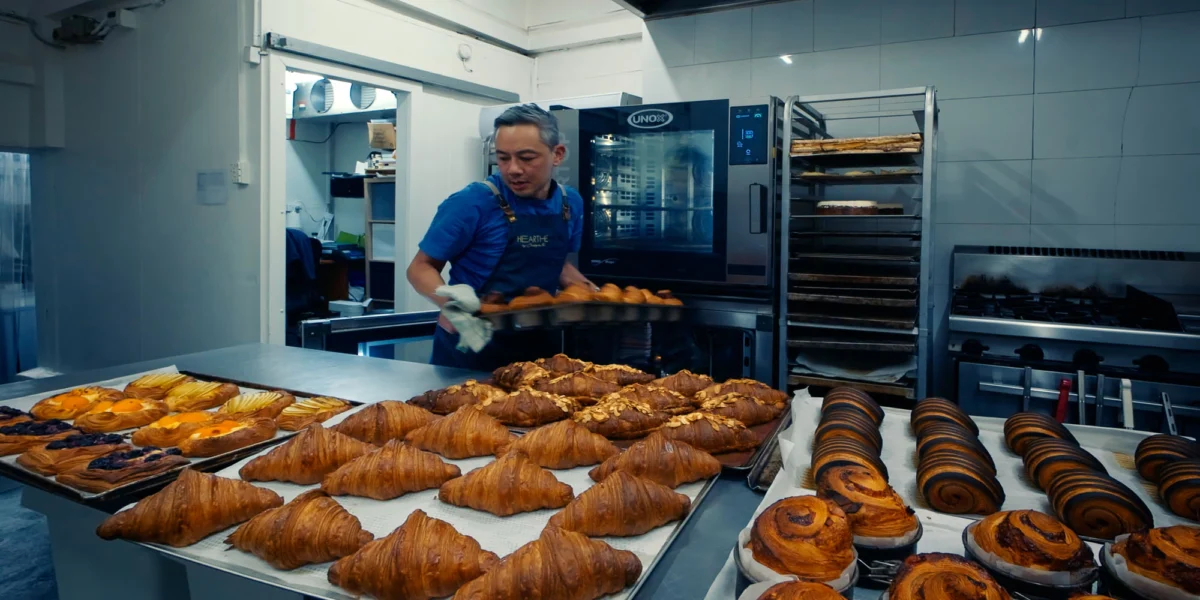
That narrative is beginning to shift. More than a year after completing their pioneering spatial documentary short, Thé Fine Dining Bakery, production house MainCourseFilms (MCF) has achieved what it describes as a world-first milestone: the complete, commercial downconversion of a native Apple Immersive Video film into a conventional, non-immersive presentation.
The documentary has been reformatted into a standard 4K Scope container featuring a cinematic 2.40:1 aspect ratio and an immersive 7.1 surround sound mix. While the original 2025 spatial cut remains accessible to Apple Vision Pro users via the Fovii and Theatre streaming platforms, this newly engineered conventional master opens the door for widespread distribution across standard theatrical and home-viewing screens. By proving that high-end immersive assets can successfully cross over into the traditional exhibition market, MCF has significantly elevated the commercial viability and financial predictability of shooting on advanced spatial formats like AIV and the Blackmagic Design URSA Cine Immersive camera.
The Chronology of an Immersive Experiment
The journey to bring Thé Fine Dining Bakery from headset-bound isolation to mainstream screens was a calculated, multi-stage engineering feat that unfolded over the better part of two years.
Mid-2025: MCF completes Thé Fine Dining Bakery as a native Apple Immersive Video documentary short, optimized for the 90 frames-per-second, 180-degree stereoscopic environment of the Apple Vision Pro.
Late 2025 – Early 2026: Recognizing the commercial imperative to reach non-headset audiences, co-founders Clara Chong and Ben Allan embark on an extended research-and-development phase. Previous industry attempts at non-immersive releases—such as Apple TV’s Bono: Songs of Surrender—relied on parallel capture methods, shooting simultaneously with immersive arrays and secondary traditional cameras like the ARRI ALEXA 65. MCF, however, sought a true downconversion workflow originating entirely from the single-source AIV camera masters.
Mid-2026: The technical hurdles of color management, frame rate translation, and spatial-to-surround audio translation are systematically conquered within DaVinci Resolve Studio and Fusion.
Late 2026: MCF officially finalizes the 4K Scope master, establishing a replicable technical blueprint for future spatial-to-traditional cinematic workflows.
Technical Architecture and Supporting Data
Translating a medium designed around infinite viewer freedom into a rigid, director-controlled frame required a radical rethinking of post-production pipelines. The production team faced critical technical roadblocks regarding frame rates, color spaces, geometry, and acoustic downmixing.
Frame Rate and Resolution Strategy
The native AIV master was captured and delivered at an ultra-smooth 90 fps to eliminate motion judder within the headset environment. However, attempting to export a conventional 2D version at 90 fps was unfeasible for universal playback, while dropping to a traditional cinematic 60 fps would introduce undesirable high-frame-rate (HFR) artifacts.
Opting for a filmic look, the team targeted a UHD 4K container at 30 fps. This provided a mathematically proportional 3:1 frame reduction from the original 90 fps plates, ensuring clean, artifact-free frame-rate conversion.
Color Management and Spatial Data Preservation
The original production utilized Blackmagic RAW (BRAW) camera originals. To retain critical metadata—such as Inter-Lens Pupillary Distance (ILPD) required for correct stereoscopic un-distorting, alongside Apple Immersive Motion Data—the team established a robust intermediary pipeline.
Master timelines were pre-rendered to Stereoscopic 3D Apple ProRes files with integrated noise reduction and metadata preservation. These ProRes pre-renders were subsequently imported into a new UHD project using DaVinci Resolve’s Dynamic Project switching.
For color management, MCF maintained the DaVinci Wide Gamut Intermediate (DWG) color space. DWG offered superior bit-depth efficiency compared to ACES, which is typically optimized for massive 16-bit EXR workflows rather than the already heavy data loads of Apple Immersive files. While the original AIV version was mastered in PQ HDR (1000 nits tone-mapped down to 108 nits for headset viewing comfort), the 4K downconversion shifted to a standard Rec.709 (Scene) output color space for maximum hardware compatibility.
Geometry and the Un-Distortion Process
Because the URSA Cine Immersive captures a circular, 180-degree fisheye stereoscopic image, flattening the footage required sophisticated intervention within the Fusion VFX page of DaVinci Resolve Studio. MCF utilized two distinct methods:
The Technical Approach: Leveraging Fusion’s Immersive Patcher tool placed after a Stereo Combiner node. The Immersive Patcher allowed precise manipulation of X, Y, and Z axes (functioning equivalently to camera tilt, pan, and roll) and controlled the Angle of View (typically mapping between 65° and 110° per shot).
The Organic Approach: For specific extreme shots, the team bypassed pure mathematical correction in favor of a Transform node coupled with one to three Lens Distortion nodes. This intentionally reintroduced subtle optical imperfections, mimicking the organic quirks of physical glass lenses that are otherwise digitally flattened by the Vision Pro’s projection mapping.
Rather than sticking to a standard 16:9 aspect ratio, MCF discovered that framing within a 2.40:1 Scope letterbox yielded vastly superior compositional results, aligning naturally with human horizontal scanning patterns.
Audio Translation: From Spatial Audio to 7.1 Surround
Perhaps the most complex hurdle was translating Apple Spatial Audio Format (ASAF) into a traditional channel-based surround mix. Because ASAF objects dynamically alter loudness, equalization, and reverb based on virtual distance coordinates within a 3D environment, simply routing an ASAF master bus to traditional submixes yielded unrecognizable, unusable results.
Drawing inspiration from vintage analog radio and television workflows, Ben Allan engineered an innovative internal patching solution. Utilizing Rogue Amoeba’s Loopback software alongside Fairlight’s internal patch-bay tools, the team routed the ASAF monitoring outputs into virtual stereo and 7.1 destinations. By soloing and muting specific elements via VCAs, they successfully recorded out clean dialogue, music, foley, and effects stems—while capturing 360-degree room tone as 7.1 Ambisonics—laying the foundation for a rich, highly compatible 7.1 theatrical surround mix.
Official Perspectives from Main Course Films
Reflecting on the conceptual hurdles of the project, writer, director, and editor Clara Chong emphasized that the barriers were primarily creative rather than purely mechanical:
"The challenges are more creative and conceptual than technical, although there were plenty of technical issues to solve as well! Because the way we experience AIV is on a biological level, there’s a lot of things that we had to take into account in making the film and other factors that affect perception in normally framed formats differently to AIV, such as pacing. We have been attempting to get to a down-converted version of this over the last year, but are only now at the point where we’re happy enough with the results both in terms of technical quality and conceptual approach to have something we’re ready to release publicly."
Ben Allan ACS CSI, who served as cinematographer, colorist, and sound mixer, noted how the conversion forced a fundamental translation of visual guidance:
"In Apple Immersive, the pan and tilt is controlled by the viewer in real time, so the images are composed to give them the freedom to look where they want, while guiding them to notice the important things. Converting to a traditional format involves converting that pan and tilt guidance into formal framing decisions."
Addressing the pacing differences inherent to spatial media, Chong explained how individual shots required internal re-editing:
"What holds very effectively as a single perspective in the Vision Pro can work much more effectively as two or even more shots, cutting between wide shots and close ups from the same original Immersive image."
Industry Implications
The successful commercial release of Thé Fine Dining Bakery’s 4K downconversion marks a watershed moment for the broader adoption of spatial capture technology.
Historically, producers have hesitated to invest in ultra-specialized formats like Apple Immersive Video due to the restrictive "walled garden" nature of headset-only distribution. By demonstrating a repeatable, high-fidelity post-production workflow that successfully bridges the gap between 180-degree stereoscopic capture and conventional 2D exhibition, Main Course Films has mitigated one of the greatest economic risks in modern independent cinema.
As studios and independent filmmakers alike look toward future slates, the ability to shoot once on systems like the Blackmagic URSA Cine Immersive and deliver simultaneously to high-end spatial headsets and standard global theatrical markets changes the financial equation entirely. Immersive filmmaking is no longer confined to the boundaries of virtual reality—it is officially ready for the mainstream silver screen.