A Timeless Classic Gets a Modern Makeover: Inside Broadway’s Groundbreaking Revival of ‘The Fantasticks’
NEW YORK — Shane and Ilya, move aside. Musical theater enthusiasts are currently witnessing a Heated Rivalry–style love connection unfold on a grand scale in Manhattan. The historic Hayes Theater is currently hosting previews for the first-ever Broadway production of The Fantasticks, a monumental milestone for a show that has served as an Off-Broadway and regional theater staple since the 1960s.
While the structural bones of the world’s longest-running musical remain recognizable—tracking the soaring romantic highs, the desperate lows, and the meddling intervention of well-meaning parents—this fresh staging reimagines the central romance entirely. It trades traditional conventions for a same-sex love story, breathing new life into a theatrical institution and setting the stage for what producers hope will be a defining run of the 2026 theater season.
Main Facts: A Paradigm Shift for a 1960s Staple
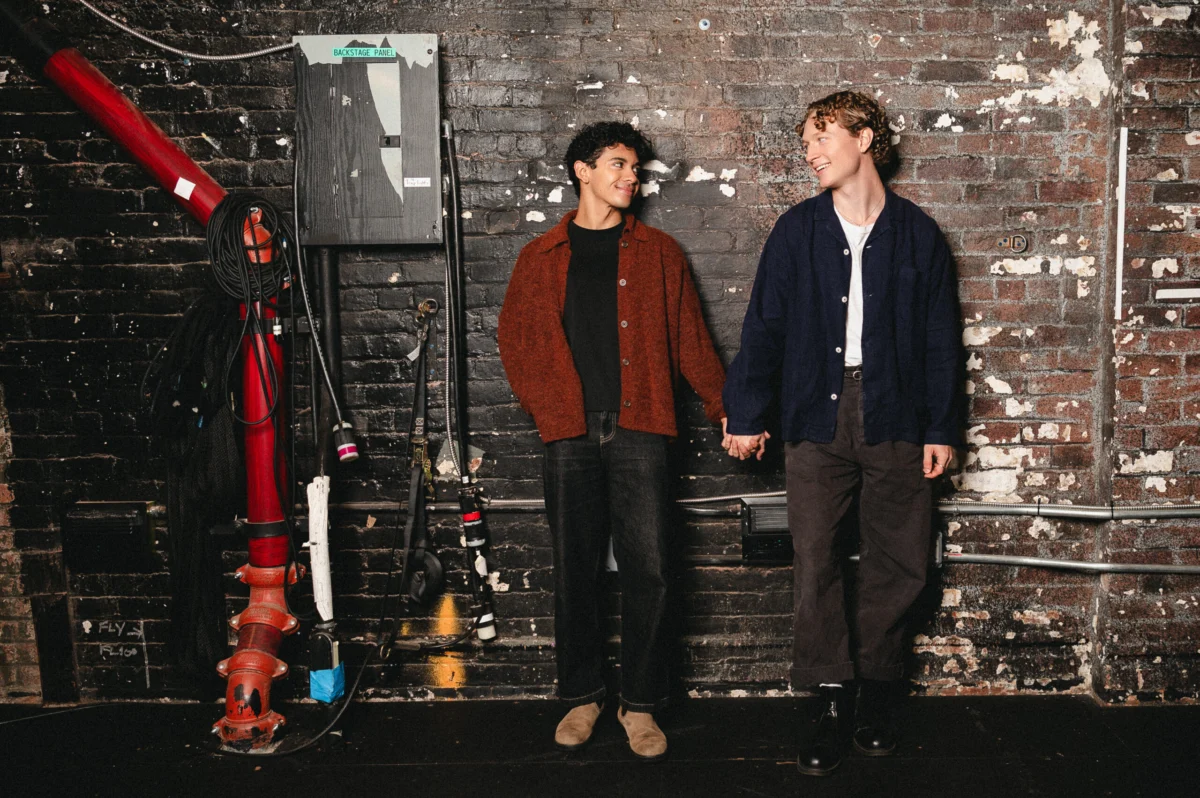
For decades, the central couple of The Fantasticks was universally known as Matt and Luisa, a traditional boy-and-girl pairing whose youthful romance fueled the plot. However, this high-profile Broadway revival rewrites the narrative to focus on the roller-coaster romance between Matt and Lewis, brought to life by dynamic newcomers Nathan Levy and Maxim Chlumecky, respectively.
The gender-reversal casting choices extend far beyond the youthful lovers. Traditionally, the pair’s eccentric, feuding-yet-colluding parents have been portrayed as two fathers. In this production, the parental dynamic is shifted to two mothers. Tony Award winner Ruthie Ann Miles steps into the role of Lewis’s mother, while Tony Award nominee Leslie Rodriguez Kritzer takes on the role of Matt’s mother.
Rounding out the principal company is Zane Phillips, who stars as the charismatic, sword-wielding bandit El Gallo. Under the stewardship of director and choreographer Christopher Gattelli—fresh off guiding the stage version of Schmigadoon! to 12 Tony nominations and a victory for Best Musical—the creative team has crafted a production that honors the historic score while boldly updating its perspective for contemporary audiences.
Chronology: From Off-Broadway Legend to Broadway Innovation
To understand the weight of this current production, one must look at the unprecedented timeline of The Fantasticks.
May 1960:The Fantasticks officially opens at the Sullivan Street Playhouse in New York’s Greenwich Village. With music by Harvey Schmidt and book and lyrics by Tom Jones, the intimate musical becomes an overnight cultural phenomenon.
January 2002: After an astonishing 42-year run and 17,162 performances, the original Off-Broadway production finally closes its doors.
The Early 2000s: Recognizing shifts in cultural sensitivities, late co-creator Tom Jones revisits his own work. He removes outdated language, notably eliminating the word "rape" from key musical numbers and changing the title of "The Rape Ballet" to "The Abduction Ballet."
August 2006: A successful Off-Broadway revival opens at the Jerry Orbach Theater, proving the material’s enduring appeal.
2023: Tom Jones passes away at the age of 96, leaving behind a legacy that includes unpublished notes and blessings for future directors to explore diverse casting avenues that embrace the timelessness of his lyrics.
Late 2026:The Fantasticks arrives on Broadway at the Hayes Theater for its first-ever mainstem run. Previews begin in the fall, setting the stage for an official opening night scheduled for November 16, 2026.
Supporting Data: Evolution of the Script and Score
The transition of The Fantasticks to a Broadway house is not merely a cosmetic costume change; it represents a deep structural and textual examination by the creative team. When asked at a recent press day if they are prepared to become Broadway’s answer to popular queer romance obsessions like HBO’s Heated Rivalry, Levy and Chlumecky playfully demurred, suggesting they are "off-brand Heated Rivalry." However, the data and textual adjustments tell a story of careful, high-stakes artistic precision.
The Monologue Adjustments
One of the most notable textual changes involves an iconic line traditionally delivered by Luisa during an emotional monologue expressing a desire for a grander life: "I am special, I am special. Please, God, please, don’t let me be normal!"
With a queer male character stepping into the role, that specific phrasing required a rewrite. While Nathan Levy has understandably declined to reveal the exact new line to preserve the theatrical surprise for opening night, he notes that viewing the show through the modern lens of a queer character allows for a seamless emotional translation. The desire to break free remains identical, but the vocabulary has evolved to match Lewis’s specific lived experience.
Lyric Revisions and El Gallo’s Role
The production also fully embraces the lyric updates initiated by Tom Jones in the early 2000s regarding the abduction sequences. In the original 1960 text, the parents hire El Gallo to stage an elaborate, theatrical abduction ("rape" by historical definition of force) to push the lovers together. Today, numbers like "It Depends on What You Pay" and "The Abduction Ballet" utilize updated terminology like "abduction" and "raid."
Zane Phillips, playing El Gallo, points out that these changes maintain the theatrical, swashbuckling comedy of the original piece while aligning with modern ethical sensibilities. Furthermore, because El Gallo is now playing to two mothers rather than two fathers, his seductive, tongue-in-cheek swagger shifts the dynamic, turning the young men’s love story into a complex triangle that deepens the emotional stakes of the musical comedy.
Official Responses: What the Cast and Creative Team Say
During interviews with Gold Derby and other press outlets, the creative team expressed immense pride in how the cast has navigated the rehearsal process. Director Christopher Gattelli praised his young leads, noting that their modesty about comparisons to modern pop-culture pairings belies their actual onstage chemistry.
"There will be a lot of love for them," Gattelli said with a smile. "I’m telling you, they are quite the discovery and quite the pairing. People are going to fall in love with them without a doubt."
Gattelli also underscored that gender-swapping the roles was entirely in line with the flexible, poetic nature of the material intended by Tom Jones and Harvey Schmidt.
"One of the reasons The Fantasticks has endured for so long is because Tom and Harvey found this really delicate balance of timeliness that spoke to the then as well as to the now," Gattelli explained. "The fact that they did this gender swap made it even more obvious that this show could be about two boys or two girls instead of just a boy and a girl. At its heart, it’s a musical about love, loss, and growth, and the way they captured that is like magic in a bottle."
Actor Maxim Chlumecky highlighted the collaborative environment of the rehearsal room:
"There’s been a lot of figuring out in the rehearsal room which jokes work and which emotional keys work now that three characters have switched genders. But we’re also making sure to honor what The Fantasticks has always been."
Nathan Levy echoed this sentiment, emphasizing how honoring Jones’s own history of self-revision inspired the current cast:
"If anything, it’s given us the confidence to continue to ask questions and not be afraid to suggest new things. As Chris has said, Tom himself went back into his own work and changed it, and we realize how impressive and honorable that is."
Implications: A New Era for Classic American Musicals
The arrival of The Fantasticks on Broadway with a queer central romance carries profound implications for the commercial theater landscape. For decades, classic American musical theater—particularly works originating in the mid-20th century—has often been viewed through a rigid, heteronormative lens that precluded traditional revivals from embracing contemporary diversity without wholesale, often clunky rewrites.
By utilizing alterations authorized by the original creators late in life, this production of The Fantasticks demonstrates that classic masterworks can be organically reinterpreted. It proves that the universal themes of youthful longing, parental overprotection, and the bittersweet passage into adulthood do not depend on traditional gender configurations to resonate.
As the cast uses the final preview performances leading up to the November 16 opening night to polish every note, comedic beat, and sword swing, the theatrical community is watching closely. If this production successfully captures the hearts of Broadway audiences, it could open the floodgates for other golden-age classics to be re-examined through diverse, modern lenses.
For now, the young lovers at the Hayes Theater are ready to give audiences goosebumps. Or, as some backstage wags have affectionately dubbed the vibe: a Chill Rivalry worth singing about.