
Beyond the Arena: Francis Lawrence and the Evolution of the Dystopian Epic

For over a decade, director Francis Lawrence has been the primary architect of modern cinematic dystopia. Having stepped into the director’s chair for nearly every installment of The Hunger Games franchise—from the record-breaking sequels to the recent prequel The Ballad of Songbirds and Snakes—Lawrence has become synonymous with stories of youth, oppression, and systemic collapse.
However, as he prepares to transition from the world of Panem to the sprawling, space-faring hierarchy of Pierce Brown’s Red Rising, Lawrence is keen to clarify that while the thematic DNA of his work may overlap, the narrative execution remains distinct. In a recent discussion regarding his upcoming projects, including the 2025 Stephen King adaptation The Long Walk and the highly anticipated Red Rising feature, Lawrence articulated why he believes these stories are not mere retreads of the same survivalist tropes, but entirely different beasts.
The Master of Dystopia: A Chronology of Influence
To understand Lawrence’s trajectory, one must look at his body of work. His career is characterized by an ability to ground high-concept, often brutal, fictional worlds in visceral human reality.
- 2013–2015: Lawrence took over the Hunger Games franchise following the departure of Gary Ross. Under his direction, Catching Fire and the Mockingjay films solidified the series as the definitive young-adult dystopian franchise, focusing heavily on the intersection of media, propaganda, and political revolution.
- 2023: With The Ballad of Songbirds and Snakes, Lawrence proved he could return to the well and find new meaning, shifting the lens toward the origin of tyranny and the psychological corruption of a young Coriolanus Snow.
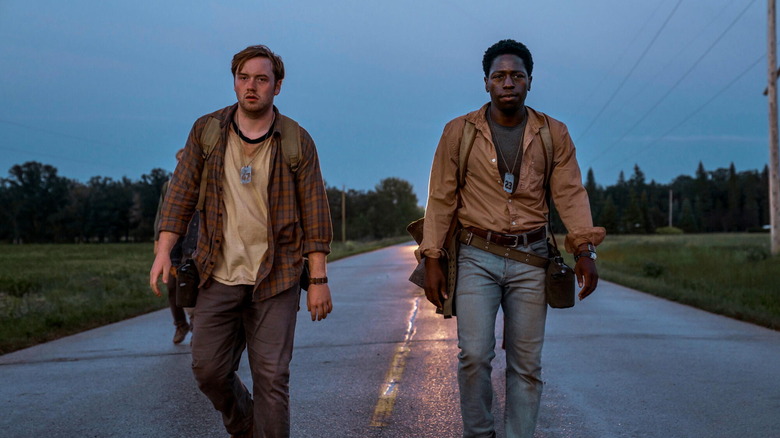
- 2025: Lawrence tackles the Stephen King classic The Long Walk. Moving away from the arena-based combat of Panem, this project explores the psychological toll of a grueling endurance test, emphasizing interpersonal relationships over political spectacle.
- The Future: With the announcement of the Red Rising adaptation, Lawrence is set to tackle a narrative that scales from the claustrophobic depths of Mars to the heights of interplanetary warfare.
Decoding the Differences: The Infiltration Narrative
The most significant point of divergence between Red Rising and Lawrence’s previous work lies in the protagonist’s journey. While Katniss Everdeen fought against a system from the outside—and often from a position of disadvantage—Darrow’s journey in Red Rising is fundamentally different.
"Red Rising, on the other hand, even though there’s similar elements [to Hunger Games and The Long Walk], to me, is an amazing infiltration story," Lawrence explained.

This distinction is crucial. In The Hunger Games, the conflict is reactive and survival-based; in Red Rising, the conflict is proactive and subversive. Darrow must physically and socially "become" the enemy, infiltrating the upper echelons of a caste-based Martian society to dismantle it from within. Lawrence highlights that this brings a unique "set of parameters and moral choice dilemmas." The internal conflict arises when the protagonist begins to develop genuine empathy for those he is sworn to destroy—a tension that promises to add a layer of complexity not typically seen in the standard "resistance" narrative.
The Philosophy of World-Building
A common thread throughout Lawrence’s filmography is his intense focus on world-building. When asked about his career-long commitment to stories centered on fascism and the oppression of young people, Lawrence offered a refreshingly honest perspective. He doesn’t view his filmography as a series of political statements, but rather as a series of creative opportunities to construct immersive, non-contemporary realities.
"I like the visual aspect of filmmaking, so world-building is a very, very important part of what I love to do," Lawrence stated. "If somebody were to hand me a contemporary heist movie, I wouldn’t do it. I just have no interest in just going out in the streets and shooting some kind of… I just feel like there’s not enough for me to do."
This aversion to "the mundane" puts Lawrence in the company of visionaries like Robert Eggers, who has famously expressed a distaste for filming contemporary objects like cellphones or automobiles. For Lawrence, the "dystopian" label is merely a vehicle for high-stakes environmental design. He thrives on creating spaces that feel lived-in, historically layered, and visually distinct from the world the audience walks out of the theater into.
Supporting Data: Why Tone Matters
Lawrence’s work succeeds because he treats every project as a unique thematic puzzle. He noted that even within the Hunger Games franchise, the goals shift significantly.

For the upcoming Sunrise on the Reaping (the Haymitch Abernathy origin story), the focus is on "implicit submission" and the importance of finding one’s voice amidst a culture of apathy. Conversely, The Long Walk is, for Lawrence, "less about the games and more about the relationships" and the "metaphor for existence."
By breaking down his projects into these core components—infiltration for Red Rising, endurance and brotherhood for The Long Walk, and systemic resistance for Hunger Games—Lawrence demonstrates that he is not simply a "dystopian director," but a storyteller who uses extreme environments to stress-test the human condition.
Implications for the Red Rising Adaptation
The implications of Lawrence’s approach for Red Rising are substantial. Fans of the Pierce Brown novel series have long worried that a film adaptation might simplify the brutal, complex politics of the Solar System into a standard "arena battle" blockbuster. However, Lawrence’s emphasis on the "moral dilemmas" of infiltration suggests he intends to lean into the espionage and psychological elements of the books.
Furthermore, the scale of Red Rising presents a challenge that exceeds even the Hunger Games. Where Panem was limited to a single nation-state, the world of Red Rising spans multiple planets, each with distinct biomes, cultures, and technologies. Lawrence’s stated passion for world-building will be put to the test here, as he must translate the distinct aesthetic of "Reds" (the labor class) and "Golds" (the ruling elite) into a cohesive visual language that feels grounded yet futuristic.
The Path Forward
As we look toward the future, the landscape of cinematic dystopia is shifting. With The Hunger Games: Sunrise on the Reaping slated for a November 20, 2026 release, audiences will once again be invited into the Capitol’s machinery. But the true test of Lawrence’s evolution will likely arrive with Red Rising.
If Lawrence can successfully marry his mastery of large-scale, atmospheric world-building with the nuanced character work he showcased in The Long Walk, he may well redefine the genre for the next generation. He has proven that he is not just a director of "youth-in-danger" films, but a craftsman who understands that the most compelling stories aren’t just about winning a game—they are about the moral cost of the systems that force us to play them in the first place.
Whether it is the haunting, rhythmic march of The Long Walk or the high-stakes deception required to topple a Martian empire, Francis Lawrence continues to find ways to keep the genre feeling vital, dangerous, and profoundly human. For those who fear that the dystopian genre has run its course, Lawrence’s upcoming slate suggests that we have only scratched the surface of what these imagined worlds can tell us about our own.
