The Fab Four on the Big Screen: Inside Sony Pictures’ Unprecedented Four-Film Beatles Cinematic Event
Main Facts
When it comes to popular music, no group altered the cultural landscape quite like the Beatles. Capturing their groundbreaking, history-making run requires an approach as revolutionary as the band itself. Enter SonyPictures’ The Beatles — A Four-FilmCinematicEvent, an ambitious, interconnected collection of biopics officially unveiled at CinemaCon.
Unlike traditional music biopics that try to cram an entire band’s complex history into a standard two-hour runtime, this project takes a radically different route. Each of the four films is told strictly from the perspective of an individual band member—Paul McCartney, John Lennon, Ringo Starr, and George Harrison. Directed entirely by Academy Award winner Sam Mendes, the films are currently in production and slated for a massive theatrical release in April 2028.
The project has assembled a star-studded cast of rising British and Irish talent to portray the iconic Fab Four:
Paul Mescal (Gladiator II, Normal People) as Paul McCartney
Harris Dickinson (Babygirl, The Iron Claw) as John Lennon
Barry Keoghan (The Banshees of Inisherin, Saltburn) as Ringo Starr
Joseph Quinn (Stranger Things, The Fantastic Four: First Steps) as George Harrison
With screenplays being crafted by an elite trio of writers—Jez Butterworth (Ford v Ferrari), Oscar winner Peter Straughan (Conclave), and Emmy winner Jack Thorne—this cinematic undertaking promises to rewrite the rules of how biographical dramas are conceived, produced, and consumed.
Chronology of Production and Announcements
The road to bringing the Fab Four’s individual stories to the big screen has been a meticulous process, marked by strategic reveals designed to build global anticipation.
The Genesis: For years, director Sam Mendes toyed with the idea of making a Beatles movie. However, he repeatedly hit a creative wall, realizing that the sheer scope of the band’s history simply could not fit into a single feature film, nor did a television series feel tonally correct. The concept of an interconnected four-film event eventually provided the breakthrough he was looking for.
The CinemaCon Unveiling (2025): Sony Pictures officially announced the project at CinemaCon, sending shockwaves through the industry by revealing that four separate, synchronized theatrical biopics were in development.
Early Casting Waves (Late 2025): Throughout 2025, casting announcements rolled out, filling out the expansive supporting ensemble. Hollywood heavyweights and rising stars alike signed on to play the vital figures orbiting the Beatles’ world, from managers and producers to romantic partners.
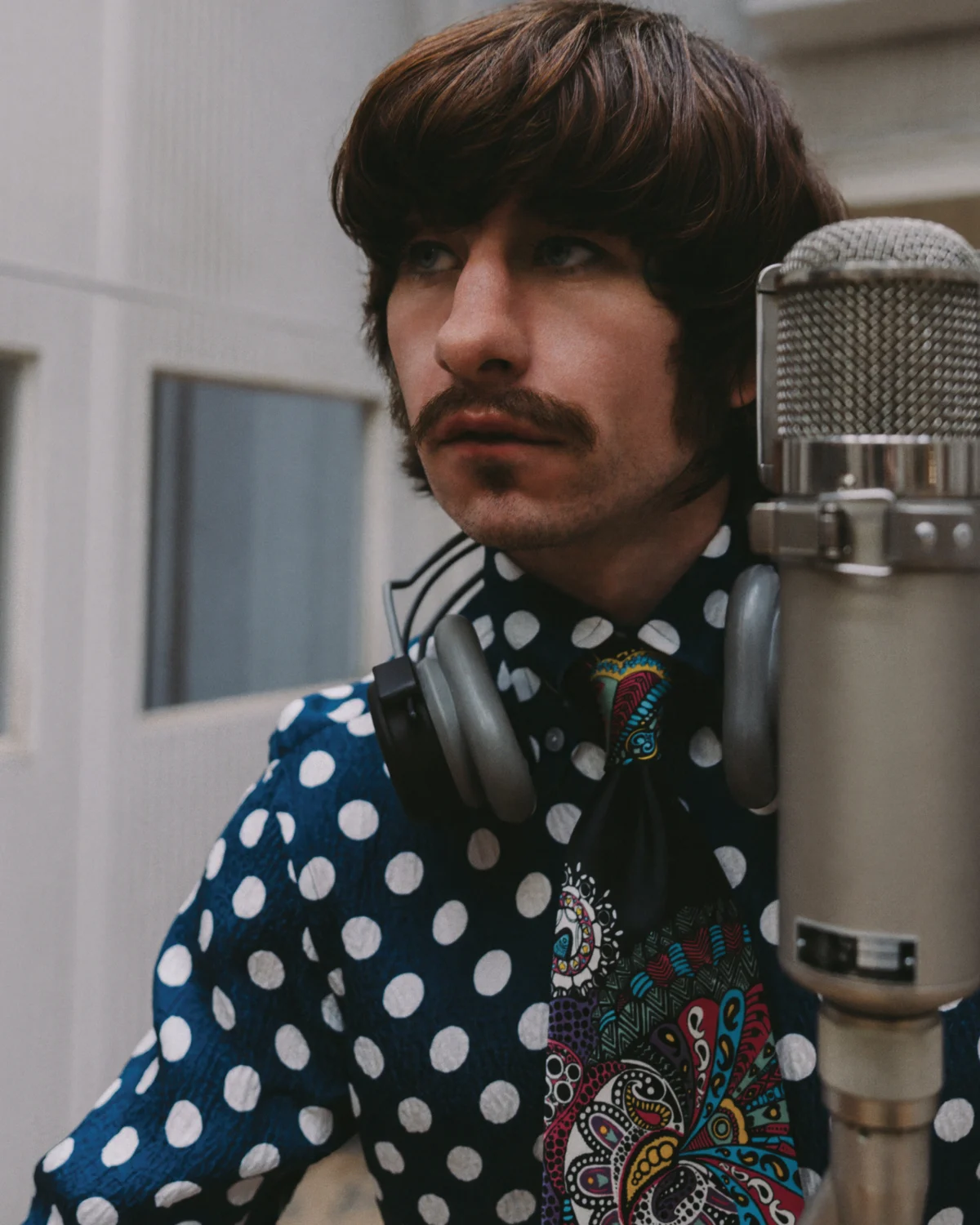
The Postcard Campaign and First-Look Reveal (January 2026): On January 30, 2026, Sony officially dropped the first images of Mescal, Dickinson, Keoghan, and Quinn in character. This came a day after the Liverpool Institute of Performing Arts (LIPA)—located in the band’s hometown—teased the project by hiding promotional postcards around its campus for students to discover, igniting social media buzz.
The Horizon (April 2028): Production is currently underway, with Sony targeting an unprecedented simultaneous or near-simultaneous theatrical rollout in April 2028.
Supporting Data and Comprehensive Cast Ensemble
To bring the 1960s music scene to vivid life, Sam Mendes and his casting directors have assembled a massive, highly decorated ensemble cast. The films will deeply explore the internal and external relationships that shaped the band’s creative output and personal lives.
The Romantic Partners and Inner Circle
Saoirse Ronan as Linda McCartney
Anna Sawai (Shōgun) as Yoko Ono
Lucy Boynton (Bohemian Rhapsody) as Jane Asher (McCartney’s partner)
Morfydd Clark (The Lord of the Rings: The Rings of Power) as Cynthia Lennon (Lennon’s first wife)
Mia McKenna-Bruce (How to Have Sex) as Maureen Starkey (Starr’s first wife)
Aimee Lou Wood (The White Lotus) as Pattie Boyd (Harrison’s first wife)
The Musical Collaborators and Management
James Norton (House of Guinness) as Brian Epstein, the legendary manager who shaped the Beatles into global icons.
Harry Lloyd as George Martin, the iconic producer who helped forge their experimental sound.
Farhan Akhtar as Ravi Shankar, the celebrated sitar master who heavily influenced George Harrison’s musical evolution.
Harry Lawtey (Industry) as Stuart Sutcliffe, the band’s original, ill-fated bassist during their Hamburg days.
Family and Road Crew
David Morrissey as Jim McCartney (Paul’s father)
Leanne Best as Aunt Mimi (John Lennon’s guardian)
Bobby Schofield as Neil Aspinall (Road manager)
Daniel Hoffman-Gill as Mal Evans (Roadie)
Arthur Darvill as Derek Taylor (Press officer)
Adam Pally as Allen Klein (The band’s controversial second manager)
Behind the scenes, the creative architecture is equally formidable. While Sam Mendes directs all four chapters, the screenwriting duties are shared among Jez Butterworth, Peter Straughan, and Jack Thorne, though the precise division of labor across the individual scripts remains under wraps.
Official Responses and Creative Vision
The unorthodox nature of the project has generated significant commentary from the filmmakers regarding how audiences are expected to consume the quartet of movies.
Speaking during a keynote speech at the BFI London Film Festival’s Industry Forum, producer Pippa Harris shed light on the distribution and viewing strategy.
"The idea at the moment is the films will come out in 2028, and we want people to be able to experience them in the cinema during the same period," Harris told The Hollywood Reporter. "That doesn’t necessarily mean we’re thinking that people will go and see all four films on the same day. But within the same month, you might see one a week, or you might see one on a weekend, two the next one. However you see it, I think our hope is that people will see all four films."
Sam Mendes has likewise emphasized that the project was born out of a desire to avoid the superficiality of standard musical biopics. In his address to theater owners, Mendes noted:
"I’ve been trying to make a film about the Beatles for years, but I had temporarily given up. I just felt the story of the band was too huge to fit into a single movie, and a TV series just somehow didn’t feel right. I felt there simply had to be a way to tell a big story of those four extraordinary men for a new generation. I’m sure we all think we know a version of the Beatles’ story, but I can assure you, there is still plenty to tell. I think we found a way to do that."
The release of The Beatles — A Four-Film Cinematic Event in April 2028 carries profound implications for the film industry, both commercially and critically.
From a structural standpoint, Sony is testing a brand-new release model. Releasing four interconnected biographical films within the span of a single month asks for a unique level of commitment from moviegoers. If successful, it could pioneer a new template for blockbuster franchise storytelling, pivoting away from endless CGI-driven superhero sequels toward event-driven, prestige biographical universes.
Furthermore, the project creates an fascinating dilemma for awards bodies like the Academy of Motion Picture Arts and Sciences. Musical biopics are historically catnip for Oscar voters, who consistently reward transformative performances involving singing, physical transformation, and historical immersion.
However, this unique four-film setup creates an internal competition nightmare. With Paul Mescal, Harris Dickinson, Barry Keoghan, and Joseph Quinn all playing leading roles in their respective films—while theoretically appearing as supporting figures in the others—awards campaigns could see the cast cannibalize their own votes. If voters are forced to choose between multiple critically acclaimed performances from the same cinematic universe, or if the films split the voting bloc across different categories, it could lead to an unprecedented awards season showdown.
As production pushes forward toward its 2028 window, the global film community will be watching closely to see if Sam Mendes and Sony Pictures can successfully pull off the most ambitious cinematic gamble in music history.