
The Post-Production Paradigm Shift: Adobe’s AI-Driven Evolution of Premiere and After Effects
The most grueling aspects of professional video editing have rarely been the creative choices themselves. Rather, they are the "invisible" bottlenecks—the desperate search for a missing B-roll shot, the tedious manual labor of cleaning up a distorted audio recording, or the administrative nightmare of untangling a project file that has ballooned into thousands of unorganized layers.
Ahead of IBC 2026, Adobe has unveiled a comprehensive suite of AI-powered features for Premiere Pro and After Effects, signaling a strategic pivot in its software development philosophy. By embedding generative media, intelligent audio processing, and natural-language project management directly into its professional ecosystem, Adobe is attempting to redefine the relationship between the editor and the machine. The objective is no longer to simulate creativity, but to automate the technical friction that separates a filmmaker’s vision from its execution.
The New Frontier: Generative Media in the Timeline
Perhaps the most significant change arriving in Premiere Pro is the Generative Media Tool. For years, editors have relied on third-party AI platforms, requiring a disruptive "out-of-app" workflow: export, prompt, download, import, and re-conform. Adobe is effectively eliminating this cycle.
Contextual Visual Generation
The Generative Media Tool allows editors to select a range within their timeline and, via a natural-language prompt, generate video or sound effects without ever leaving the sequence. What separates this from basic generative video is the inclusion of "reference frames." By analyzing the existing sequence, the AI understands the visual language, lighting, and continuity of the scene. Furthermore, Adobe is embracing an open-model approach, allowing users to choose between its proprietary Adobe Firefly model and high-end third-party generators, including Google Veo, Kling, Runway, and Luma.
Audio Generation and Ambient Intelligence
The audio suite within this update is equally ambitious. The Generate Soundscape feature can analyze up to 15 seconds of visual content to produce contextually aware, immersive sound beds. Simultaneously, Generate Music provides an original, royalty-free instrumental soundtrack, complete with controls for tempo, intensity, and looping. Most impressively, the tools allow for "voice-guided" creation; an editor can hum a rhythm or provide a vocal guide, and the AI will match the tempo and structure of the generated audio to that performance.
After Effects: The Intelligent Assistant
While Premiere focuses on speed and generation, After Effects is undergoing a structural revolution. The new AI Assistant, currently in public beta, represents a shift from a "tool-based" interface to a "conversational" interface.

Managing Project Complexity
Motion designers often struggle with projects that contain thousands of layers, complex expressions, and nested compositions. The AI Assistant acts as a project manager. Instead of manually digging through menus or debugging lines of code, a designer can issue natural-language commands: "Organize these layers into nested comps based on color," or "Identify the broken expression in this layer and suggest a fix."
By analyzing the entire project architecture—rather than just the active composition—the Assistant provides a level of oversight that was previously impossible without a seasoned technical director. It does not replace the designer’s creative intent; instead, it performs the procedural housekeeping that traditionally consumes hours of an artist’s day.
Precision Audio: Tackling Production Failures
For documentary filmmakers and field producers, audio is often the Achilles’ heel of a production. Adobe’s latest updates to its audio engine provide surgical precision for notoriously difficult recordings.
Enhance Audio and Crosstalk Separation
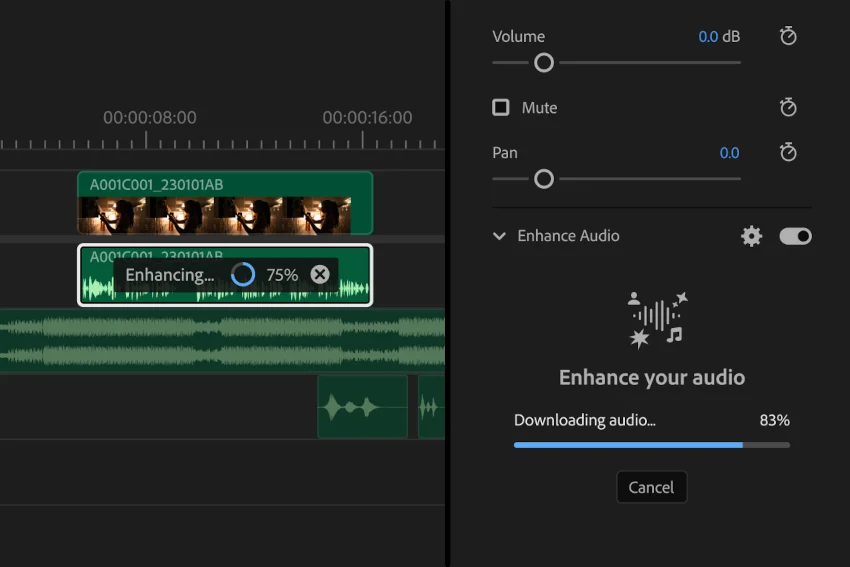
The Enhance Audio suite, an evolution of Adobe’s popular "Enhance Speech" technology, now offers granular control over the audio mix. Editors can now treat a single file as a multi-track recording, adjusting dialogue, music, and ambient noise levels independently.
Perhaps the most impressive technical feat is Separate Crosstalk. This tool addresses the "cocktail party" problem: two people speaking simultaneously. By isolating the individual voices and assigning them to independent tracks, Adobe is providing a lifeline to editors working with un-mic’d, overlapping interview audio. The system automatically creates a cleaned-up dialogue track while retaining a safety version of the original audio for verification.
A Chronology of Adobe’s AI Integration
To understand the significance of these updates, one must look at Adobe’s trajectory over the past three years:

- 2023: Adobe introduces the Firefly model and "Text-Based Editing," marking the first major shift toward AI-assisted workflows.
- 2024: The focus shifts to "AI Speech Enhancement," proving that Adobe could clean up field audio with cloud-based processing.
- 2025: Integration of Frame.io into the core workflow, centralizing media management.
- 2026 (IBC Announcement): The launch of the "Generative Media Tool" and the After Effects "AI Assistant." This represents the transition from assisting editors to collaborating with them in real-time.
Implications for the Creative Industry
The implications of these tools are multifaceted, touching upon technical, financial, and creative domains.
The "Technical Debt" Reduction
Every professional editor carries "technical debt"—the time spent waiting for renders, searching for assets, or re-recording dialogue. By automating these tasks, Adobe is effectively increasing the "creative capacity" of the workforce. If an editor saves two hours a day on housekeeping, that is two hours redirected toward storytelling, color grading, and pacing.
The Democratization of Advanced Techniques
Historically, removing background noise or managing complex expressions in After Effects required specialized training or expensive plugins. By integrating these capabilities into the base software, Adobe is leveling the playing field for independent creators and small production houses.
The Reliability Question
As these tools enter public beta, the industry remains cautious. Generative media in a professional timeline must be frame-accurate, color-consistent, and legally compliant. Adobe’s decision to allow third-party model integration suggests they are aware of these limitations. For these tools to become industry-standard, they must prove they can perform under the pressure of a broadcast deadline, where "close enough" is rarely sufficient.
Official Perspective and Future Outlook
Adobe’s messaging remains consistent: the goal is to "reduce the technical work between an idea and its execution." In an interview regarding the update, Adobe representatives emphasized that these tools are designed to augment the editor’s skill set, not replace the human decision-making process.
"The AI is a tool, not a director," says the Adobe product team. "The creative decision—the cut, the choice of tone, the emotional weight—remains the sole domain of the artist. Our job is simply to ensure that when the editor decides on a change, they don’t have to spend three hours executing it."

Expanding the Ecosystem
Beyond the headline-grabbing AI tools, Adobe is continuing to refine the foundational experience. The Color Mode update, featuring new Vignette and Midtones Style Modules, aims to provide more intuitive grading workflows. Furthermore, the expansion of Frame.io Mounted Storage to all accounts marks a permanent shift toward cloud-first post-production, allowing editors to stream full-resolution media as if it were on a local NVMe drive.
Conclusion
The 2026 update to Adobe Premiere Pro and After Effects is less about a single "killer feature" and more about the maturation of AI as an integrated production layer. We are moving away from the era of "AI as a curiosity" and into the era of "AI as a colleague."
For the filmmaker of 2026, the barrier to entry for high-end production continues to lower. While the core tenets of storytelling—timing, rhythm, and narrative structure—remain unchanged, the process of achieving them is undergoing a profound transformation. As these beta tools move toward general release, the industry will be watching closely to see if they deliver on their promise of seamless integration. If successful, Adobe will have done more than just update software; they will have effectively rewritten the job description of the modern editor.
Disclaimer: As an Amazon Associate and a participant in other affiliate programs, we may earn a small commission from qualifying purchases made through some of the links on this page – at no additional cost to you.
