
The Recursive Reality of Nathan Fielder and Lance Oppenheim: How ‘You Can See Everything’ Elevates the Architecture of Deception
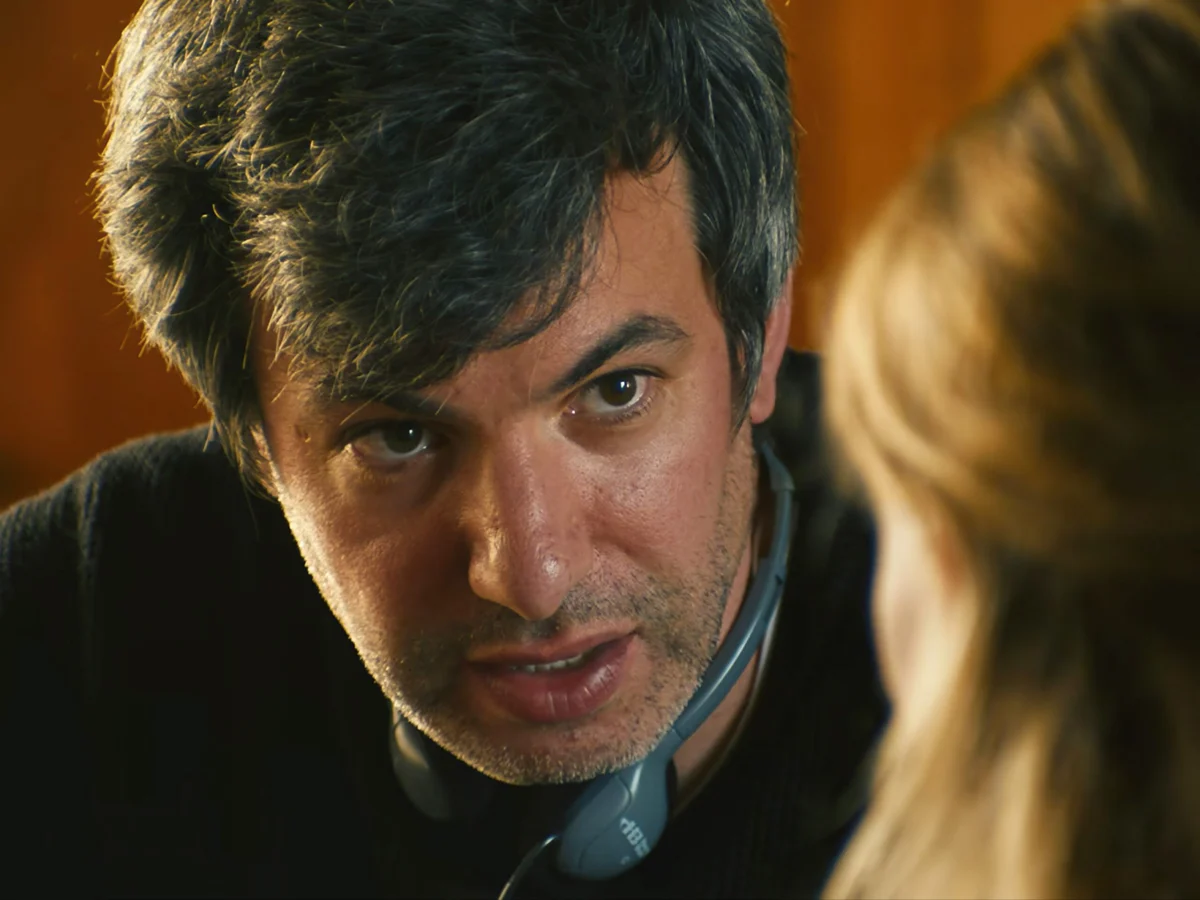
[Editor’s note: The following article contains major spoilers for the A24 documentary “You Can See Everything.”]
If cinematographer David Bolen and camera operator Jonathan Mitchell were tasked with filming vérité coverage of the IndieWire office in New York following the release of Lance Oppenheim and Nathan Fielder’s A24 documentary You Can See Everything, the footage would capture a very specific kind of visual transience. There would be an overarching, unsettling tension—the exact atmospheric weight that defines the first half of the film.
In You Can See Everything, Oppenheim, Fielder, and their tightly knit production team documented Elizabeth Holmes’ final month of freedom before she reported to federal prison to serve an 11-year sentence for multiple counts of wire fraud. Yet, walking through a shifting newsroom amid cardboard boxes, abandoned Tupperware, and mystery mugs, the sense of displacement mirrored the film’s existential core. Everyone on staff was grappling not just with the physical reality of relocating office floors, but with the cultural shockwave of a project that has fundamentally altered how we think about documentary ethics, performance, and truth.
This widespread digital discourse prompted IndieWire’s TV Critic, Ben Travers, to pose a wry question: Given the monumental release weekend Fielder experienced with You Can See Everything, would the idiosyncratic filmmaker even be keen on returning for a third season of The Rehearsal? That groundbreaking HBO series has previously allowed him to execute feats as wildly divergent as transporting a replica of a Brooklyn bar across state lines and flying a commercial airliner.
Without overthinking it, Craft Editor Sarah Shachat blurted out a spontaneous verdict: "He’s already made Season 3. It’s this movie."

While HBO Head of Comedy Casey Bloys has confirmed that a third season of The Rehearsal is officially in development—sparking wild Reddit threads theorizing whether Fielder intends to single-handedly solve geopolitical crises or leak classified archives—the sentiment rings true. You Can See Everything functions as an organic evolutionary leap from Fielder’s past television experiments. It challenges its audience to roll with a degree of recursive self-reflexiveness so intense that even avant-garde pioneer Peter Watkins would likely scratch his head in disbelief.
The Architecture of Artifice: From The Rehearsal to San Diego
To fully understand the cinematic mechanisms at play in You Can See Everything, one must trace the lineage back to the intricate production design of The Rehearsal Season 1. Whether building out the meticulous replica of "Nate’s Lizard Lounge" or constructing full-scale studio apartments, Fielder’s work has consistently trained viewers to recognize that everything we interact with is deliberately constructed.
In Fielder’s universe, physical spaces are rarely strictly "real" or "fake." If a location is authentic, it is meticulously recreated and repurposed, often multiple times, with Fielder hovering nearby behind a laptop. If a space is fabricated entirely for the production, it invariably becomes the staging ground where the most genuine, emotionally raw human interactions take place.
Consider the deliberate contrast in how subjects are introduced across The Rehearsal. In Episode 1, we are introduced to Kor in his actual home. Even though the scene of the New York school teacher playing along with Jeopardy! was clearly staged for the cameras, viewers retain a baseline sense of observing an unvarnished daily reality.
Conversely, when Angela is introduced in Episode 2, we drop straight into mid-rehearsal. The sequence opens on a wall of surveillance monitors before pulling back to reveal Fielder inside a control room, flanked by his production crew and the biological mothers of the child actors playing Angela’s faux son, Adam. We are forced to process the artifice before we ever truly process the person. This stylistic choice permanently colors how we navigate both narratives and alters our perception of Fielder’s relationship with his subjects.

The core philosophical inquiry of The Rehearsal asks what kind of authentic emotional catharsis can be extracted from an artificial environment, particularly for individuals who struggle with genuine self-expression. Perhaps the structured fiction of "rehearsing" life can pave the way for something profoundly true. Yet, as the lines between performance and genuine emotion continually blur, drawing a definitive boundary becomes an impossible task—a moral hazard that multiplies exponentially when child actors are brought into the fold.
Chronology of an Illusion: The San Diego Return
Major spoilers for “You Can See Everything” follow.
When You Can See Everything shifts its focus to the rental home in San Diego where Elizabeth Holmes and her partner, Billy Evans, spent their final months before Holmes relocated to Texas for imprisonment, Fielder and actor Amanda Seyfried are ostensibly searching for physical grounding. They comb through the empty rooms to map out the physical geography of a space Holmes has long since abandoned.
However, their objective quickly transcends mere investigative journalism. They purposefully bend reality far enough into theatrical artifice in the hopes of circling back around to an elusive emotional truth. By running back the baffling, surreal month they spent in Del Mar through staged dramatic scenes featuring Seyfried—alongside a brilliantly game Christopher Abbott—Fielder and Oppenheim attempt to reverse-engineer an understanding of both the public spectacle and Holmes herself.
The film relies heavily on nearly invisible tonal shifts. In one notable moment, Seyfried uncovers the now-infamous mixing bowl used by Holmes to beat eggs, finding it tucked away in a cabinet right where it had been left. But the moment the film cuts to a dramatization of Seyfried-as-Holmes meeting Fielder for the first time, a professional set-decoration team has intervened to make the sterile rental house look vibrantly lived-in once again.

This rhythmic oscillation—alternating between the script performed by Fielder and Seyfried, and behind-the-scenes discussions dissecting those exact moments as Fielder’s subjective memories of a real event—acts as a narrative anchor. It teaches the audience how to interpret the layers of media they are consuming.
A single sequence might begin with Fielder and Seyfried conversing in reality, cut immediately to the polished dramatic recreation, and then transition to Fielder coaching a costumed Seyfried in a makeup chair. Verité footage, staged dialogue within a recreated set, and full-scale dramatic reenactments exist here on a seamless, sliding scale of reality. It is a structural architecture that Fielder and editor Adam Locke-Norton perfected over years of television production.
Supporting Data: The Escalation of Communication Failures
The thematic groundwork laid in You Can See Everything shares a direct DNA with The Rehearsal Season 2, which deeply investigated humanity’s collective inability to successfully communicate high-stakes truths.
While Season 2’s premiere explores the systemic pressures and psychological incentives that compromise pilot communication inside commercial cockpits, it also serves as a broader meta-commentary on public perception. One need only look at the excruciatingly awkward CNN interview Fielder endured to promote the show—where mainstream anchors routinely dismissed a comedian attempting to highlight systemic aviation safety flaws—to recognize how easily society dismisses uncomfortable truths delivered through a satirical lens.
Both The Rehearsal Season 2 and You Can See Everything confront the painful limits of mutual understanding. The HBO series deployed massive, expensive recreations—including a fully functional airport terminal and Fielder speed-running the entire life of Chesley "Sully" Sullenberger before embodying him for "the Miracle on the Hudson"—to dissect these communicative disconnects, all punctuated by ironic needle-drops from Evanescence.

In You Can See Everything, the recreations serve an inverted purpose: they attempt to chart the contours of imperfect, compromised communication to figure out where genuine humanity ends and calculated performance begins. This acts as a fascinating thematic counterpoint to Season 2 of The Rehearsal, where Fielder pushed meta-realism to its absolute extreme by actually attending flight school, earning a commercial pilot’s license, and flying an actual 737 carrying the entire extended cast of actors for the season finale. Fielder quite literally became his own subject, transforming his lived experience and permanently altering his self-perception.
Official Responses and Creative Interventions
Faced with the reality that he could see and converse with Holmes in prison, but was strictly barred from bringing cameras or recording devices inside the visiting room, Fielder sought counsel from Seyfried. While the actor expressed a willingness to recreate whatever dialogue Fielder required, Fielder harbored deep reservations. He openly questioned whether even an Academy Award-nominee like Seyfried could accurately recreate the essence of Holmes—let alone grant the audience a reliable window into Holmes’ actual state of mind.
Ultimately, the production moves forward with the prison visitation reenactment, cleverly intercut with Fielder and Seyfried reviewing the script by a dramatic fireplace. Yet, conscious stylistic choices define the scene. When Fielder arrives at the prison and endures an agonizingly long wait in the sterile visiting room, the sequence is shot in standard documentary coverage: wide angles, medium shots focused on Fielder’s tense posture, and insert shots of humming vending machines.
However, when Seyfried-as-Holmes finally enters the frame, the camera deliberately frames her from behind in wide shots, deliberately obscuring her face.
One can easily imagine a parallel multiverse where Oppenheim and Fielder maintained this austere distance throughout the entire sequence, forcing viewers to project their own assumptions onto the empty air. Instead, we are given Seyfried’s deeply committed performance. When her Holmes looks dead into the camera and states, "I’m tired of having other people speak for me," the line carries an undeniable, haunting weight. It feels viscerally lived-in.

Implications: The Limits of Empathy
Ultimately, You Can See Everything functions as a cautionary escalation of The Rehearsal. The film demonstrates how dizzyingly easy it is for an artist to become hopelessly lost inside a transformative performance. It delivers a sobering thesis: no matter how meticulously a documentary filmmaker reconstructs the past, total objective accuracy remains perpetually out of reach.
It is Seyfried herself—emerging as the true emotional anchor and heroine of the project—who voices the film’s most damning meta-critique. She gently points out to Fielder that the more time he spends trying to decode Holmes, the harder it becomes for him to remain detached, and the more their complex relationship inevitably taints the purity of the documentary record.
Yet, as both The Rehearsal and You Can See Everything ultimately remind us, spending time trying to understand one another—however flawed, manipulated, or artificial the medium may be—is all we really have.
“You Can See Everything” is now playing in select theaters nationwide.
