
The Audacity of Spite: Inside Giselle Bonilla’s Provocative Sundance Dark Comedy The Musical
By Staff Cultural Correspondent
Park City, Utah — Who among us has not harbored a fleeting, deliciously malicious fantasy about orchestrating the utter downfall of an irritating, overwhelmingly successful rival? Human nature is complex, and nobody is entirely pure of heart. Yet, the vast majority of us possess the emotional restraint necessary to keep those dark impulses safely filed away in the theater of the mind.
Then, of course, there is Doug Leibowitz.
Portrayed with a tightly wound, highly combustible, ready-to-snap nervous energy by Will Brill, Doug stands squarely at the chaotic center of The Musical. This fiercely audacious dark comedy serves as the feature-length directorial debut for Giselle Bonilla, an alum of the prestigious Sundance Institute Ignite program. Premiering on January 25 at the Eccles Theatre during the 2026 Sundance Film Festival—where it competed in the U.S. Dramatic Competition—the film introduces audiences to a deeply frustrated middle school drama teacher who elects to channel his profound personal grievances into an elaborate, wildly inappropriate, and astonishingly tasteless campaign of revenge.
Main Facts: A Masterclass in Petty Sabotage
At its core, The Musical explores the dangerous intersection of wounded male ego and unchecked creative ambition. Doug Leibowitz is a failing playwright whose artistic aspirations have continuously stalled out. Working as a middle school drama teacher in an environment he views with quiet disdain, Doug is already spiraling when his life hits a compounding series of cascading catastrophes.
First, his romantic relationship collapses. His girlfriend, Abigail—portrayed with world-weary charm by Gillian Jacobs—decides to pull the plug on their romance. Adding insult to injury, Abigail happens to be the art teacher at the very same school, meaning Doug must endure seeing her on a daily basis. Professionally, things are scarcely better: Doug faces continuous rejection letters from competitive theater fellowships that might otherwise have provided his ticket to a fresh start in New York City.
The proverbial final straw arrives when Doug discovers that Abigail has moved on and is now romantically involved with the school’s relentlessly ambitious, hyper-charismatic principal. Principal Brady, played with pitch-perfect, smooth-talking swagger by Rob Lowe, has a singular fixation: securing the coveted "Blue Ribbon of Academic Excellence" to cement his legacy and imbue the institution with an aura of elite prestige.
Armed with this information, and following one impeccably timed visual gag that crystallizes his wicked epiphany, Doug formulates his masterstroke of sabotage. To torpedo Principal Brady’s pristine academic aspirations and humiliate the administration, Doug decides to have his unsuspecting middle school students stage an original, high-concept musical about the events of September 11.
Chronology: From Concept to Festival Premiere
The Genesis of a Controversial Premise
The journey of The Musical from a daring script to a major Sundance premiere is a testament to the creative partnership between director Giselle Bonilla and screenwriter Alexander Heller. While a 9/11-themed school musical sounds like a premise designed exclusively to court controversy, the filmmakers approached the material with a specific psychological inquiry into human pettiness.
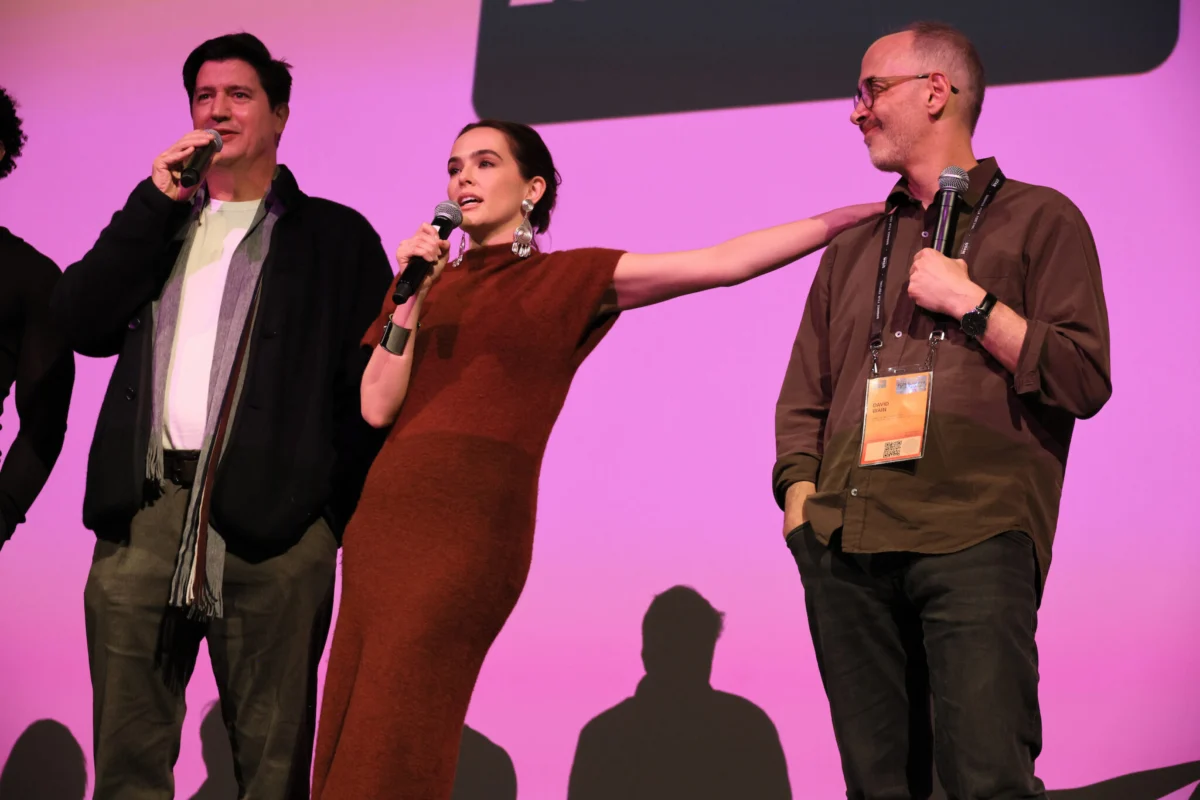
During the post-premiere Q&A session at the Eccles Theatre, Festival programmer Heidi Zwicker posed a direct question to Bonilla regarding what compelled a first-time feature director to take on such a high-wire, incendiary project for her debut.
Bonilla’s response was characteristically unfiltered: "I don’t know, look at the frickin’ world," she remarked to an amused and receptive audience. "Like, my neutral is rage, but people don’t really listen to me when I’m yelling, so if I can make them laugh first, then sometimes they listen."
Bonilla has frequently credited Heller with convincing her to steer the ship. However, when asked about the biographical origins of the story, Heller offered a self-deprecating explanation that kept the audience laughing. "I think just every experience of mine somehow becomes traumatic," Heller joked. "I’m not very good at dealing with stuff."
Production Secrecy and Guerilla Tactics
Executing a film centered around the covert staging of an inappropriate theatrical production required logistical gymnastics that mirrored the chaotic energy of the plot itself. In a fascinating meta-narrative twist, the production team had to adopt the secretive, calculated tactics of their own protagonist.
"What’s crazy is that we shot at the school without them knowing what it was about," Bonilla revealed during the discussion, referencing the real-world constraints and child actors involved in the shoot. "So we made sure that all the sets were very mobile and we could pack them up at the end of each day. And we all kind of turned into Doug, every department head, in the actual making of the film."
The casting process presented its own unique hurdles. Bonilla was adamant about avoiding the polished, homogenized aesthetic often found in youth-oriented media. "I was extremely nervous about casting kids because I didn’t want it to feel like Disney kids," she explained. "I wanted it to feel like real kids, and I wanted their personalities to shine through."
That authenticity paid off dividends, both on screen and during the festival’s live events, where the young ensemble cast charmed attendees with their sharp wit and keen insights.
Supporting Data: Cast, Crew, and Production Details
- The Musical
- Director: Giselle Bonilla (Sundance Institute Ignite program alum)
- Screenwriter: Alexander Heller
- World Premiere Date: January 25, 2026
- Venue: Eccles Theatre, Park City, Utah (2026 Sundance Film Festival)
- Festival Category: U.S. Dramatic Competition
- Key Cast Members:
- Will Brill as Doug Leibowitz (The bitter, failed playwright and middle school drama teacher)
- Gillian Jacobs as Abigail (The school art teacher and Doug’s ex-girlfriend)
- Rob Lowe as Principal Brady (The ambitious, charismatic school principal)
- Aidyn James Ahn as a student ensemble member
- Additional appearances by Nevada Jose and Alexander Heller alongside the youth cast.
- Cinematography & Photography: Distributed via Getty Images for Sundance Film Festival (Photos by Cindy Ord).
Official Responses and Creative Insights
Navigating the minefield of a comedy touching upon a sensitive historical tragedy requires a delicate tonal balance. Alexander Heller was quick to clarify the narrative boundaries during the public panel, ensuring the audience understood that the film’s target is human flaw rather than historical trauma.
"It’s not a 9/11 comedy, I think, for any of us," Heller emphasized. "It’s a comedy about this guy who’s selfish and petty and would, you know, stop at nothing, even exploiting a tragedy, for his own ends, and I happen to know quite a bit about being a selfish, petty guy, so I felt pretty good about that."
For lead actor Will Brill, capturing Doug’s frantic, desperate energy required tapping into a lifetime of accumulated artistic anxieties. When asked how he prepared for the physically and emotionally demanding role, Brill leaned into the humor of the moment.
"I mean, it was a lifetime of preparation," Brill joked during the Q&A. "Every moment of my life has led to this. Everything has been a challenge. What can I say? It was fraught with doubt, everything was hard, and everything was fun. And these guys made it eminently easier, too," he added, gesturing warmly toward the young actors who played his students.
The young actors themselves demonstrated an impressive grasp of the film’s deeper thematic undercurrents. Aidyn James Ahn, who delivers a standout performance as one of Doug’s drama students, offered a memorable summation of the movie’s appeal during the Eccles Theatre panel:
"I love this movie so much," Ahn stated, winning over the room. "Because nobody really talks about the power of, like, spite and rage."
Implications: The Politics of Middle School Theater and Modern Satire
While Doug operates under the delusion that he is orchestrating a grand, subversive masterwork to stick it to the institutional powers-that-be, The Musical cleverly shifts its lens to examine how institutions absorb and redirect chaos.
To the middle school students enlisted in Doug’s guerrilla production, the underlying motivations of their erratic teacher are entirely opaque. Shielded from the petty romantic vendettas driving the project, these dedicated young performers view the endeavor through a lens of pure artistic earnestness. They believe they are participating in a brave, boundary-pushing statement; they see a fired-up educator challenging the establishment.
Furthermore, the micro-politics of the schoolyard inevitably rear their head. As the production gathers steam, the classic power struggles of middle school drama take over—proving that not even a misguided musical about a national tragedy is entirely immune to the fierce, high-stakes competition for lead roles, solos, and social capital among preteens.
By anchoring the absurdity in recognizable human emotions—insecurity, romantic jealousy, professional stagnation, and unadulterated rage—Bonilla and Heller have crafted a feature debut that refuses to take the easy way out. The Musical challenges viewers to laugh not at the tragedy at the center of Doug’s play, but at the staggering, comical lengths to which a small-minded man will go to soothe his own bruised ego.
As The Musical continues its run on the festival circuit following its buzzy Sundance premiere, it establishes Giselle Bonilla as a fearless new voice in American dark comedy—one unafraid to use laughter as a vehicle when yelling simply isn’t loud enough.
