
Master of the Fractured Frame: The Visionary Cinema and Enduring Legacy of Nicolas Roeg
Main Facts
The cinematic landscape of the 1970s was defined by a raw, unvarnished intimacy that Hollywood today rarely dares to touch. At the forefront of this movement was Nicolas Roeg, a master cinematographer turned director whose visual grammar permanently altered how the medium handled time, memory, and desire. Roeg passed away at the age of 90, leaving behind a compact yet towering filmography that challenged audiences to perceive cinema not as a linear storytelling tool, but as a hallucinatory dreamscape.
Roeg’s career is anchored by a ferocious, albeit brief, golden era spanning roughly a decade. Beginning with his co-directorial debut Performance (1970) and culminating with masterpieces like Don’t Look Now (1973), Walkabout (1971), The Man Who Fell to Earth (1976), and Bad Timing (1980), Roeg crafted works of staggering psychological depth and erotic tension. His trademark editing style—characterized by radical time-jumps, visceral associative cutting, and non-linear chronology—taught viewers that in Roeg’s cinematic universe, the past is always present, climaxes are merely preludes, and every human action is tethered to a larger, inescapable circle of fate.
Chronology: From Master Lensman to Auteur
To understand Nicolas Roeg’s revolutionary directorial vision, one must trace his extensive apprenticeship within the British film industry. Born in London, Roeg spent over two decades working as a camera operator and cinematographer before ever stepping behind the director’s chair. His early technical mastery was forged under the tutelage of legendary directors, though not without friction. Roeg worked as a cinematographer on David Lean’s monumental Lawrence of Arabia and engaged in famously contentious creative battles with Lean on Doctor Zhivago.
His distinctive visual signature began to solidify in the late 1960s. He infused John Schlesinger’s Far from the Madding Crowd (1967) with a Thomas Hardy-on-sedatives atmospheric gauziness, and brought a fashion-forward, Godard-meets-Carnaby-Street kinetic energy to Richard Lester’s Petulia (1968).
Roeg’s transition to feature filmmaking began in earnest in 1968 when he co-directed Performance with Donald Cammell. A dark psychodrama exploring the intersection of a fugitive London gangster and an isolated rock star (played with magnetic, lurid abandon by Mick Jagger), the film proved so menacing and elliptically structured that Warner Bros. panicked. Shelved until 1970 and heavily recut, Performance nonetheless radiated an underworld cult griminess—a sordid, hypnotic exploration of identity erasure.
Following Performance, Roeg traveled to the Australian outback to direct Walkabout (1971), a deceptively conventional survival tale centering on two stranded siblings (featuring Roeg’s son, Luc, alongside Jenny Agutter) and an Indigenous Australian wanderer played by David Gulpilil. The film demonstrated Roeg’s ability to imbue traditional narratives with profound anthropological and humanist weight.
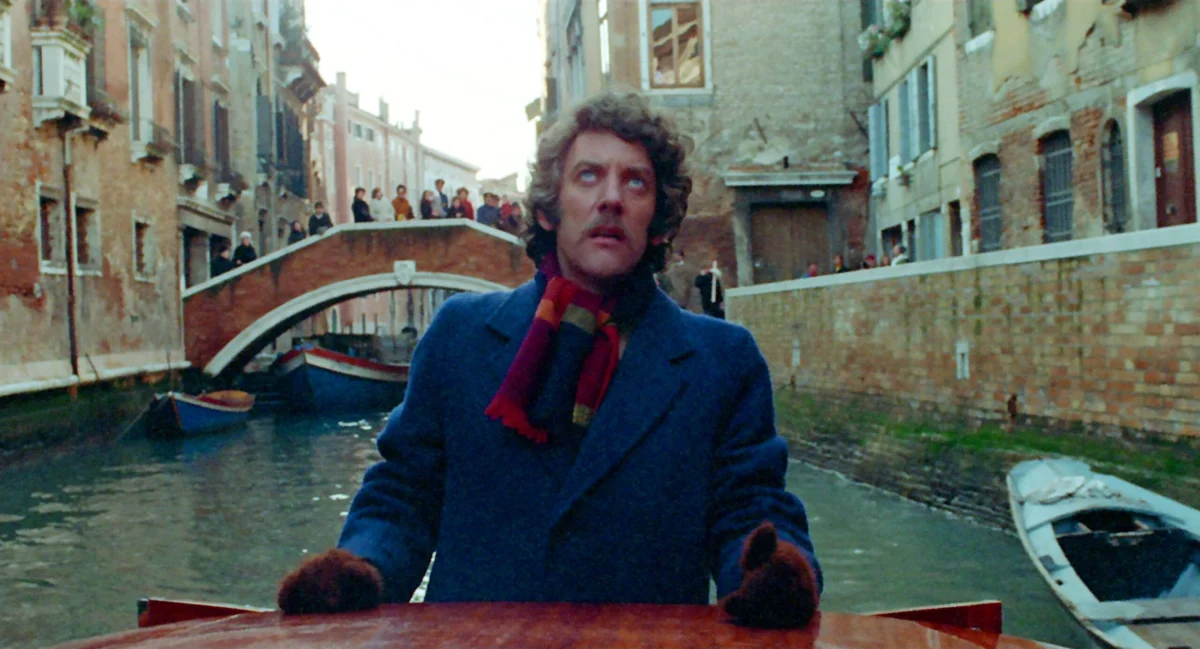
By 1973, Roeg delivered what many consider his masterwork: Don’t Look Now. Adapted from a Daphne du Maurier short story, the film starred Donald Sutherland and Julie Christie as a grieving middle-class couple in Venice attempting to process the accidental drowning of their daughter. Elevated by a legendary, graphic love scene intercut with mundane post-coital dressing, the film redefined the horror genre. Roeg transformed a standard ghost story into a prismatic poem of fear, establishing the blueprint for the modern psychological gothic thriller.
In 1976, Roeg directed The Man Who Fell to Earth, capturing the silky, decadent otherworldly mystique of David Bowie in his prime. Chronicling an alien’s tragic assimilation into corporate American greed and media saturation, the film stands as a prophetic vision of modern alienation. Roeg’s peak directorial era concluded with 1980’s Bad Timing: A Sensual Obsession, an uncompromising, deeply disturbing dissection of male toxicity and emotional destruction starring Art Garfunkel and Theresa Russell.
Supporting Data: Critical Reception and Cultural Impact
While Roeg’s major works are routinely cited by contemporary critics among the greatest films of the 20th century, his box office trajectory tells a more complex story of an artist continually operating just ahead of his audience.
- The Box Office Paradox: Aside from isolated successes, Roeg’s uncompromising aesthetic frequently alienated mainstream studio executives. Warner Bros.’ delayed release and heavy interference with Performance set a precedent for how studios would wrestle with his narrative ambiguity.
- Critical Reappraisal: Films like The Man Who Fell to Earth initially divided critics, with some dismissing its languid pace. Decades later, however, it is universally recognized as a foundational pillar of modern science fiction, directly influencing cyberpunk milestones like Ridley Scott’s Blade Runner.
- The Infamous Love Scene: The love sequence between Sutherland and Christie in Don’t Look Now remains a watershed moment in cinematic history. By intercutting the raw, ecstatic passion with mundane footage of the couple dressing afterward, Roeg not only hoodwinked British censors but fundamentally altered how intimacy was framed on screen—demonstrating that even the most wild acts of passion are anchored in the quiet, humdrum reality of everyday life.
- Post-1980 Output: Following the commercial and critical chill surrounding Bad Timing—which was famously labeled "a sick film made by sick people" by Rank Organization executive Terry Doyle—Roeg’s career shifted toward smaller, more idiosyncratic projects. These included the intellectual comedy Insignificance (1985), which imagined an encounter between Albert Einstein and Marilyn Monroe, and his 1990 adaptation of Roald Dahl’s The Witches.
Official Responses and Industry Tributes
The announcement of Nicolas Roeg’s passing prompted an outpouring of grief, reverence, and critical reassessment from across the global film community. Filmmakers, actors, and critics alike took to public platforms to honor a pioneer who refused to compromise his visual language.
Prominent figures in contemporary cinema frequently cite Roeg as a primary influence on non-linear storytelling. Directors such as Steven Soderbergh, Danny Boyle, and Christopher Nolan have acknowledged the debt modern editing owes to Roeg’s associative cutting techniques. Film historians emphasize that Roeg liberated the camera from the tyranny of chronological continuity, proving that cinematic grammar could mirror the chaotic, associative nature of human memory and psychological trauma.
Furthermore, collaborators like Theresa Russell—who transitioned from Roeg’s muse to his wife—have spoken extensively about his rigorous, deeply collaborative, yet fiercely singular directorial vision on set, noting that working with Roeg required an absolute surrender of conventional actorly vanity in exchange for profound emotional authenticity.
Implications: The Road Not Taken and the Enduring Vision
The legacy of Nicolas Roeg ultimately invites a poignant counterfactual historical inquiry: What if Hollywood’s machinery of escapism had fully embraced Roeg’s avant-garde sensibilities?
By the time Roeg reached his late forties, following the release of The Man Who Fell to Earth just one year before George Lucas’s Star Wars revolutionized commercial cinema, the industry was pivoting decisively toward high-concept, easily digestible blockbusters. Roeg’s uncompromising commitment to fractured timelines, psychological ambiguity, and dark, adult themes rendered him an increasingly rare breed: an uncompromising art-house auteur operating within commercial parameters.
Though his peak output was restricted to a remarkably concise window of roughly four or five truly monumental films, their impact is outsized. To watch a Nicolas Roeg film today—whether it is Mick Jagger hypnotizing the screen with "Memo from Turner," a terrifying small figure in a red hood stalking the foggy alleyways of Venice, Donald Sutherland clinging desperately to a crumbling church scaffolding, or David Bowie channel-surfing across multiple television sets—is to step into a singular alternate universe.
It is a place where human beings desperately seek to transcend the confines of their earthly existence, only to discover that the nightmare is cracking open inside their own minds. Roeg’s cinema remains wide-awake, dangerous, and dazzlingly alive, proving that true cinematic vision never truly fades.
