
Mavis Camera 8.2 Transforms the iPhone 18 Pro Into an Advanced Cinema-Grade Production Tool
The latest major update to the premier iOS professional cinematography suite bridges the gap between pocket-sized mobile devices and Hollywood-tier cinema rigs, introducing direct hardware controls, ProRes RAW workflows, and a powerful developer ecosystem.
Main Facts
Mavis has officially launched Mavis Camera 8.2 (with version 8.2.1 already rolling out via the App Store), marking a monumental shift in how mobile devices integrate into high-end broadcasting and professional filmmaking environments. Rather than serving merely as a manual exposure utility or a basic filter application, this new iteration squarely targets professional filmmakers, broadcast engineers, multi-camera production teams, and systems developers.
The headline additions in version 8.2 include native, direct control over the variable aperture found on the newly released iPhone 18 Pro and iPhone 18 Pro Max. Furthermore, the app introduces ProRes RAW recording capabilities to external storage mediums, professional-grade HDMI output with low-latency monitoring overlays, and a robust new WebSocket-based API designed to allow deep integration into customized studio production systems and multi-camera arrays.
While core features like variable aperture, external HDMI output, and ProRes RAW handling are available natively, Mavis has also structured a flexible monetization model. The app remains free to download, backed by a new $29.99 annual subscription that encompasses the Pro Pack, Film Kit, NDI protocols, and full API functionality. Alternatively, the API can be acquired independently as a $19.99 one-time in-app purchase, ensuring legacy users retain their previously unlocked features.
Chronology
The journey toward mobile cinema parity has been incremental, but the release of Mavis Camera 8.2 represents a structural leap forward:

- Foundation and Evolution: Mavis originally carved out a niche by offering granular, frame-rate accurate manual controls for iOS devices, empowering independent filmmakers to bypass the stock camera’s aggressive auto-processing algorithms.
- Hardware Alignment: Apple’s continuous hardware maturation—culminating in the advanced optics of the iPhone 18 Pro and iPhone 18 Pro Max—set the stage for software developers to access deeper, previously restricted optical parameters.
- The 8.2 Rollout: Mavis developed and deployed version 8.2 to harness these next-generation hardware capabilities, introducing complex I/O pipelines like external ProRes RAW ingestion and clean HDMI feeds.
- Immediate Post-Launch Iteration: Following initial user feedback and edge-case testing, Mavis swiftly released version 8.2.1 to optimize stability, ensuring that high-throughput workflows like sustained RAW recording and network-based API commands operate seamlessly under stressful production conditions.
Supporting Data & Technical Specifications
To understand the weight of Mavis Camera 8.2, one must look closely at the underlying technical metrics and architectural upgrades included in the patch notes:
Optical and Storage Performance
- Aperture Manipulation: On the iPhone 18 Pro and iPhone 18 Pro Max, operators can manipulate the variable aperture dynamically while actively recording. This can be handled tactilely via the physical Camera Control Wheel or through software-based onscreen thumbrails. Crucially, this functions seamlessly in both manual and auto-exposure modes.
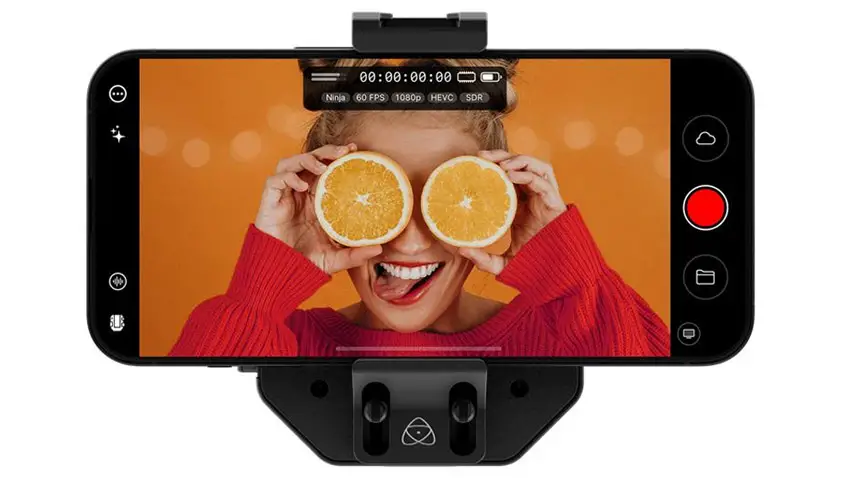
- RAW Capture Capabilities: Users can record natively in ProRes RAW at full 4K resolutions or in Open Gate configurations. Because these high-bitrate files outpace internal storage capacities and throughputs, they are captured directly to a compatible external solid-state drive (SSD).
- HDMI Latency and Monitoring: Mavis engineers have built a professional HDMI out pipeline capable of mirroring the camera’s exact capture frame rate. Internal testing confirms an impressively low HDMI latency threshold of just two frames at 29.97 fps.
- Assistance Overlays: The external HDMI feed can output a clean image or a data-rich overlay featuring timecode, audio meter levels, current focus distance, ISO, shutter speed, frame rate, and device health status. Critical monitoring tools—including focus peaking, false color, zebras, framing guides, aspect-ratio masks, and tally lights—can be mirrored directly to the external monitor.
API Architecture
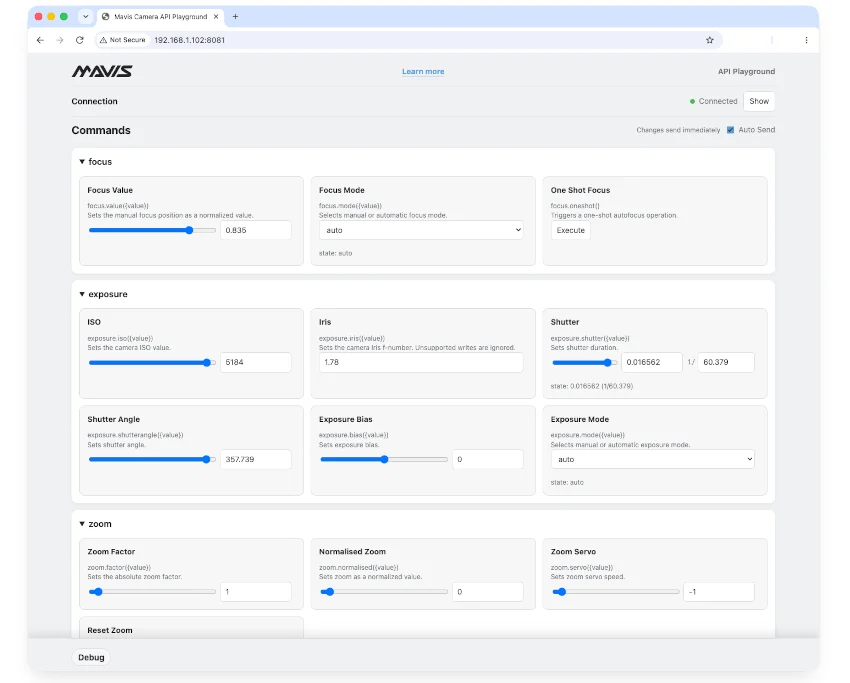
- Network Protocol: The newly introduced API operates locally over standard local networks utilizing a WebSocket connection. This enables bi-directional communication, allowing external applications to push commands while instantaneously receiving status feedback regarding camera adjustments.
- Control Parameters: Developers and technical directors can programmatically manipulate exposure values, focus points, white balance presets, zoom levels, lens switching, tally states, and color shading.
- API Playground: To lower the barrier to entry, Mavis has bundled a browser-based "API Playground" environment. This allows system integrators to test and audit available controls visually before writing bespoke software wrappers.
Official Responses and Industry Perspective
While Mavis has not published a lengthy press manifesto, the technical design of version 8.2 speaks volumes about the company’s strategic vision. By leaning heavily into hardware-adjacent features, Mavis is positioning itself not as an app developer for casual content creators, but as a critical infrastructure partner for modern video production units.
Industry analysts and early-adopter cinematographers have noted that the integration of a local network WebSocket API bridges a long-standing divide between mobile devices and traditional studio switchers (such as those from Blackmagic Design, Ross Video, or NewTek). By allowing an iPhone 18 Pro to be shaded, focused, and triggered remotely from a central control board, Mavis has transformed a consumer pocket computer into a viable, lightweight broadcast studio camera.
Furthermore, the inclusion of Atomos-friendly workflows (such as external ProRes RAW recording) aligns with existing modular cinema setups, allowing mobile units to drop into multi-camera shoots alongside full-frame mirrorless and cinema line cameras without requiring transcoding or proprietary color-space conversions.
Implications
The release of Mavis Camera 8.2 carries profound implications for multiple tiers of the video production ecosystem:
1. For Independent Filmmakers and Solo Shooters
The combination of variable aperture control and ProRes RAW recording on the iPhone 18 Pro gives independent creators unprecedented cinematic depth-of-field control and post-production color-grading latitude. Gone are the days of hyper-sharp, artificially deep mobile video; filmmakers can now dial in physical aperture adjustments to isolate subjects naturally, retaining highlight and shadow details that traditional compressed mobile codecs would crush.
2. For Multi-Camera Productions and Broadcast Environments
The introduction of the Mavis API and professional HDMI output solves major logistical hurdles for live-event and multi-camera shooters. Production teams can now mount lightweight iPhone 18 Pro units in tight spaces—such as car interiors, overhead riggings, or jib arms—and control them entirely via network commands, feeding pristine, low-latency video feeds out to switchers and monitors.
3. For App Developers and Hardware Integrators
By opening up a well-documented WebSocket API, Mavis invites hardware tinkerers and software engineers to build custom physical control surfaces, automated studio tracking rigs, and specialized tally systems. This transforms the iPhone ecosystem from a closed, isolated recording device into a modular node within a larger, programmable production infrastructure.
Ultimately, Mavis Camera 8.2 is less of a routine software update and more of a conceptual milestone. It proves that the iPhone 18 Pro—when paired with professional-grade software architecture—is ready to step off the social media feed and onto the professional soundstage.
