
Country Star Zach Bryan Wears “Free Palestine” Shirt at Gillette Stadium Amid Ongoing Industry Fallout Over Free Speech and Middle East Conflict
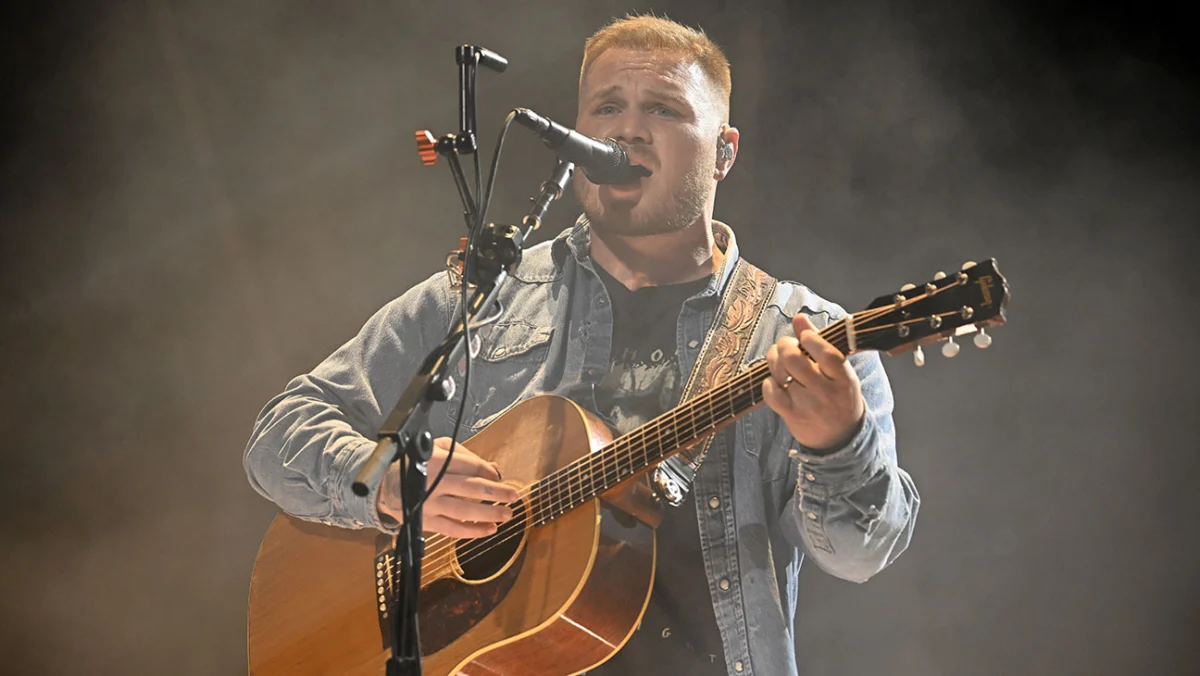
FOXBOROUGH, Mass. — Country music star Zach Bryan delivered a striking visual statement during his sold-out concert at Gillette Stadium on Friday night, stepping onto the stage wearing a black t-shirt emblazoned with the words “Free Palestine.”
The performance, part of Bryan’s sprawling With Heaven On Tour, took place at the very venue owned by New England Patriots billionaire owner Robert Kraft. The high-profile demonstration arrived on the heels of a massive industry-wide controversy involving Kraft, rapper Macklemore, and growing tensions over political expression, artist blacklisting, and the devastating humanitarian crisis in Gaza.
While Bryan did not explicitly address the shirt or make verbal remarks regarding Palestine from the stage, fan-captured photos and videos circulating widely across social media showed the singer and several members of his backing band donning Palestine-branded apparel throughout the night. The concert marked the first of a two-night stadium run intended to close out Bryan’s current tour.
Main Facts
The intersection of major live music touring and geopolitical activism has triggered unprecedented friction across the entertainment industry, culminating in Bryan’s silent yet unmistakable protest at Gillette Stadium.
- The Demonstration: Zach Bryan performed at Robert Kraft’s Gillette Stadium on Friday night wearing a “Free Palestine” t-shirt. Several members of his touring band wore matching Palestine-solidarity clothing.
- The Venue Context: The concert took place at a venue owned by Robert Kraft, who recently defended his role in lobbying to remove rapper Macklemore from Ed Sheeran’s touring lineup due to Macklemore’s pro-Palestinian stage remarks.
- The Broader Controversy: Macklemore’s removal sparked a chain reaction, including solidarity boycotts by fellow opening acts, multi-million dollar charitable donations, and a rapidly sold-out international benefit tour organized by Macklemore.
- Silence From the Artist: Bryan did not address the political messaging verbally during his performance, maintaining focus on his music while letting his wardrobe speak for the collective movement.
Chronology of the Controversy
To understand the weight of Zach Bryan’s wardrobe choice at Gillette Stadium, it is necessary to examine the cascading events that transformed a routine concert tour into a flashpoint for free speech and international politics.
Phase 1: The MetJersey Show and Macklemore’s Onstage Remarks
The friction began weeks prior when rapper Macklemore performed as an opening act on Ed Sheeran’s major stadium tour. During his set at MetLife Stadium in New Jersey, Macklemore shouted “Free Palestine” to the crowd and projected visual footage from Gaza onto the jumbo screens behind him. The moment was intended to draw mainstream attention to the plight of Palestinian civilians caught in the crossfire of the Israel-Hamas war.
Phase 2: The Backstage Lobbying and Removal
Following the MetLife performance, pressure mounted behind the scenes. According to Macklemore, Robert Kraft and a coalition of fellow stadium owners intervened. Macklemore later alleged that Kraft “rallied some of the other stadium owners and collectively they gave him an ultimatum: if Macklemore stays on the tour, you will not be allowed to play in our venues.” Consequently, Macklemore was dropped from the upcoming Gillette Stadium dates scheduled for late September.
Phase 3: Tour Departures and Solidarity
As news of Macklemore’s removal spread, the ripple effects hit Ed Sheeran’s tour directly. In a display of industry solidarity, several other scheduled opening acts—including singer-songwriter Finneas, Danish pop band Lukas Graham, and Irish artist Aaron Rowe—voluntarily dropped out of the tour in protest of what they viewed as corporate censorship and the silencing of political speech.
Phase 4: Million-Dollar Pledges and Matching Funds
In the wake of his dismissal, Macklemore announced he was personally donating $1 million to support Palestinian humanitarian relief efforts and publicly challenged Robert Kraft to match the contribution. Surprisingly, Kraft accepted the challenge, announcing a $2 million commitment toward aid in the region to address the humanitarian crisis.
Phase 5: Macklemore’s “Free Palestine” Tour
Refusing to be sidelined, Macklemore announced a dedicated Free Palestine Tour, scheduling high-profile arena dates in international cultural hubs including Dublin, Paris, and London for late October. All proceeds from the tour were pledged directly to pro-Palestinian charitable organizations. Within days, all three dates completely sold out.
Phase 6: Zach Bryan’s Gillette Stadium Statement
Against this backdrop of intense scrutiny, corporate retaliation, and artistic defiance, Zach Bryan took the stage at Gillette Stadium. By wearing the “Free Palestine” shirt on Robert Kraft’s home turf, Bryan injected himself directly into the debate, ensuring that the conversation surrounding censorship, real-world conflict, and artistic freedom remained front and center in Foxborough.
Supporting Data and Industry Statistics
The collision of pop culture, stadium politics, and philanthropy has generated remarkable quantifiable metrics across social media, ticket sales, and charitable funding:
- $3 Million Total Relief: Combined commitments from Macklemore ($1M) and Robert Kraft ($2M) established a substantial financial pool directed toward humanitarian aid in the Middle East.
- 100% Sell-Out: Macklemore’s newly minted Free Palestine Tour sold out all international dates (Dublin, Paris, London) almost instantly upon announcement.
- Multiple Defections: At least four major musical acts (Macklemore, Finneas, Lukas Graham, and Aaron Rowe) either parted ways with or were removed from high-profile touring lineups due to the fallout.
- Viral Reach: Social media posts featuring Zach Bryan’s shirt garnered millions of impressions across platforms like X (formerly Twitter) and Instagram within hours of the Friday night concert.
Official Responses and Statements
The war of words between artists, promoters, and venue owners has highlighted deep ideological divides over what constitutes acceptable speech on the concert stage.
Macklemore’s Critique of the Billionaire Class
In a strongly worded public statement addressing his removal from the Sheeran tour, Macklemore emphasized that the issue transcends personal career grievances:
"What happened to me is bigger than one artist or one stage. When the billionaire class can decide which voices are allowed on stage and which ones are too dangerous to hear, everyone should be paying attention."
Following Bryan’s performance, Macklemore amplified the moment on his Instagram Stories, sharing a photo of Bryan in the shirt alongside the caption “Robert Kraft,” accompanied by a side-eye emoji and a Palestine flag.
Later, reflecting on the rapid sell-out of his benefit tour, Macklemore added:
"I’m honestly blown away. We put these shows together fast and in community, believing that musicians can stand in solidarity with Palestine, use the stage to raise funds and show what collective action can look like. When those in power try to silence our calls for liberation, art will always be a form of resistance."
Robert Kraft and Gillette Stadium’s Defense
Defending the decision to block Macklemore from performing, Robert Kraft and venue management released a comprehensive statement emphasizing community safety, venue standards, and opposition to hate speech:
"Gillette Stadium has a longstanding commitment to providing a welcoming environment for all guests and ensuring that events held at our venue do not provide a platform for hate speech. Based on Macklemore’s recent actions, material shared from the stage during Ed Sheeran’s shows in New Jersey, and a broader history of antisemitic rhetoric and imagery that we believe has been deeply offensive and hurtful to the Jewish community, we determined that his participation in the September 25th and 26th concerts at Gillette Stadium would cross that line."
Kraft also extended an olive branch regarding dialogue, stating that he would "welcome the opportunity to sit down with Macklemore and discuss the facts, because ultimately our goal is the same — peace for all people, an end to suffering, and an end to all hate."
Ed Sheeran’s Distance from the Decision
Headliner Ed Sheeran sought to clarify his own position as the tour’s primary artist, noting that the logistical and booking decisions rested entirely outside his personal control:
"Macklemore coming off tour was the promoter’s decision, it was not mine. Macklemore’s contract for the tour was with the promoter, not me."
Implications for the Live Entertainment Industry
Zach Bryan’s silent protest at Gillette Stadium signals a potential turning point in how artists interact with corporate venue ownership, political controversy, and cancel culture within the music business.
1. The Erosion of Corporate Neutrality
For decades, major sports stadiums and corporate-backed venues have attempted to maintain a veneer of political neutrality, insulating themselves from controversial global conflicts to protect commercial interests. By utilizing venues owned by prominent political donors and sports moguls to make subtle political statements, artists are effectively challenging this corporate insulation. When a superstar like Zach Bryan wears a politically charged garment inside Robert Kraft’s stadium, it demonstrates that artists can bypass traditional media channels to project their personal beliefs directly to tens of thousands of fans.
2. The Power and Risk of Artist Solidarity
The willingness of acts like Finneas, Lukas Graham, Aaron Rowe, and now Zach Bryan to align themselves with Macklemore highlights a growing sense of collective worker solidarity among musicians. While in past eras artists might have remained silent to protect booking opportunities, the modern touring landscape—heavily influenced by social media activism—increasingly rewards ideological consistency and authenticity, even at the risk of corporate blacklisting.
3. The Weaponization of the Stage
As geopolitical conflicts continue to dominate global headlines, the concert stage has increasingly become a battleground for ideological expression. Promoters and venue owners face mounting pressure to police content, fearing alienating sponsor bases, ticket holders, or local communities. Conversely, artists view censorship by billionaire venue owners as an unacceptable infringement on creative freedom.
As Zach Bryan wraps up his tour and Macklemore prepares for his sold-out European benefit dates, the entertainment industry is left grappling with an uncomfortable reality: the intersection of music, money, and global politics can no longer be easily separated by a backstage contract.
