
Hollyland Introduces the LARK M3: A Scalable Multi-Device Wireless Audio Ecosystem Redefining Location Sound
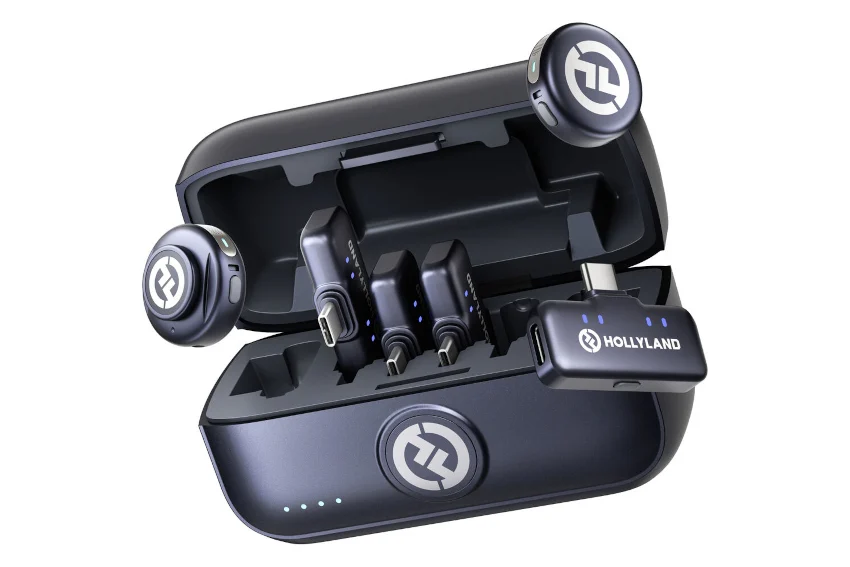
As modern video productions, podcasts, and digital storytelling grow increasingly complex—frequently featuring multi-speaker panel discussions, distributed interviewees, and multi-camera shoots—traditional wireless audio kits are facing new limitations. Standard fixed-configuration wireless microphone systems, typically bound to a strict one-transmitter-to-one-receiver pairing, often require costly duplication of hardware when production scopes expand.
Addressing this modern workflow bottleneck head-on, Hollyland has officially announced the LARK M3. Breaking away from the conventional mould, the LARK M3 introduces a highly scalable, multi-transmitter and multi-receiver architecture. By allowing flexible one-to-many and many-to-one configurations, the system is designed to adapt fluidly to the shifting demands of contemporary filmmakers, content creators, podcasters, and live-event crews.
Main Facts: The Core Architecture of the LARK M3
At its foundation, the Hollyland LARK M3 is engineered to dismantle the traditional boundaries of wireless audio routing. Rather than locking users into a rigid hardware ratio, the system allows cross-pairing flexibility across multiple devices.
Multi-Transmitter and Multi-Receiver Capabilities
- Many-to-One Configuration: Users can connect up to four independent transmitters to a single receiver. This makes it an ideal solution for roundtable podcasts, group interviews, and multi-person panels where every speaker requires a dedicated audio channel.
- One-to-Many Configuration: The architecture is entirely reversible. A single transmitter can beam its audio feed simultaneously to up to four distinct receivers. This setup is tailored for multi-camera shoots and hybrid productions where a single subject’s audio must feed multiple recording devices—such as primary cinema cameras, secondary mirrorless rigs, and backup smartphones—without requiring separate wireless kits for each recording device.
Hardware Configurations and SKUs
To accommodate diverse production scales, Hollyland offers the LARK M3 in seven different SKUs, including individual add-on components and comprehensive charging case kits. Notable combinations include:
- 4 Transmitters and 2 Receivers (4TX/2RX)
- 2 Transmitters and 4 Receivers (2TX/4RX)
- 2 Transmitters and 2 Receivers (2TX/2RX)
- 2 Transmitters and a single Receiver (2TX/1RX)
This modular approach ensures that solo content creators scaling up to small interview crews, or boutique production houses tackling complex corporate events, only invest in the exact hardware ratios they require.
Chronology and Evolution of Wireless Audio Scale
To understand the industry significance of the LARK M3, it helps to look at how location sound gear has evolved over the past decade.
- The Analog and Early Digital Era: For years, wireless audio was defined by bulky VHF and UHF analog systems. Expanding a setup meant coordinating multiple discrete frequency blocks, managing intermodulation distortion, and carrying heavy racks of stationary receivers.
- The Dual-Channel Boom (2020–2023): As compact 2.4GHz wireless microphone systems surged in popularity, manufacturers standardized the dual-channel kit (typically two transmitters and one receiver). While revolutionary for mobile journalism and two-person sit-down interviews, these systems hit a wall the moment a third speaker entered the frame or a second camera was added to the B-camera angles.
- The Networked Audio Era (Present Day): With the introduction of the LARK M3, the industry is shifting toward fluid audio "networks." Transmitters and receivers are no longer paired endpoints; instead, they act as interchangeable nodes that can be dynamically linked, unlinked, and rerouted depending on the immediate needs of the production day.
Supporting Data: Audio Specs, Processing, and Hardware Performance
Beyond its architectural flexibility, the LARK M3 packs high-end professional specifications and intelligent signal processing designed to survive demanding acoustic environments.
Audio Fidelity and Dynamic Range
- 32-Bit Float Audio: The system supports 48 kHz/32-bit float audio output alongside standard 48 kHz/24-bit recording. The implementation of 32-bit float provides a massive dynamic safety net, virtually eliminating clipped audio caused by unexpected loud outbursts or sudden drops in dialogue volume, giving post-production engineers immense headroom.
- Acoustic Performance: Hollyland specs the system with an impressive 70 dB signal-to-noise ratio (SNR) and a maximum Sound Pressure Level (SPL) of 125 dB, ensuring clean, distortion-free capture even when miking loud vocalists or high-energy environments.
Intelligent Audio Processing Tools
Modern field recording rarely takes place in acoustically treated soundstages. To combat real-world challenges, the LARK M3 integrates several onboard computational tools:

- AI Noise Cancellation: Utilizing deep learning and computational auditory scene analysis, the system features a three-level adjustable noise reduction engine. It is specifically tuned to isolate human speech from ambient nuisances such as traffic rumble, high winds, HVAC hums, and running water.
- Vocal Presets and Fine-Tuning: Users can apply and customize distinct vocal profiles directly to individual transmitters, shaping the tonal character of a voice before it ever hits the editing timeline.
- Auto-Limit Clip Protection: This feature acts as an instantaneous safety valve, preventing unpredictable volume spikes from overwhelming the digital-to-analog conversion stages.
Range, Redundancy, and Power
- Wireless Reach: Under optimal, open, and unobstructed conditions, the LARK M3 delivers a stable transmission range of up to 300 meters (approx. 1,000 feet). An integrated RF interference-resistant circuit helps maintain signal integrity in congested urban centers, corporate offices, and bustling event spaces.
- Receiver Redundancy: When deploying multi-receiver setups, the system establishes a Primary and Secondary hierarchy. The Primary Receiver manages configuration parameters, while backup receivers monitor the stream. If the primary unit unexpectedly drops offline, secondary receivers can automatically assume control, mitigating single points of failure during critical live-to-tape shoots.
- Form Factor and Battery Life: Each transmitter weighs an ultra-light 9 grams and utilizes a low-profile magnetic mounting system for discreet wardrobe placement. Individual transmitters deliver up to 8 hours of continuous operation. When utilizing multi-device charging case configurations—such as alternating transmitters in a 2TX/2RX setup—total operational runway can extend up to an impressive 48 hours.
Official Responses and Post-Production Implications
A major pain point in multi-speaker productions has always been the mixing bottleneck in post-production. When multiple microphones are summed down to a single stereo track live on set, dialogue editors lose the ability to independently process, EQ, or adjust the volume of individual speakers later.
The LARK M3 solves this by supporting up to four independent audio tracks.
When connected via a compatible Hot Shoe Adapter configuration, or when the USB-C / Camera Receiver is interfaced with a computer via USB-C using third-party multi-track recording software, the system outputs completely isolated channels for each transmitter.
Hollyland’s engineering philosophy behind this feature is simple: give field recordists the flexibility of a multi-mic cart system in a package small enough to fit in a jacket pocket. For post-production teams cutting documentaries, corporate panels, talk shows, and serialized podcasts, having discrete tracks for every participant dramatically simplifies dialogue cleanup, noise gate application, and volume balancing.
Implications for the Creator Economy and Professional Crews
The release of the Hollyland LARK M3 marks a significant milestone for several distinct segments of the media production landscape:
- Documentary and Run-and-Gun Filmmakers: The ability to route a single talent’s mic to multiple camera bodies simultaneously eliminates the tedious process of wireless audio splitting or relying on scratch audio tracks that require manual timecode syncing later.
- Corporate Event and Live-Streaming Crews: The system’s Primary/Secondary receiver redundancy offers peace of mind during unrepeatable live events, ensuring that a failing receiver port doesn’t ruin the entire broadcast feed.
- Podcasters and Content Creators: Scaling from a solo show to a four-person roundtable no longer necessitates buying an entirely new audio ecosystem. Creators can simply add extra transmitters or receivers to their existing LARK M3 kit.
Conclusion
By shifting the paradigm from rigid hardware packages to a scalable audio network, Hollyland has positioned the LARK M3 as a forward-thinking solution for modern content creators. Combining 32-bit float recording, AI-driven noise suppression, robust 300-meter transmission ranges, and true four-track multi-channel output, the LARK M3 proves that professional, broadcast-grade audio reliability no longer requires cumbersome, complex infrastructure.
For production teams looking to future-proof their audio gear against increasingly complex multi-camera and multi-speaker demands, the Hollyland LARK M3 offers a compelling, highly adaptable pathway forward.
