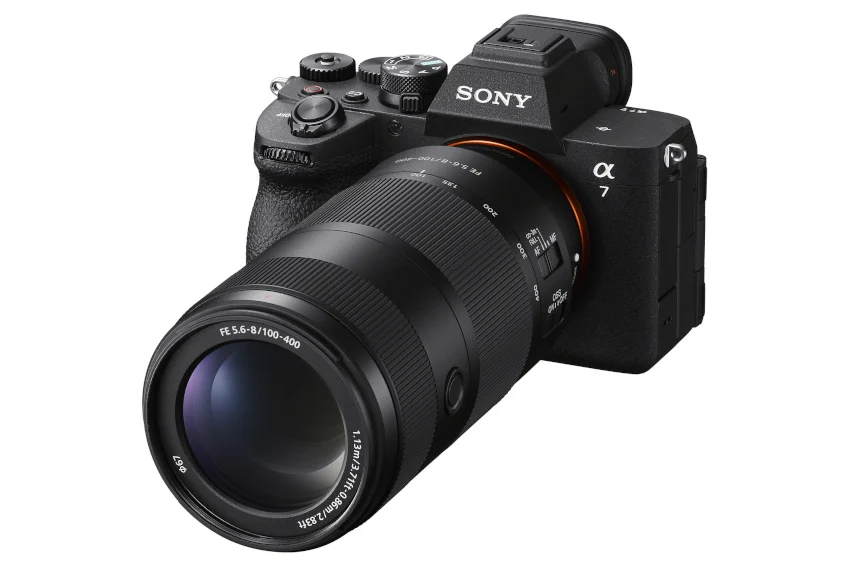
Sony Rewrites the Rules of Telephoto Portability: The New FE 100-400mm F5.6-8 OSS Breaks the Weight Barrier
For decades, photographers and videographers venturing into the realms of wildlife, sports, and documentary production have accepted an unyielding law of optical physics: long reach equals heavy glass. Achieving a maximum focal length of 400mm or beyond typically required hauling cumbersome, heavy-duty barrels that strained shoulders, required bulky tripods, and left creators exhausted after a single afternoon in the field.
Sony is challenging this longstanding compromise with the introduction of the FE 100-400mm F5.6-8 OSS. By rethinking what a full-frame super-telephoto zoom needs to be, Sony has engineered a highly portable lens that tips the scales at a mere 23.1 ounces (approximately 654 grams). Designed specifically for Sony’s E-mount ecosystem, this optic targets creators who demand substantial focal reach but refuse to be weighed down by traditional, professional-grade bulk.
Main Facts: The Anatomy of a Lightweight Telephoto
At its core, the Sony FE 100-400mm F5.6-8 OSS is a study in calculated engineering tradeoffs. Rather than chasing the constant, bright apertures that define high-end cinema and professional sports lenses, Sony built this optic around mobility, everyday carry, and field efficiency.
Focal Length Range: 100mm to 400mm, delivering tremendous framing versatility on full-frame E-mount bodies.
Maximum Aperture: Variable f/5.6 at the wide end, stepping down to f/8 at the 400mm telephoto extreme.
Weight: Approximately 654 grams (23.1 oz), making it radically lighter than traditional alternatives.
Autofocus System: Driven by dual linear motors capable of high-speed tracking, fully compatible with high-frame-rate bodies like the Sony Alpha 9 III up to 120 fps.
Optical Construction: Features two extra-low dispersion (ED) elements to suppress chromatic aberration and two aspherical elements to control distortion.
Stabilization & Weather Sealing: Built-in Optical SteadyShot (OSS) image stabilization paired with a dust- and moisture-resistant chassis.
Teleconverter Compatibility: Fully supports Sony’s 1.4x and 2.0x teleconverters, expanding the reach to 140–560mm and 200–800mm, respectively.
Chronology and Development: The Evolution of Sony’s Telephoto Philosophy
To understand the significance of the FE 100-400mm F5.6-8 OSS, it is helpful to look at how Sony’s telephoto lineup has evolved to meet diverse creator demands.
The Heavyweight Pioneer: The G Master Era
Years prior, Sony established its high-performance telephoto standard with the release of the FE 100-400mm f/4.5-5.6 GM OSS (and subsequent professional equivalents). Weighing in at roughly 1,840 grams (nearly 4.1 pounds), the G Master lens was built for uncompromising optical performance, featuring a faster constant/semi-constant aperture profile designed for low-light sports stadiums and professional photojournalism. While revered for its sharpness, it remained a piece of gear that required dedicated backpacks, monopods, and physical endurance.
Shifting Demands in Content Creation
As hybrid shooting—combining high-resolution stills with 4K and 8K video—became the norm, the demographics of telephoto users shifted. Wildlife enthusiasts hiking deep into nature reserves, travel vloggers exploring remote landscapes, and outdoor sports shooters covering youth or amateur events began expressing a desire for lightweight alternatives. They did not necessarily need an f/4.5 aperture that demanded massive glass elements; instead, they needed a lens they could comfortably carry around their neck or in a small daypack for eight hours straight.
The Conception of the F5.6-8 Architecture
Sony’s engineers tackled this challenge by leaning into modern sensor advancements. With modern mirrorless cameras offering astonishingly clean high-ISO performance and advanced AI-driven noise reduction software, the penalty for shooting at f/8 has shrunk dramatically. Recognizing this, Sony developed the FE 100-400mm F5.6-8 OSS—a lens engineered from the ground up to strip away excess weight without sacrificing the essential building blocks of focal versatility, autofocus speed, and weather resistance.
Supporting Data: Comparative Metrics and Performance Specifications
When evaluating the new optic, the numbers tell a compelling story of miniaturization versus performance.
Weight and Form Factor Comparison
The most striking metric is the sheer reduction in mass.
Lens Model
Weight
Maximum Aperture
Target Audience
Sony FE 100-400mm F4.5-5.6 GM OSS
~1,840 g (4.06 lbs)
f/4.5–5.6 (Constant-ish G Master)
Professional sports, photojournalists, low-light specialists
Sony FE 100-400mm F5.6-8 OSS
~654 g (1.44 lbs)
f/5.6–8 (Variable)
Travel, hiking wildlife shooters, mobile content creators
By shedding nearly 1,200 grams, the new F5.6-8 model transforms a multi-item camera kit into a lightweight, highly mobile package. A photographer can now slip a 400mm telephoto zoom into a bag alongside standard primes or mid-range zooms without breaking weight limits for airline travel or backcountry hikes.
Optical Design and Sharpness Control
Despite its lightweight footprint, Sony did not cut corners on glass quality. The inclusion of two extra-low dispersion (ED) elements ensures that purple fringing and chromatic aberrations are kept to an absolute minimum, even when shooting high-contrast subjects like birds against bright sky backgrounds. Furthermore, two aspherical elements counteract spherical aberrations and distortion, ensuring edge-to-edge sharpness across the entire zoom range from 100mm to 400mm.
Autofocus and Frame Rate Synergies
A slower aperture often raises concerns about autofocus tracking performance, but Sony has bypassed this limitation by equipping the lens with two dedicated linear motors. These motors deliver fast, near-silent, and precise focus acquisition.
Crucially, the lens is fully certified to work with Sony’s high-speed flagship bodies, such as the Sony Alpha 9 III, supporting continuous autofocus and auto-exposure (AF/AE) tracking at up to 120 frames per second. For sports and wildlife creators, this means zero compromise on speed, even if the maximum light intake is reduced compared to G Master alternatives.
Extending Reach with Teleconverters
The lens’s versatility is further multiplied through its native compatibility with Sony’s 1.4x and 2.0x teleconverters:
With the 1.4x Teleconverter: The focal range shifts to 140–560mm, pushing deep into wildlife territory while retaining manageable handling.
With the 2.0x Teleconverter: The lens transforms into a 200–800mm super-telephoto zoom.
While attaching teleconverters results in an even narrower maximum aperture (reaching f/16 at the long end of the 2.0x configuration), the option to scale a lightweight lens up to an 800mm reach provides unprecedented flexibility for field shooters who refuse to carry dedicated, heavy-duty super-telephoto prime lenses.
Official Responses and Industry Context
Industry reception to the announcement has highlighted a broader trend within the mirrorless camera market: the democratization of extreme focal lengths through weight reduction.
In official statements accompanying the release, Sony emphasized that the FE 100-400mm F5.6-8 OSS was designed to address direct feedback from everyday photographers and videographers. Rather than positioning the lens as a replacement for their high-end G Master lineup, Sony frames it as an alternative philosophy—one that prioritizes endurance and accessibility.
"Our goal with the FE 100-400mm F5.6-8 OSS was to eliminate the physical barrier that prevents creators from bringing long reach on their daily adventures," notes product development feedback from Sony. "By leveraging advanced sensor technology and high-efficiency optical layouts, we have created a lens that proves you no longer need to sacrifice your physical comfort to capture distant subjects with precision."
Retailers and industry analysts have echoed this sentiment, pointing out that many hobbyists, semi-professional nature lovers, and travel journalists are often discouraged by the sheer physical weight of traditional professional kits. This lens directly targets that demographic, filling the gap between consumer-grade variable telephoto zooms (such as 70-300mm lenses) and exorbitantly expensive, heavy professional glass.
Implications: What This Means for Photographers, Filmmakers, and the Market
The release of the Sony FE 100-400mm F5.6-8 OSS carries several significant implications for the photography and videography communities.
1. The Redefinition of "Field-Ready" Wildlife and Sports Gear
For amateur and enthusiast wildlife photographers, the combination of a 654g weight tag and 400mm reach changes how expeditions are planned. Navigating rugged terrain, climbing steep hiking trails, or waiting hours in a blind becomes substantially less fatiguing. Creators no longer need to anchor themselves to a heavy tripod; handheld shooting becomes genuinely sustainable over long periods, aided by the lens’s built-in Optical SteadyShot stabilization.
2. A New Option for Mobile Filmmaking and Documentarians
Videographers working in documentary, outdoor, and travel genres often operate as one-person crews. Carrying heavy cinema-grade telephoto zooms is frequently prohibitive. The FE 100-400mm F5.6-8 OSS offers documentary filmmakers a way to capture distant action, candid wildlife behavior, or sweeping landscape details from afar without destabilizing a lightweight gimbal or mobile rig. However, creators must account for the f/8 maximum aperture at the telephoto end, making the lens best suited for well-exterior daylight environments rather than dim interior or night shoots.
3. A Shift in Lens Design Philosophy Across the Industry
Sony’s willingness to embrace a slower maximum aperture in exchange for dramatic weight savings signals a maturing market. As mirrorless sensors become more capable of handling higher ISO sensitivities with minimal noise penalty, lens manufacturers have greater freedom to design optics around ergonomics and portability rather than chasing numerical aperture specs that many users may not strictly require for daylight shooting.
Final Thoughts
The Sony FE 100-400mm F5.6-8 OSS is not designed for everyone. Studio photographers, indoor sports shooters working under harsh arena lights, and professionals who demand razor-thin depth of field will still gravitate toward faster G Master options like the 100-400mm f/4.5-5.6 GM OSS or dedicated fast primes.
However, for the vast majority of outdoor creators, hikers, travelers, and field enthusiasts, this lens represents a liberating breakthrough. By trading a few stops of light for an ultralight, highly mobile, and sharp optical package, Sony has made 400mm reach—and up to 800mm with teleconverters—more accessible, portable, and practical than ever before.