
Festival Buzz: Jacqueline Lentzou’s Transcendent Feature Debuts at the 2026 New York Film Festival
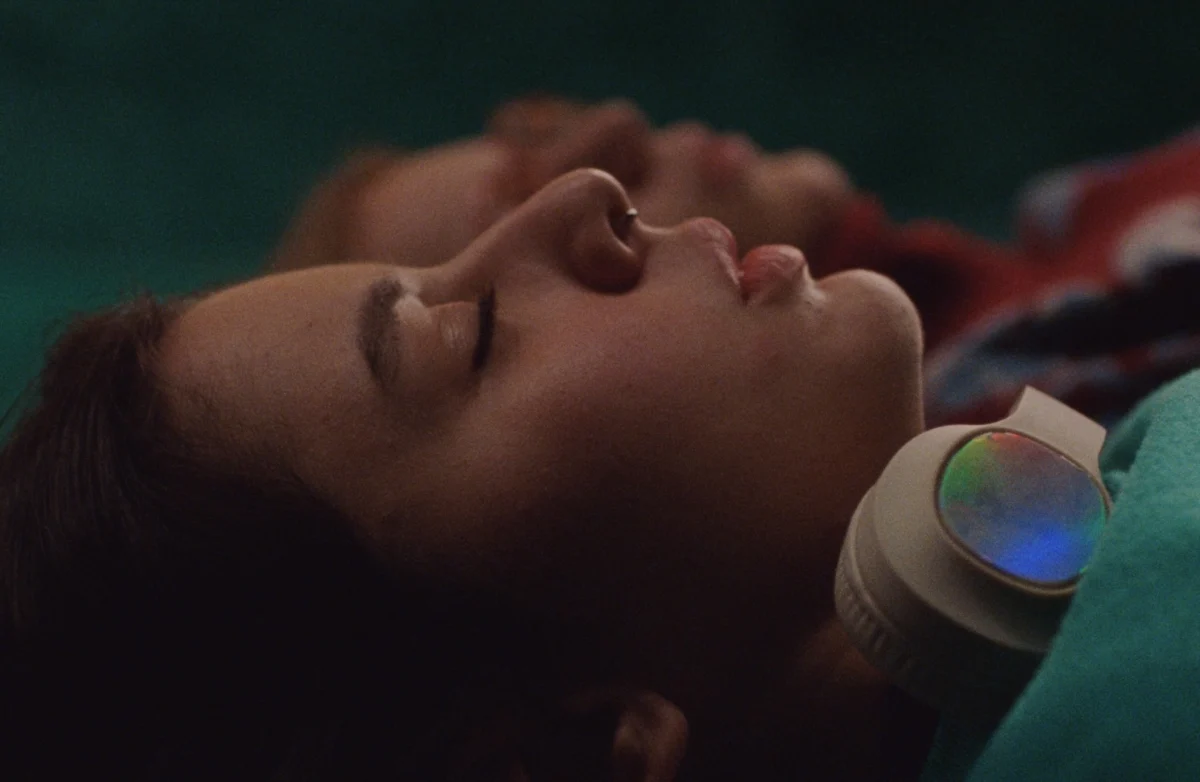
NEW YORK — The 2026 New York Film Festival served as the premiere stage for one of the most structurally inventive and emotionally resonant cinematic offerings of the year: A Day in the Life of Jo: Chapter Phaedra. Directed by Greek auteur Jacqueline Lentzou—following her acclaimed 2021 feature Moon, 66 Questions—the film immediately establishes itself as a masterclass in atmospheric storytelling. Distributed theatrically by 1–2 Special in 2027, the 82-minute feature has already sparked critical acclaim for its daring defiance of traditional coming-of-age tropes, opting instead for an ethereal exploration of memory, mortality, and the liminal spaces of human consciousness.
The film opens not with dialogue or exposition, but with a visceral auditory and visual cue. A teenage girl lies supine in a grassy field, her hand resting on her belly. Her breathing fills the sound design so intensely that the cinematic medium itself feels linked to her lungs. As she drifts to sleep, disembodied voices—internal consciousness or an external cosmic force—debate the imagery to project onto the back of her eyelids: wind chimes, a Colorado Avalanche hat featuring anomalous wings, and a bullet casing. The voices ultimately accept the ominous final symbol, noting with chilling detachment that the girl won’t understand its meaning just yet.
Chronology of a Liminal Day: Following Jo Through an Unfolding Mystery
The narrative tracks a seemingly ordinary day in the life of Jo (played with naturalistic depth by Evita Andriopoulou), a teenager navigating the monotonous rhythms of a generic suburb in Athens. Yet, from its opening sequence, time and space behave with fluid unpredictability.

- Morning: A drifting, God’s-eye-view tracking shot captures Jo missing her neighborhood bus. When her mother, Eleni (Eleni Vergeti), a frustrated local dance instructor, refuses to drive her into town, Jo unleashes an unexpected burst of physical aggression against the family car.
- Midday: At school, hormonal turbulence and social rituals dominate. Students sneak kisses in stairwells, mock simple art assignments involving punctured construction paper, and endure the public humiliation of vocal performances in music class. It is here that Jo encounters Phaedra (Anastasia Gouliamou), a shy classmate wrapped in a chunky floral knit sweater. An ancient ballad sung by Phaedra evokes an inexplicable wave of tears in Jo.
- Afternoon: Bonding over their shared status as fatherless daughters, Jo and Phaedra discuss breathing techniques and make plans to attend a movie together later that evening.
- Night: Jo ultimately ghosts Phaedra. Though the narrative pivot echoes a tragic, real-life incident from Lentzou’s own youth in Athens—an event well-documented in the director’s interviews—the film treats the ultimate fate of its characters not as a conventional plot twist, but as an existential inevitability.
Throughout this timeline, Lentzou employs striking visual motifs that undermine standard chronology. A square reflection of a fluorescent light against a window mimics a rectangular moon hanging in a clear blue sky, signaling early on that reality is prone to fracturing. In a breathtaking stylistic transition, a simple camera movement seamlessly transforms the hardwood floor of Eleni’s dance studio into Jo’s high-school basketball court.
Supporting Data and Production Craft
Clocking in at a brisk 82 minutes, A Day in the Life of Jo: Chapter Phaedra derives its unique texture from a powerhouse below-the-line creative team.
- Cinematography: Grimm Vandekerckhove shoots on 16mm film, utilizing an emulsified crackle that evokes a searching, tactile quality. The camera consistently hunts for the invisible forces—such as breath, hands, and isolation—that anchor human existence.
- Thematic Sub Director Jacqueline Lentzou uses the film’s sprawling opening credits to append a secondary sub A Film About Breath, Hands, and Loneliness (and the Lack of Them All).
- Cinematic Lineage: Rather than adhering to the survivalist struggles typical of classic teen dramas like The Breakfast Club or Lady Bird, Lentzou’s work aligns closer to the existential unease of Gus Van Sant’s Death Trilogy. It also shares a curious cosmic serendipity with Sandra Wollner’s feature Everytime, exploring parallel anxieties regarding the ephemerality of being.
Official Statements and Artistic Intent
Jacqueline Lentzou has been remarkably transparent regarding the deeply personal roots of A Day in the Life of Jo. Informed by a traumatic event she experienced as a teenager in Athens, the director has consistently pushed back against viewing the film as a traditional tragedy or a simplistic portrait of adolescence.

"Adolescence is not a crucible; it is a transitory state of being," production notes and festival press packets indicate. It is designed as a vulnerable in-between phase where individuals simultaneously narrow their identities down to a singular ego while being exposed to the vast infinity of the universe.
Critics and festival programmers have similarly praised the film’s philosophical underpinnings. One of the film’s most striking philosophical lines summarizes its core conceit: "The architecture of forgetting is the most precise. You remember nothing, yet are remembered forever." This meditation on the spectral essence of mutability asks a haunting question posed by a jaded character within the film regarding local disappearances: "Have you ever heard of anyone being found after they go missing?" Lentzou’s camera suggests that cinema itself possesses the power to track down those who vanish, preserving them in the amber of the screen.
Implications for Contemporary Independent Cinema
The arrival of A Day in the Life of Jo: Chapter Phaedra marks a significant milestone for European arthouse cinema and independent distribution. By bypassing standard narrative constraints in favor of a lyrical, poem-like cadence—comparable to the lyrical inventiveness of Björk music videos—Lentzou challenges the modern audience’s consumption of youth narratives.

Furthermore, the film’s thematic obsession with where characters go when they are not being actively watched on screen expands the meta-textual boundaries of film theory. As 1–2 Special prepares the film for its commercial theatrical rollout in 2027, industry analysts predict that Chapter Phaedra will serve as a touchstone for how modern directors can address grief and memory without relying on exposition or melodrama.
Ultimately, Lentzou’s latest feature operates as an elusive prayer. It celebrates the boundless nature of cinema while tenderly lamenting how frequently both art and life fail to achieve the infinite potential they rightfully deserve.
