
Finding Sanctuary Amid the Ruins: Lukas Dhont Returns with the Cannes-Acclaimed WWI Romance Coward
Main Facts
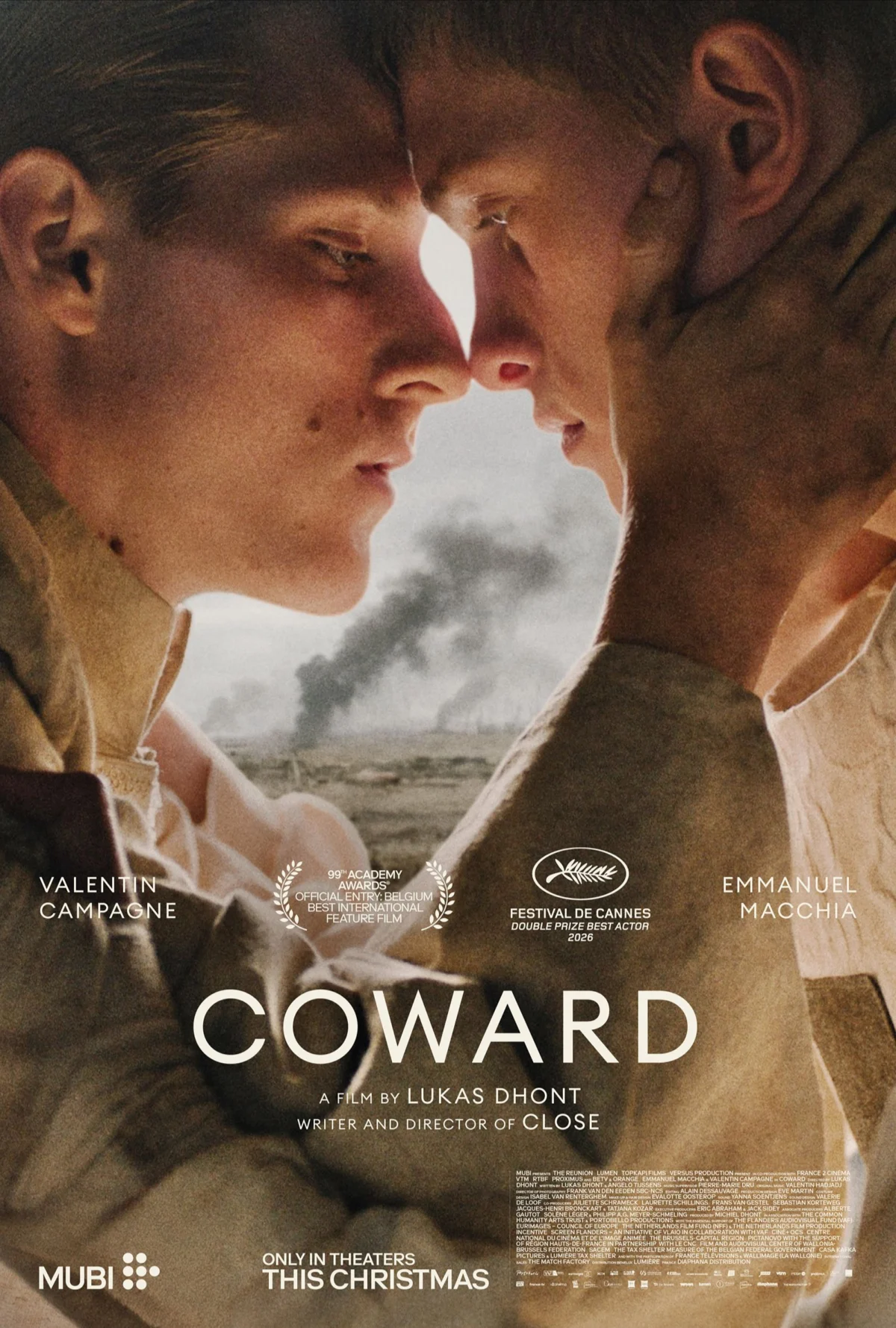
Following a triumphant world premiere in the main competition at the Cannes Film Festival—where breakout stars Emmanuel Macchia and Valentin Campagne shared the prestigious Best Actor prize—director Lukas Dhont’s highly anticipated third feature film, Coward, has been officially selected as Belgium’s submission for the Academy Award for Best International Feature Film.
Global distributor MUBI has acquired the rights to the film and has scheduled a theatrical release beginning December 25, offering audiences a poignant holiday counter-programming option. To build anticipation for its cinematic rollout, MUBI has unveiled the official trailer and theatrical poster, offering a first look into the visceral yet tender world Dhont has constructed.
Moving away from the contemporary domestic settings of his previous critically acclaimed works, Girl (2018) and Close (2022), Dhont shifts his narrative lens to the brutal, mud-soaked trenches of World War I. Coward follows Pierre (Emmanuel Macchia), an idealistic young soldier who arrives at the front lines eager to prove himself in a reality completely consumed by mechanized violence. His worldview undergoes a profound transformation when he encounters Francis (Campagne), a kindred spirit whose ambitious plan to stage a front-line theatre production introduces Pierre to dimensions of humanity and beauty he never knew existed.
What begins as a fleeting, imaginative escape from the daily horrors of trench warfare gradually blossoms into a deeply emotional and tender love story. Anchored by the undeniable, crackling chemistry of its two lead actors, the film examines how art and intimacy can carve out a sanctuary of innocence, devotion, and profound emotional truth while the world burns around them.
Chronology of Production and Reception
The journey of Coward from conception to global acclaim reflects the careful, deliberate craftsmanship characteristic of Lukas Dhont’s career.
- Pre-Production and Development: Following the international breakout success of Close, which earned an Academy Award nomination for Best International Feature Film and won the Grand Prix at the 2022 Cannes Film Festival, expectations for Dhont’s follow-up were exceptionally high. Choosing to pivot away from modern adolescence into historical drama, Dhont spent significant time researching the psychological impacts of World War I, specifically focusing on the experiences of soldiers within the Belgian army stationed along the French front.
- Principal Photography: Filming took place under rigorous physical conditions designed to replicate the unforgiving environments of early 20th-century warfare. Dhont worked closely with his creative team to balance the grim, sensory terror of the trenches with the vibrant, theatrical escapism brought into the narrative by the characters of Pierre and Francis.
- Cannes Film Festival World Premiere: Coward made its global debut in competition at the 2025 Cannes Film Festival. The screening drew widespread critical attention, establishing the film as a major player in the festival’s awards race. The joint Best Actor win for Emmanuel Macchia and Valentin Campagne marked a historic highlight for the festival, cementing the young actors as major talents to watch.
- Oscar Selection: Shortly after its festival run concluded, the Royal Association of professional film organizations in Belgium announced that Coward had been chosen as the country’s official entry for the 98th Academy Awards, positioning it as a strong contender in the international race.
- Distribution and Marketing Rollout: In late October 2025, MUBI released the official trailer and poster for Coward, setting the stage for its upcoming December 25 theatrical release.
Supporting Data and Critical Analysis
To fully understand the artistic weight of Coward, critics have looked closely at how the film subverts traditional war cinema tropes. Savina Petkova, writing in her review for The Film Stage out of Cannes, noted the historical weight of the genre:
"Cinema has taken viewers to the trenches of World War I so often that audiences might as well have formed sensory memories of a throat-clenching terror, the screams drowned by a sudden explosion and ears ringing. It’s all artificial, of course, but film’s empathy machine is perfectly suited for such participatory experiences from the safety of our seats. Yet war, like love, has too many faces and facets to ever be extensively represented."
Petkova highlighted how Dhont utilizes this heavily trodden cinematic landscape not for mere battle choreography, but as a contrasting canvas for an intimate love story. Furthermore, the title itself serves as a psychological anchor for the narrative. As Petkova observed:
“Coward is one of those provocative titles called into question by everyone but the film’s protagonist. In the Belgian army (on the French side), Pierre (Emmanuel Macchia) and his mates take pleasure in naming others cowards, be it enemies or deserters, summarizing a hero/weakling binary from the get-go.”
By examining the rigid definitions of bravery and cowardice imposed by military structures, Dhont forces the audience to re-evaluate what true courage looks like in a time of systemic destruction. For Pierre, abandoning the cold detachment required by the military in favor of deep emotional devotion to Francis is framed not as an act of treason or cowardice, but as the ultimate form of resistance.

Official Responses and Creative Vision
Lukas Dhont has consistently spoken about his desire to explore the nuances of human vulnerability, relationships, and societal expectations. In early statements regarding Coward, the director explained that transitioning to a historical period piece allowed him to examine timeless themes of love and identity through a different lens.
"War strips away the unnecessary noise of modern civilization, forcing individuals to confront the absolute fragility of existence," Dhont noted during discussions surrounding the film’s premiere. "In that extreme environment, the discovery of another human being—the choice to love deeply despite the constant threat of annihilation—becomes the most radical act possible."
The casting of Emmanuel Macchia and Valentin Campagne was a deliberate gamble that ultimately paid massive dividends. Neither actor entered the production with the heavy global recognition of established stars, allowing audiences to meet Pierre and Francis with fresh eyes. Their intense chemistry, recognized unanimously by the Cannes jury, forms the emotional bedrock of the film.
Producers and studio representatives at MUBI have similarly expressed immense enthusiasm for the project. In a joint statement regarding the holiday release strategy, MUBI executives emphasized that Coward offers a transcendent cinematic experience that combines epic historical scale with deeply moving, personal storytelling.
Implications for Cinema and Awards Season
The release of Coward carries significant implications for the contemporary film landscape, particularly regarding the evolution of LGBTQ+ historical cinema and the ongoing career trajectory of Lukas Dhont.
1. Redefining War Cinema
For decades, war films have predominantly focused on camaraderie, sacrifice for the nation, and physical valor on the battlefield. Coward shifts the paradigm by centering queer intimacy not as a tragic subtext or a fleeting subplot, but as the emotional core of the narrative. By framing the creation of an underground, front-line theatre production as an act of emotional salvation, Dhont expands the vocabulary of what war movies can achieve, proving that tenderness can be just as cinematic as explosions.
2. The International Breakthrough of Macchia and Campagne
Winning the Best Actor prize at Cannes as debutants places Emmanuel Macchia and Valentin Campagne in an elite tier of rising international stars. The industry will be watching closely to see how this career-launching recognition shapes their subsequent film choices. Their performances are already being discussed as potential benchmarks for future awards consideration as the Oscar race heats up.
3. Belgium’s Oscar Prospects
As Belgium’s official submission for the Academy Awards, Coward enters the international race with powerful momentum. The Academy has historically favored films that balance high artistic merit with emotionally resonant human struggles against historical backdrops. Given Dhont’s existing relationship with Academy voters following the success of Close, Coward is well-positioned to make a significant impact on the shortlist and potentially secure a nomination.
As audiences prepare to witness the emotional journey of Pierre and Francis on December 25, Coward stands poised to leave a lasting mark on both the cinematic treatment of World War I and the hearts of viewers worldwide.
