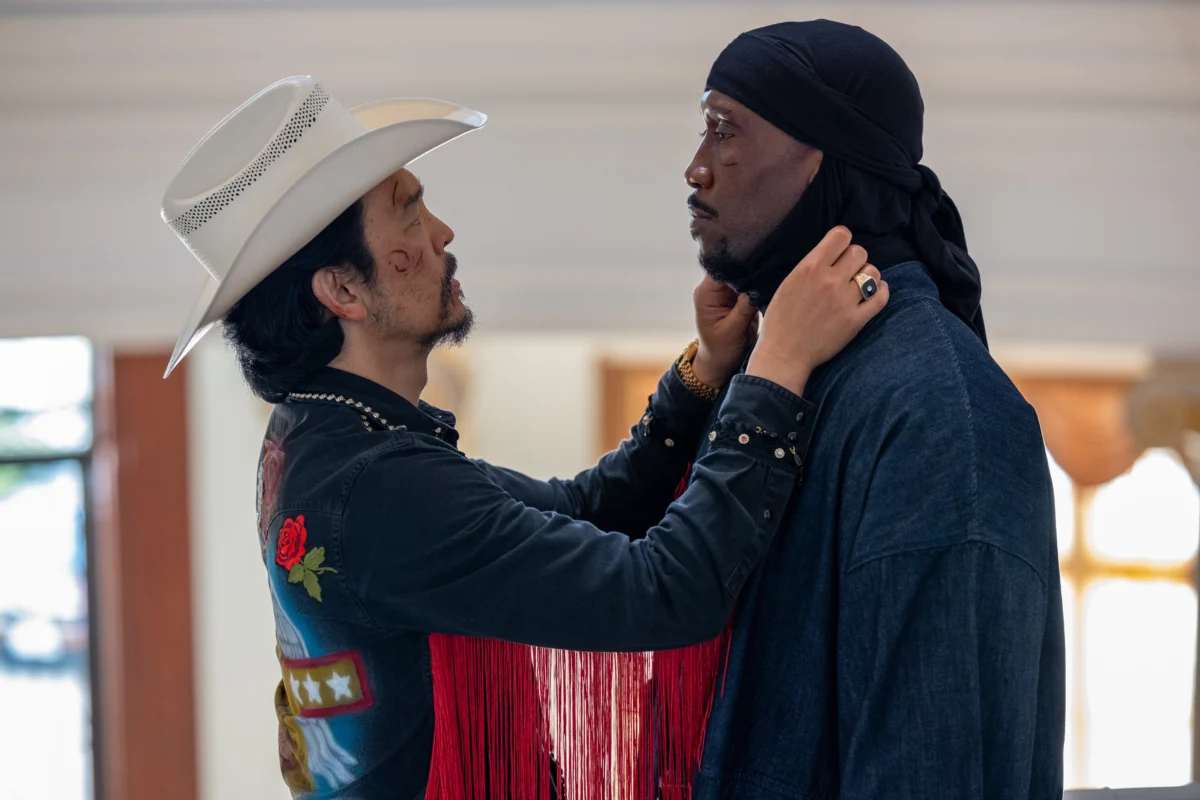
Threads of Conflict and Culture: Deirdra Elizabeth Govan’s Costume Design for Bassam Tariq’s Your Mother Your Mother Your Mother
Main Facts
In the cinematic landscape of contemporary American film, few projects shatter traditional molds quite as decisively as writer-director BassamTariq’s Your Mother Your Mother Your Mother. Released by Orion and distributed theatrically, the film has quickly garnered critical acclaim for its daring tonal balance and its rare, grounded exploration of a practicing Black Muslim family navigating life in Houston, Texas. At the center of this narrative is Latif, portrayed with nuanced gravity by Academy Award winner Mahershala Ali. Latif embodies a profound paradox: he is a devout family man and father, yet he also operates as a contract killer. His strict adherence to his faith stands in violent, irreconcilable opposition to his professional trade.
Bringing this intricate world to visual life required an equally complex design philosophy. Costume designer DeirdraElizabethGovan—a native Houstonian—was tasked with translating Latif’s internal and external contradictions through fabric, silhouette, and texture. Eschewing monolithic tropes, Govan heavily researched the rich intersection of Black Muslim identity, contemporary Southern lifestyle, and historic warrior aesthetics. Her work extends beyond Latif, shaping the ideological antagonist Pastor Hwan (John Cho)—an evangelical cult leader commanding a heavily armed militia—and Latif’s sharp, fiercely independent teenage daughter, Fatiha (Adia). Through rigorous research, cross-departmental collaboration, and rapid-fire execution, Govan’s costume design became an essential narrative engine for a film that refuses easy categorization.
The journey of outfitting Your Mother Your Mother Your Mother was defined by intense preparation, deep cultural immersion, and, at times, breakneck timelines.
Pre-Production & Research Phase: Deirdra Elizabeth Govan began her work by leaning into her own roots growing up in Houston, allowing her to appreciate the city’s vast multicultural tapestry. She synthesized diverse historical and global influences, drawing upon Tuareg aesthetics (notably indigo colorways), Baye Fall African warrior traditions, and the utilitarian minimalism of Japanese samurai apparel.
The Fittings: Due to the rigorous constraints of modern indie-to-studio filmmaking schedules, Govan was limited to a single fitting with each of her lead actors. Despite this constraint, her meticulous preparation ensured that the transformations were instantaneous. For John Cho, stepping into the fitting room wearing the fully realized western militia garb—complete with a subversively subtle cowboy hat, customized denim, and black ostrich boots—cemented his physical transition into Pastor Hwan.
The 72-Hour Emergency Turnaround: One of the most demanding logistical hurdles occurred late in the production cycle. On a Friday evening, Govan received a late note from the creative team requesting a portrait of a mother airbrushed onto the back of Pastor Hwan’s shirt, with a firm camera-ready deadline of the following Monday morning. Needing six identical multiples, Govan scrambled to source an airbrush artist over the weekend. Simultaneously, her team applied hand-painted details, fringe, and metallic studs to the placket and collar, successfully delivering the finished garments within a grueling 72-hour window.
Principal Photography & Release: With the costumes seamlessly integrating into the production design and cinematography of the film, principal photography captured Houston’s diverse communities. Following its festival and critical rollout, the film landed in theaters courtesy of Orion, sparking conversations around its striking visual language.
Supporting Data & Design Breakdowns
Govan’s costume design operates as a psychological map for the film’s central trio. Every garment was engineered to reflect the character’s internal friction, generational perspective, and cultural positioning.
Latif (Mahershala Ali)
The Duality of Dress: Latif’s wardrobe balances the quiet restraint of a father with the tactical needs of a professional operative. Because the audience meets him as a killer before understanding his backstory, Govan avoided loud or self-announcing costumes.
Custom Thobe & Meditation Gear: For the funeral sequence, Govan designed a custom thobe blending a traditional tunic silhouette with micro-stripe shirting, a contrasting denim band collar, and matching cuffs. For his sword-meditation practice, she created loose blue-and-white shalwar trousers. His multicolored morning tunic was specifically tailored to project an air of unrequited optimism.
The Denim Kimono: In a key collaboration with Daisuke Muramatsu, owner of the brand Prospective Flow, Govan utilized pieces from his collection to craft a long denim kimono coat. Paired with a Tuareg-inspired tagelmust head wrap and an embossed leather belt holding his sword sheath, this hybrid garment successfully merges ancient warrior iconography with modern streetwear.
Pastor Hwan (John Cho)
The Texas Cult Leader Aesthetic: Researching real-life cult leaders and the visual language of American militias, Govan grounded Hwan’s look in Texas and Western iconography.
Key Elements: His assertive silhouette relies on a subtle cowboy hat, spurs, embellished denim featuring cross iconography, and the aforementioned rushed airbrushed mother-portrait shirt adorned with fringe and studs. He finishes the look in menacing fashion with black ostrich boots and an eye-catching cross-embossed belt buckle.
Fatiha (Adia)
Youthful Rebellion & Modesty: As a young woman forced to mature rapidly to care for her siblings, Fatiha’s style serves as a generational counterpoint to her father. Govan blended modest, modern teenage silhouettes with roomy streetwear, sports jerseys, track jackets, and sneakers.
Color Palette and Hijab Styling: Fatiha’s hijabs were tied in diverse, individualized ways to signify youthful autonomy and controlled rebellion. Her color palette relied on rich mustard yellows, muted greens, blues, and soft lavender hues.
Standout Moments: In a pivotal scene where Fatiha steals milk for her baby sister, she is visually defined by a vibrant hockey jersey worn over jeans with her hijab—a striking juxtaposition against the traditional attire of elders observed while she sits quietly inside a local mosque.
Official Responses and Creative Insights
The success of the film’s visual identity heavily stems from the close collaboration between costume designer Deirdra Elizabeth Govan, writer-director Bassam Tariq, and the broader department heads. Speaking on her approach to Muslim identity on screen, Govan emphasized the importance of avoiding monolithic stereotypes.
"This is a man who is battling his faith," Govan explained in her interview with IndieWire regarding Mahershala Ali’s character, Latif. "I wanted to be very mindful and respectful of Muslim identity, but not fall into a prescribed idea of what a Muslim is, because there is no such thing. But there is a construct of Black Muslim style and contemporary modern life, an unabashed way of dress that is vibrant, that is rich in texture, that is rich in color and swag."
Govan also stressed that character definition could not exist in a vacuum, crediting the film’s cohesive look to deep team synergy:
"I knew that the palette that I was establishing would sit within their world," Govan noted, highlighting her work alongside the production designer and cinematographer. "I didn’t want the characters to stand outside it, and I didn’t want them to announce themselves. Everything was about balance, and that can’t happen alone. No costume designer, no cinematographer, no production designer is an island unto themselves. We work together, and we had a great collaboration."
Implications for Modern Cinema and Visual Storytelling
The release and design reception of Your Mother Your Mother Your Mother carry significant implications for contemporary Hollywood filmmaking. For decades, depictions of Muslim communities on American movie screens have suffered from acute narrowness—often restricted to geopolitical thrillers or flat, assimilationist narratives. By centering a complex Black Muslim family rooted in the rich cultural ecosystem of Houston, Texas, Tariq and Govan’s work broadens the visual vocabulary available to filmmakers.
Furthermore, Govan’s approach dismantles the binary often found in genre cinema, where characters are neatly categorized as either pious or violent, good or evil. By embedding historical cross-cultural references—ranging from Tuareg indigo textiles and Baye Fall traditions to Japanese samurai silhouettes—into contemporary Texan streetwear and tailoring, the film validates the global and multi-layered influences that shape modern diasporic identities.
Ultimately, the wardrobe of Your Mother Your Mother Your Mother proves that costume design can transcend mere historical or regional accuracy to become a profound narrative instrument. As audiences continue to embrace stories that defy conventional genres, Govan’s meticulous, high-stakes craftsmanship sets a new benchmark for how cinematic style can visually articulate the deepest spiritual and personal conflicts of the human condition.