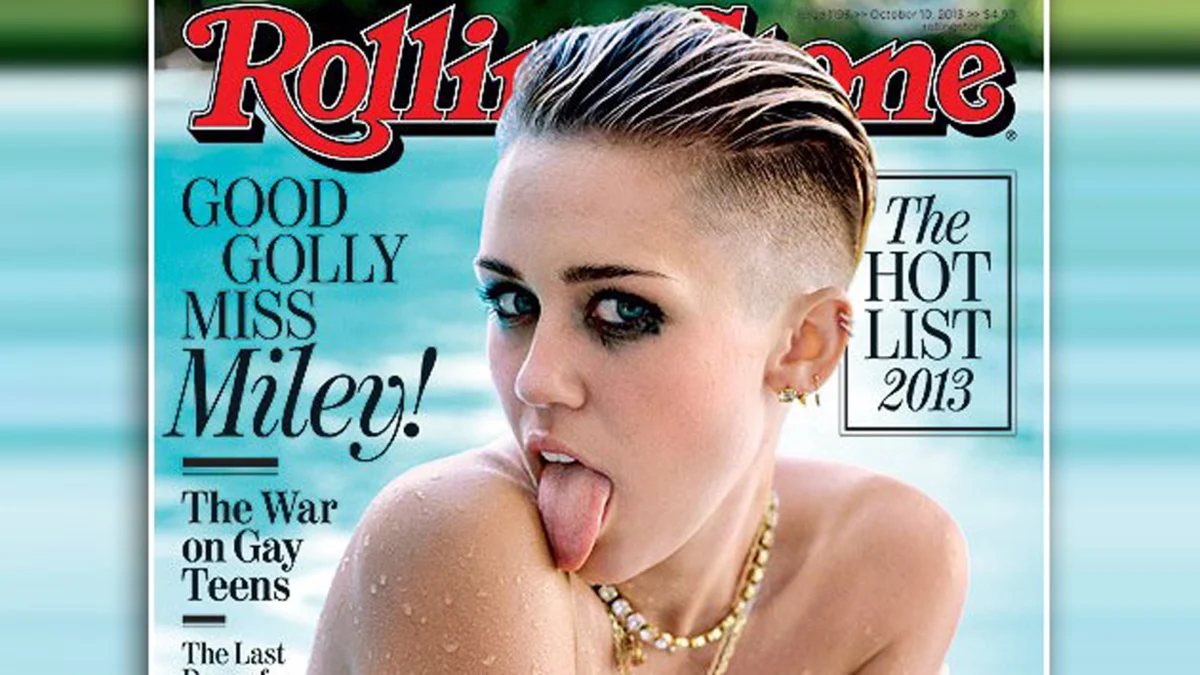
Breaking the Mold: Miley Cyrus Defends Her Infamous VMA Performance, Discusses Double Standards, and Finds an Unlikely Ally in Kanye West
Main Facts
In the wake of a relentless media storm surrounding her highly publicized and controversial performance at the 2013 MTV Video Music Awards, pop star MileyCyrus is finally setting the record straight. Appearing on the cover of Rolling Stone magazine, Cyrus addressed the intense scrutiny, social media backlash, and widespread debates sparked by her provocative routine alongside singer Robin Thicke.
Sporting a striking, topless look for the magazine’s cover shoot—this time keeping her tongue inside her mouth—Cyrus pulled back the curtain on the performance that dominated global headlines for weeks. Far from expressing regret over the spectacle, which featured her wearing a flesh-colored latex bikini, twerking, and using a giant foam finger, Cyrus maintained that the routine was relatively tame compared to what she and her creative team had originally envisioned.
Furthermore, the pop star confronted the gender-based doublestandards she believes fueled the outrage, pointing out that public criticism disproportionately targeted her body while ignoring her male collaborator’s active participation. She also addressed accusations of cultural appropriation regarding her use of black backup dancers, firmly rejecting the notion that they were mere props. Amid the firestorm of criticism, Cyrus revealed that she found unexpected validation and mentorship from hip-hop icon KanyeWest, who reached out to offer words of encouragement backstage after watching her rehearse.
Chronology: From Disney Darling to VMA Shockwaves
To fully understand the gravity of the Rolling Stone interview, one must trace the timeline of Miley Cyrus’s dramatic evolution and the seismic reaction to her VMA appearance.
The Disney Era (2006–2011): For millions of fans globally, Miley Cyrus was first introduced as the wholesome, squeaky-clean protagonist of the Disney Channel mega-hit Hannah Montana. During these formative years, Cyrus operated strictly within the boundaries of family-friendly entertainment, carefully curated by the media machine.
The Transition (2012–Early 2013): As Cyrus approached her twenties, she signaled a deliberate departure from her past. She chopped off her long brown hair, bleached it blonde, and adopted an edgy, hip-hop-influenced aesthetic. This period laid the groundwork for her musical shift toward a more urban, provocative sound.
August 25, 2013 — The MTV VMAs: Performing her single "We Can’t Stop" before transitioning into a collaboration with Robin Thicke on "Blurred Lines," Cyrus took the stage at the Barclays Center in Brooklyn, New York. Stripping down to a nude-colored two-piece outfit, she engaged in hyper-sexualized choreography, including aggressive twerking against Thicke. The performance instantly divided viewers and ignited a digital frenzy.
The Immediate Aftermath (Late August – September 2013): Within hours, the performance became the most-discussed topic across social media platforms, generating hundreds of thousands of tweets per minute. Traditional media outlets, cultural critics, and conservative parent groups launched a barrage of condemnation against the singer.
The Rolling Stone Revelation (September 2013): Seeking an unvarnished platform to respond to the chaos, Cyrus sat down for an extensive interview with Rolling Stone. It was here that she detailed her perspective on the VMAs, recounted the private encouragement she received from Kanye West, and declared that her iconic twerking era was likely a one-time event.
Supporting Data: The Anatomy of a Cultural Firestorm
The cultural shockwaves of Cyrus’s VMA performance can be measured not only by the column inches it generated but by the specific metrics of public discourse and artistic intent.
According to social media analytics firms, the 2013 VMAs shattered previous engagement records, with Cyrus’s performance acting as the primary catalyst. Twitter reported a peak of over 300,000 tweets per minute during the segment—surpassing major sporting events of that year. Yet, the quantitative spike in attention was met with starkly polarized qualitative feedback.
Cyrus argued in her Rolling Stone interview that critics fundamentally misunderstood the environment of the VMAs compared to other prestigious award shows.
"Honestly, that was our MTV version," Cyrus explained to the magazine. "We could have even gone further, but we didn’t. I thought that’s what the VMAs were all about! It’s not the Grammys or the Oscars. You’re not supposed to show up in a gown, Vanna White-style. It’s supposed to be fun!"
Despite her insistence that the performance was meant to be playful and boundary-pushing in the tradition of past MTV shocks—such as Madonna, Britney Spears, and Christina Aguilera’s 2003 kiss—the public response quickly moved past lighthearted entertainment into deep sociological debates concerning race, gender, and the policing of young women’s bodies in the public eye.
Official Responses and Critiques: Navigating the Double Standard and Cultural Accusations
The backlash against Cyrus was multifaceted, coming from feminist critics, cultural commentators, and pop culture observers alike. The criticisms generally fell into three distinct categories: hyper-sexualization, double standards regarding gender, and cultural appropriation.
Confronting the Gender Double Standard
Cyrus directly targeted what she perceived as a glaring hypocrisy in how the media and public assigned blame for the performance. While headlines overwhelmingly focused on her physical movements, very little analytical weight was given to her co-performer, Robin Thicke.
"No one is talking about the man behind the ass," Cyrus noted. "It was a lot of ‘Miley twerks on Robin Thicke,’ but never, ‘Robin Thicke grinds up on Miley.’ They’re only talking about the one that bent over. So obviously there’s a double standard."
This observation struck a chord with gender studies scholars and cultural critics, many of whom noted a historical precedent in the entertainment industry where female performers bear the brunt of moral panic while male collaborators escape unscathed.
Addressing Accusations of Cultural Appropriation
Perhaps the most serious critique leveled against Cyrus involved her use of black dancers and the incorporation of twerking—a dance style with deep roots in Black and bounce music communities—into her pop routine. Critics accused her of using minority dancers as exotic props to manufacture a "gritty" persona while shedding her wholesome Disney image.
Cyrus firmly rejected this interpretation, emphasizing deep personal and professional bonds with her touring crew and creative collaborators:
"I don’t keep my producers or dancers around ’cause it makes me look cool," she asserted. "Those aren’t my ‘accessories.’ They’re my homies."
While her defense satisfied her inner circle and many fans, the debate surrounding cultural appropriation, power dynamics, and the commodification of urban dance forms by white pop stars remained a central talking point in the cultural dialogue following the interview.
Interestingly, Cyrus also offered a pragmatic, albeit humorous, perspective on the longevity of her new signature move, noting that despite the media obsession, she would "probably never do that shit again."
Implications: Kanye West’s Mentorship and the Evolution of Pop Rebellion
Amid the whirlwind of condemnation, Cyrus found an unexpected source of solidarity. Kanye West—an artist no stranger to high-profile controversies and intense media scrutiny following his own infamous VMA disruptions (such as interrupting Taylor Swift in 2009)—reached out to the young star behind the scenes.
According to Cyrus, West observed her rehearsals ahead of the broadcast and sought her out backstage to offer high praise.
"He came in and goes, ‘There are not a lot of artists I believe in more than you right now,’" Cyrus recalled. "The whole room went quiet. I was like, ‘Yo — can you say that again?!’ I just kept repeating that over and over in my mind, and it made me not nervous."
This endorsement from one of hip-hop’s most influential and polarizing figures highlights a broader theme: the fraternity of artists who operate outside conventional pop boundaries. For West, supporting Cyrus was a validation of artistic disruption. For Cyrus, his words provided a psychological anchor, helping her weather the storm of mainstream disapproval.
Long-Term Industry Ramifications
The events surrounding the 2013 VMAs and the subsequent Rolling Stone feature marked a pivotal turning point in modern pop culture. They raised critical questions about artistic autonomy, the surveillance and policing of female sexuality, and the responsibilities of pop stars interacting with cross-cultural art forms.
By taking control of her narrative in print, Miley Cyrus signaled that she was not merely a passive victim of a PR crisis, but a willing participant in a calculated artistic reinvention. Whether viewed as a liberating reclamation of bodily autonomy or a miscalculated exercise in shock value, Cyrus successfully shattered her Disney past beyond repair—ensuring that from that moment forward, the world would watch her on her own terms.