
Inside The Asylum: How David M. Latt Built an Indie Empire on Budget Discipline and Market Realism
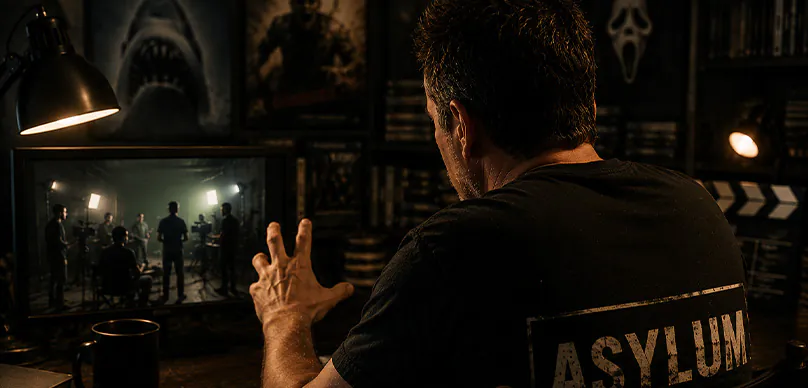
LOS ANGELES — In the hyper-competitive ecosystem of independent cinema, most filmmakers spend years—sometimes decades—scrambling, pitching, and compromising to bring a single passion project to life. They mortgage homes, max out credit cards, and wait indefinitely for a studio greenlight that rarely arrives.
David M. Latt took a fundamentally different path. As the co-founder of The Asylum, the legendary low-budget independent studio behind pop-culture touchstones like Sharknado, Mega Shark vs. Giant Octopus, and the hit television series Z Nation, Latt helped architect a machine designed to do the seemingly impossible: make movies continuously, profitably, and without waiting for Hollywood’s permission.
Latt’s story is not a standard Hollywood fairy tale of overnight artistic discovery. Instead, it is a masterclass in operational resilience, showing how creativity, production, distribution, marketing, and financial survival can operate in synchronized harmony.
Main Facts: The Anatomy of a Low-Budget Powerhouse
For over two decades, The Asylum has stood as an outlier in the entertainment industry. While major studios rely on hundreds of millions of dollars in backing and massive tentpole releases, The Asylum operates on an entirely different economic spectrum, treating filmmaking as a disciplined manufacturing and distribution enterprise.
- High-Volume Production: The company has produced well over 150 feature films, spanning horror, action, science fiction, and the studio’s signature "mockbuster" releases—timely, high-concept titles designed to capture the ancillary market of major studio releases.
- Vertical Integration: By acting as both the physical producer and the global distributor, The Asylum retains control over its product, cutting out traditional middlemen and ensuring that revenue flows directly back into future slates.
- Market-Driven Development: Rather than developing spec scripts in a vacuum, the company relies heavily on buyer demands, pre-sales, and direct network partnerships to dictate content creation.
- The Sharknado Phenomenon: Released in 2013, the Syfy original movie Sharknado shattered social media engagement metrics, transforming The Asylum from a niche home-video player into a globally recognized pop-culture brand.
Chronology: From Unemployment to an Industry Staple
The genesis of The Asylum was far from glamorous. It did not begin with a polished venture capital pitch deck or a multi-million-dollar angel investment.
The Lean Years and Early Pivots
In the mid-1990s, David M. Latt and his future partners found themselves unemployed simultaneously. Rather than dispersing into traditional corporate paths, they banded together with a singular, stubborn directive: they wanted to keep making movies.
Operating out of a modest apartment, the team took whatever work and distribution opportunities crossed their path. In its earliest iterations, the company focused on releasing art-house and foreign independent films. However, they quickly realized that competing for theatrical distribution against heavily financed distributors was a losing battle.
They forged relationships with major home-video retailers, noticing a distinct consumer appetite for genre entertainment. This realization marked the company’s first major pivot toward genre filmmaking.
Breaking the Cycle of Minimum Guarantees
Another critical turning point occurred when Latt and his partners recognized a systemic flaw in how independent distribution operated. Larger distributors routinely offered filmmakers substantial "minimum guarantees" (MGs) that smaller operations simply could not match.
Instead of fighting legacy players for finished films, The Asylum made a bold pivot: they would manufacture their own inventory. Securing initial backing from an investor for a slate of low-budget horror projects, the company transitioned into a self-sustaining cash-flow operation. Revenue generated by one wave of titles directly financed the next, creating an unbroken production cycle.
Supporting Data & Philosophy: "Big Budget on a Budget"
One of the most revealing aspects of The Asylum’s operational philosophy is its refusal to lower creative ambitions simply because funds are tight.
In traditional low-budget filmmaking, screenwriters often resort to "bottle-episodes"—such as four characters trapped in a single room—to keep production costs manageable. Latt rejects this convention outright. The Asylum scripts routinely call for monsters, natural disasters, deep-sea submarines, massive action set-pieces, and elaborate visual effects.
"We’re not making a low-budget film. We’re just making a big-budget film on a budget," Latt explains.
The distinction is subtle yet profound. The financial limitations are absolute, but instead of automatically shrinking the narrative scope, the production team leans into inventive, resourceful problem-solving to achieve the spectacle required by the script.
The Mathematics of Pre-Sales
This creative audacity is anchored by rigid financial discipline. Because The Asylum acts as its own distributor, the company frequently knows the exact commercial value of a project before cameras even start rolling.
If a foreign distributor or cable network pre-sells a film for a fixed amount, Latt’s mandate as a producer is straightforward: make the film for less than the guaranteed revenue while accounting for overhead.
This buyer-driven approach turns conventional Hollywood wisdom on its head. While mainstream studios frequently see budgets balloon due to shifting creative ambitions or protracted post-production cycles, The Asylum’s production budgets are anchored entirely to market realities. According to Latt, the company has successfully avoided catastrophic financial losses simply by refusing to spend capital they do not have secured in advance.
Official Responses and Industry Insights: The Anatomy of Sharknado
Perhaps no project better illustrates the volatile, unpredictable nature of independent film than Sharknado.
By the time the project landed on their desks, The Asylum had already produced roughly 150 feature films. Yet, even seasoned veterans within the company were skeptical. Latt admits that he initially struggled to grasp the screenplay, fearing that its biting, self-aware comedic tone deviated too far from the studio’s standard straight-to-video monster movies.
Casting proved to be an uphill battle. Numerous actors turned down roles, hesitant to have their names associated with a movie titled Sharknado. Production even utilized an alternative working title behind the scenes to help attract talent.
However, the network partner, Syfy, remained fiercely committed to the concept. Trusting the buyer, Latt pushed the project forward. What was initially viewed internally as just another routine genre assignment exploded into a cultural lightning rod, fundamentally altering public awareness of The Asylum brand and rewriting the rules of social-media-era appointment viewing.
The Law of Averages in Filmmaking
Latt is quick to warn against treating Sharknado as a blueprint to be deliberately replicated. The lesson of the film is not that creators should arbitrarily manufacture absurd, viral concepts. Rather, it highlights a stark industry truth: nobody truly knows what audiences will embrace.
Because audience taste is inherently fickle, striving for that single, mythical, earth-shattering masterpiece is an inefficient strategy. Instead, Latt advocates for a high-frequency, sustainable approach:
- Control production costs meticulously.
- Understand the demands of the marketplace.
- Keep creating consistently.
- Give your work multiple opportunities to connect with an audience.
Implications: Adapting to the Digital Evolution
The media landscape has transformed drastically since The Asylum’s inception, most notably with the decline of physical media economics (DVD and Blu-ray) and the rise of subscription streaming and video-on-demand (VOD).
Rather than stubbornly clinging to legacy distribution models, the company adapted. Recognizing that audience consumption habits were shifting heavily toward episodic, binge-watchable television, The Asylum expanded its operations into series production, notably producing Z Nation for Syfy.
While episodic television required scaling up operations, the underlying philosophy remained unchanged: follow where buyers and audiences are migrating, maintain structural flexibility, and never become emotionally wedded to a business model simply because it worked in the past.
The Power of Human Capital
Beyond budgets, visual effects, and market analysis, Latt emphasizes that the foundational currency of the entertainment industry remains human relationships.
He advises emerging filmmakers to step away from their computers, attend film festivals, participate in industry seminars, network at social events, and shake hands. Submitting blind resumes or unsolicited scripts online yields limited results. True career breakthroughs happen when industry professionals remember an individual as reliable, enthusiastic, professional, and prepared when the right opportunity materializes.
The Asylum itself was built on this exact ethos—forged through enduring partnerships, rapid market adaptation, strategic risk-taking, and a persistent willingness to say "yes" when an opportunity made logistical and financial sense.
Conclusion: A Blueprint for Industry Longevity
For independent filmmakers drowning in the complexities of modern distribution, David M. Latt offers something far more valuable than a formula for viral success: a sustainable blueprint for survival.
Understand the genuine market value of your work. Control your budgets before they control you. Build tangible production infrastructure. Listen closely to your buyers. Pivot gracefully when market conditions shift. Surround yourself with reliable executors.
Above all, keep producing. In the unpredictable world of independent cinema, the project that changes everything is often impossible to foresee—until long after you have rolled camera.
