
The Physical and Creative Transformation: How Anthony Ippolito Became Sylvester Stallone in ‘I Play Rocky’
In the annals of Hollywood lore, few origin stories are as mythic as that of Sylvester Stallone. The tale of a struggling, penniless actor who refused to sell his script for Rocky unless he was cast in the lead role—despite the massive financial risks and industry skepticism—is the ultimate underdog narrative. Now, that story is receiving the big-screen treatment in director Peter Farrelly’s I Play Rocky. At the center of this ambitious project is Anthony Ippolito, who faced the daunting task of capturing not just the iconic vocal cadence of the "Italian Stallion," but the grueling physical metamorphosis required to inhabit the man before he became a global icon.
The Physical Crucible: A Two-Year Transformation
Stepping into the shoes of a man whose physique defined an entire era of action cinema is no small feat. For Ippolito, the preparation for the role was an exercise in extreme discipline, bordering on an athletic odyssey. While the audience sees the finished product on screen, the journey behind the camera involved a complete lifestyle overhaul that lasted nearly two years.
"It had its moments for sure. I was being tested," Ippolito revealed during the AFI Fest screening in Los Angeles this past Saturday. "It’s a consistency thing. I had a great deal of time, so it became an entire lifestyle shift. It was one of the primary priorities of every day for a pretty long period."

Ippolito, who began the process as a leaner actor, had to undergo a significant weight gain, packing on 30 pounds of muscle to reach a bulked-up 180 pounds. This was not a quick-fix aesthetic adjustment; it was a methodical, science-backed approach to body recomposition. His sanctuary during this transition was the legendary Gleason’s Gym in Brooklyn, a historic venue synonymous with the grit and sweat of real-life boxing culture. By training in the same environment where many professional fighters have cut their teeth, Ippolito gained more than just muscle mass—he gained a visceral understanding of the discipline Stallone himself practiced in the mid-1970s.
The physical change was so pronounced that it didn’t go unnoticed by his inner circle. "It happened over time, but a couple of people were like, ‘What’s going on?’" Ippolito recalled. "They didn’t necessarily know I was doing the prep, and they were like, ‘What’s going on here?’ I was like, ‘I’ve been going to the gym, been eating.’"
Chronology of an Underdog: The Making of a Legend
I Play Rocky, helmed by director Peter Farrelly, serves as a biographical lens through which we view the 1976 struggle to bring the original Rocky to fruition. The film captures a pivotal moment in Hollywood history—a time when studios were wary of sports dramas and even more skeptical of a lead actor who lacked traditional box-office pedigree.

The narrative arc of the film focuses on the high-stakes gamble Stallone took. Faced with poverty and the prospect of selling his script for a quick payday, he instead chose to hold out for creative control, a decision that would eventually yield one of the most successful film franchises in history. The film explores the friction between Stallone’s artistic vision and the corporate inertia of 1970s Hollywood, painting a portrait of a man whose stubbornness was his greatest asset.
A Supporting Cast of Heavyweights
The weight of the film is shared by an impressive ensemble cast, each tasked with bringing to life the real-world figures who occupied Stallone’s orbit during his rise to prominence. AnnaSophia Robb anchors the emotional core of the film, portraying Sasha Stallone, the actor’s first wife, who stood by him through the uncertainty of his early career.
Stephan James takes on the formidable role of Carl Weathers, the man who would eventually bring Apollo Creed to life and form one of cinema’s most legendary rivalries. The film also features a deep bench of talent, including Kiki Seto, P.J. Byrne, Matt Dillon, Tracy Letts, and Jay Duplass. Together, this ensemble creates a tapestry of a bygone Hollywood era, grounding the legendary status of the Rocky franchise in the messy, human reality of its creation.

The Butkus Factor: Navigating Unpredictable Co-Stars
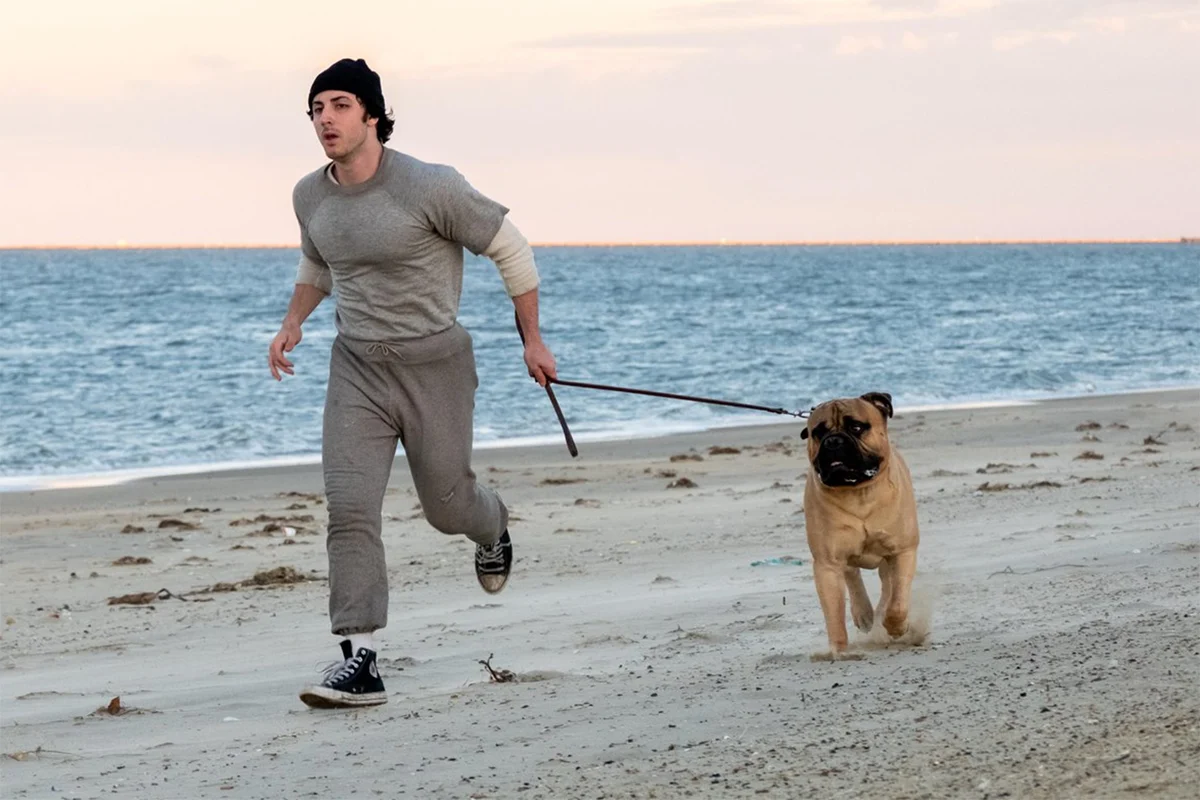
Perhaps the most charming, yet challenging, aspect of the production was the inclusion of Butkus, the Bullmastiff who was Stallone’s constant companion during his leanest years. The real-life story of Butkus—sold by a broke Stallone for $40 and bought back for a staggering $15,000 after the success of Rocky—is a testament to the bond between man and dog.
For Ippolito, the first day of filming was a baptism by fire, as his initial scenes required him to work alongside a dog portraying the iconic pet. "I hadn’t met that specific dog until the day prior to shooting," Ippolito explained. "He didn’t happen to take a liking to me until a couple of days in. When you give him enough treats, then he started to warm up."
The experience served as an unexpected metaphor for the filmmaking process itself. "At that point, he was a 140- to 160-pound dog and wasn’t a huge fan of me, so it added to the challenge. He just did whatever he wanted to do, and that was usually not what we were looking for him to do. In some ways, they give you the most beautiful stuff. You just have to be patient."

Implications and Industry Impact
The release of I Play Rocky arrives at a time when Hollywood is increasingly fascinated by the "biopic of the creative process." Unlike traditional biopics that focus on the entirety of a subject’s life, this film zooms in on a single, make-or-break moment. By focusing on the 1976 struggle, the film offers a masterclass in persistence and the high-risk nature of the film industry.
For Anthony Ippolito, this role is a potential career-defining moment. His dedication to the physicality of the character suggests a commitment to the craft that resonates with the very spirit of the man he is portraying. If the early buzz from the AFI Fest is any indication, the film is poised to be both a critical success and a poignant reminder of the power of the "Rocky" mythos.
The film’s release strategy reflects its prestige potential: a limited release beginning on November 6, 2026, followed by a wide release on November 20. As audiences flock to theaters, they will see more than just a boxing movie; they will witness the intersection of art, commerce, and the indomitable human spirit that turned a struggling actor into a cultural icon.

Conclusion: The Legacy Continues
I Play Rocky is not merely a retelling of a script sale; it is a meditation on what it takes to manifest a dream when the world tells you it is impossible. Through Ippolito’s transformative performance and the meticulous direction of Peter Farrelly, the film invites a new generation to look behind the curtain of the Rocky franchise.
The echoes of 1976 still resonate in the halls of modern Hollywood. As Stallone famously proved, the odds are irrelevant when the passion is absolute. Whether it was the grueling months of weight training at Gleason’s Gym, the patient negotiation with a 160-pound co-star, or the emotional labor of channeling the vulnerability of a young, ambitious artist, Anthony Ippolito has clearly understood that the secret to playing Rocky isn’t just about the punches—it’s about the heart.
As we look toward the film’s November release, it serves as a timely reminder that behind every "overnight success" lies a long, often lonely road of preparation. In the case of Sylvester Stallone, that road was paved with hunger, a dog named Butkus, and an unwavering belief in a story that the world wasn’t yet ready to hear. Now, thanks to I Play Rocky, the world gets to see exactly how that story was written.
