
My Undesirable Friends: Part II — Exile Review: An Epic Continuation of Julia Loktev’s Fearless, Endlessly Compassionate Portrait
By Staff Reviewers
Main Facts: The Epic Scope of an Authoritarian Crackdown
In the landscape of contemporary political documentary filmmaking, few projects match the sheer scale, visceral urgency, and staggering duration of Julia Loktev’s monumental diptych, My Undesirable Friends. The second half of this massive undertaking, My Undesirable Friends: Part II — Exile, made its world premiere at the 2026 Venice Film Festival, following the critical acclaim of its predecessor, My Undesirable Friends: Part I — Last Air in Moscow (2024).
Together, the two films span nearly 12 hours of footage: Part I clocks in at 324 minutes, while Exile stretches even further at 355 minutes. This is not merely cinema; it is an endurance test for both its subjects and its audience, capturing the fascist suffocation of truth and the dismantling of independent thought in real time.
The documentary focuses on a tight-knit circle of fiercely brave, resourceful young Russian women—independent journalists, editors, and reporters associated with TV Rain (Dozhd), one of the last remaining bastions of oppositional media in Vladimir Putin’s Russia. Among them are Anya (Anna Nemzer, who is also credited as co-director), Lera (Valeria Ratnikova), Ksyusha (Ksenia Mironova), Lena (Elena Kostyuchenko), Ira (Irina Dolinina), Alesya Marokhovskaya, and Sonya Groysman. They are later joined by figures such as Yana Kuchina (Kostyuchenko’s partner) and the prominent Ukrainian-Russian journalistic couple Peter Ruzavin and Nataliya Gumenyuk.
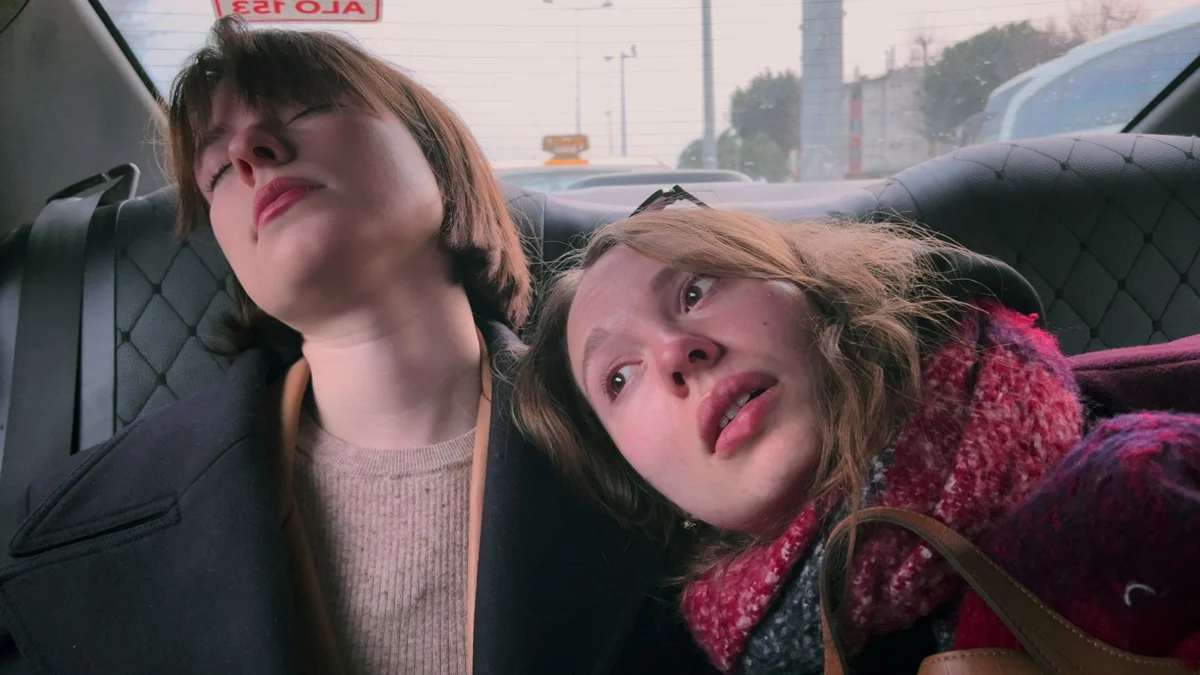
Loktev utilizes an intimate, mobile aesthetic—shooting extensively on iPhones—to maintain a breathtakingly close proximity to her subjects. This stylistic choice transforms the camera from a passive recording device into an active vessel of care, witness, and solidarity. By the time Exile hits commercial theaters on October 9, viewers are invited to immerse themselves in a sprawling, multi-year cartography of displacement that tracks the shattering of a community across Turkey, Georgia, Latvia, the Czech Republic, Poland, and the United States.
Chronology: From the Fall of Moscow to the Scattering of Diaspora
To fully comprehend the emotional architecture of Exile, one must trace the unbroken historical continuum it shares with Part I.
Phase One: The Closing Circle (Autumn 2021 – February 2022)
The first installment of the project opened in the autumn of 2021. During this period, the Russian state systematically targeted independent journalists, branding them "foreign agents." In the span of just four months, the tightening legal noose transformed investigative reporting into a criminal offense punishable by lengthy prison sentences. As rumblings of a full-scale invasion of Ukraine intensified, these journalists faced an agonizing choice: stay and risk incarceration, or flee their homeland. Part I chronicled the final, suffocating weeks of breathing air in Moscow, capturing the emotional and logistical panic of packing up entire lives into suitcases.
Phase Two: The Immediate Aftermath (March 2022)
Exile commences a mere two days after the harrowing conclusion of Part I, picking up the narrative thread in early March 2022. There is no narrative gap, yet the transition plunges the subjects—and the audience—into a radically altered reality. The safety of familiar apartments, coffee shops, and newsrooms is instantly replaced by the disorienting architecture of transit hubs, foreign border controls, and temporary safe houses.
Phase Three: The Dispersal and the Present Tense (2022 – 2026)
Spanning the years leading up to its 2026 release, Exile traces the splintering of the TV Rain collective. Some members fled south to Turkey; others found refuge in the Caucasus nation of Georgia; still others scattered across the European Union and North America. Loktev’s editing bookends each scene with stark black frames and precise inter-titles documenting the place, date, and protagonist. Yet, despite this chronological scaffolding, the emotional timeline refuses to move in a straight line. Viewers are dragged back through the collective trauma of the early war years—reliving the initial, agonizing news drops from Bucha, Irpin, and Mariupol, reports of mass graves, and accounts of systematic torture by the Russian military—all compressed within the shifting boundaries of historical memory.
Supporting Data: Time, Scale, and the Cinematic Record
To understand the weight of My Undesirable Friends, one must examine the metrics of its production and its runtime:

- Total Runtime: Approximately 679 minutes (11 hours and 19 minutes) across both parts.
- Part I (Last Air in Moscow): 324 minutes.
- Part II (Exile): 355 minutes.
- Timespan Documented: Late 2021 through early 2026 (over four calendar years).
- Geographic Footprint: Filmed across Russia (Moscow), Turkey, Georgia, Latvia, the Czech Republic, Poland, and the United States.
- Primary Medium: Intimate digital/smartphone cinematography designed to preserve personal safety and foster psychological proximity.
These numbers highlight an important philosophical question raised by the film: How valuable is our viewing time compared to the historical stakes being recorded? While audiences experience the war in abstract, compressed blocks of film hours, the subjects live out an elastic, agonizing wartime reality where the loss of their profession, their country, and their cultural identity is permanent.
Official Responses and Critical Reception: A "Fly in the Soup" Methodology
When Last Air in Moscow first premiered, film critics praised Julia Loktev’s seamless transition from narrative fiction to documentary filmmaking. Reviewers noted that her background in fiction gifted her with an acute sensitivity to framing, spatial geography, and the micro-expressions of human emotion.
With Exile, critics have observed a distinct shift in texture. The camerawork is notably more claustrophobic, propulsive, and shaky. It mirrors the psychological state of its subjects—displaced people trying to orient themselves in an erratic, hostile exilic reality.
Loktev herself has famously rejected the traditional documentary trope of the "fly on the wall," preferring instead to describe her methodology as being a "fly in the soup." She does not maintain a cold, objective distance; rather, she actively engages with her protagonists, occasionally speaking from behind the camera, sharing meals, offering comfort, and embedding herself directly into their trials.
Film festival programmers and human rights advocates have lauded the project as a vital counter-archive against authoritarian erasure. In official statements surrounding its Venice premiere, critics emphasized that Loktev’s presence acts as a stabilizing anchor. In a world where the subjects have lost their institutional backing, their homes, and their legal protections, the continuous rolling of Loktev’s camera becomes the primary source of continuity and mutual trust.
Implications: Cartography of Grief, Collective Guilt, and the Urgency of Now
The broader implications of My Undesirable Friends: Part II — Exile extend far beyond film criticism, touching upon deep ethical, political, and philosophical dilemmas regarding the Russian diaspora and the nature of modern documentation.
1. The Cartography of Grief
By tracking her subjects across multiple continents, Loktev transforms what could have been a standard travelogue of displacement into a profound cartography of grief. Every new city—whether it is an Istanbul alleyway, a Tbilisi café, or a Riga apartment—represents a psychological waystation. The film maps the invisible borders that govern the lives of political refugees: visa restrictions, language barriers, economic precarity, and the constant, lingering fear of transnational repression.
2. The Burden of Collective Responsibility
One of the most emotionally arresting elements of Exile is the recurring motif of collective guilt. Throughout the documentary, various journalists articulate a crushing sense of accountability, with multiple subjects uttering variations of the phrase: "We let this happen." This profound sense of moral burden creates a complex tension. On one hand, these individuals are the victims of Putin’s totalitarian apparatus, forced into exile for telling the truth. On the other hand, they grapple with the ambivalence of holding Russian citizenship while their nation commits atrocities in Ukraine. Their acute self-awareness elevates the film from a straightforward journalistic chronicle into a deep philosophical inquiry into national identity, complicity, and resistance.
3. Temporal Dissonance and Historical Memory
Exile forces its audience into a state of temporal and mnemonic dissonance. Because the film captures events from the immediate aftermath of the 2022 invasion up to 2026, viewers watching the completed work find themselves looking backward at a past that continues to dictate an unresolved present. In an era where news cycles move at a breakneck speed and global attention spans are continuously fractured by new crises, Loktev’s epic runtime acts as an antidote to historical amnesia. It insists that we sit down, slow down, and bear witness to the grinding gears of history as they crush human lives.
Conclusion
My Undesirable Friends: Part II — Exile is more than a sequel; it is an essential historical document. By intertwining uncompromising political analysis with deep, unyielding human empathy, Julia Loktev has crafted a cinematic monument to those who refuse to let the truth be silenced. As the film prepares for its theatrical release on October 9, it stands as a stark reminder that while authoritarian regimes can exile bodies, they cannot extinguish the moral clarity of those committed to remembering.
