
Round Three in the Ring: Can the New Live-Action Street Fighter Finally Break the Video Game Adaptation Curse?
By Film Desk Analysis
October 15, 2026
Main Facts
The Hollywood graveyard of video game adaptations is littered with high-budget misfires, cynical cash grabs, and creative miscalculations. For decades, major studios have approached the medium with the reckless optimism of Wile E. Coyote ordering gadgets from the Acme Corporation, only to plummet headfirst into the canyon of critical and commercial failure. Few franchises embody this perilous curse quite like Capcom’s legendary arcade punch-up franchise, Street Fighter.
With both 1994’s live-action Street Fighter—starring Jean-Claude Van Damme and Raul Julia—and 2009’s notoriously ill-received Street Fighter: The Legend of Chun-Li cementing themselves as historic critical flops and box-office disappointments, the bar for any subsequent attempt has been set remarkably low.
Now, a fresh cinematic reboot is stepping into the ring. Scheduled for a theatrical release on October 16, 2026, the latest live-action adaptation attempts to clear that subterranean bar. According to early reviews, the film—directed and cast with a mix of rising stars and recognizable character actors—manages to deliver flashes of campy wit and franchise-accurate absurdity. However, it ultimately struggles to balance an overstuffed plot with genuinely thrilling martial arts choreography.
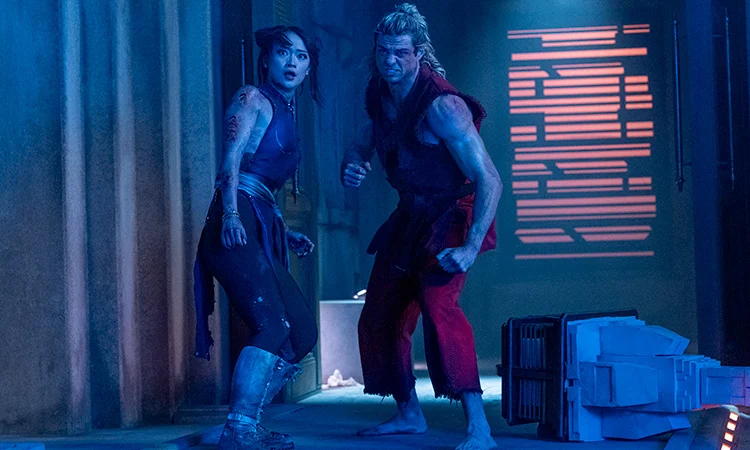
The film stars Andrew Koji as Ryu, Noah Centineo as Ken, David Dastmalchian as the sharply uniformed baddie M. Bison, Callina Liang as Interpol agent Chun-Li, and features a CG-heavy appearance by Jason Momoa as a shaggy, Hulk-like brute. While critics note it is campier than the 1994 original (which famously featured pop star Kylie Minogue), the consensus suggests that while it avoids being a total cinematic write-off, it still falls short when compared to modern genre peers like Mortal Kombat II and the latest Resident Evil installments.
Chronology: The Rocky Road of Street Fighter on Film
To understand the weight resting on the shoulders of the 2026 reboot, one must examine the rocky history of Capcom’s prized fighting franchise on the silver screen.
- December 1994: Universal Pictures releases the first live-action Street Fighter, directed by Steven E. de Souza and starring Jean-Claude Van Damme as Colonel Guile and Raul Julia in his final theatrical film role as the villainous General M. Bison. While a modest financial success globally, it was critically panned for its loose interpretation of the source material, campy tone, and deviation from the core arcade tournament structure. Over time, however, it has achieved a cult following, largely due to Julia’s unhinged, charismatic performance.
- February 2009: Marking the franchise’s 22nd anniversary, 20th Century Fox releases Street Fighter: The Legend of Chun-Li, starring Kristin Kreuk. Designed to launch a new series of character-focused films, the movie was universally reviled by critics and fans alike, grossing a paltry $12.8 million worldwide against an estimated $18 million budget. It effectively killed any immediate plans for further cinematic explorations of individual world warriors.
- 2023–2025 (Development Hell): Following a wave of successful video game adaptations—such as HBO’s The Last of Us and Universal’s The Super Mario Bros. Movie—Capcom and studio partners begin quietly developing a new live-action property. Casting announcements roll out through 2025, confirming Andrew Koji and Noah Centineo as the iconic duo Ryu and Ken, alongside David Dastmalchian as Bison.
- October 15, 2026: Early reviews drop, highlighting the film’s unique stylistic choices, including an anime-style cartoon prologue and a convoluted plot involving Frankensteinian science and mystical energy harvesting.
- October 16, 2026: Street Fighter officially hits commercial cinema screens worldwide.
Supporting Data & Production Breakdown
Examining the production choices and narrative framework of the 2026 reboot reveals a film that leans heavily into both fan service and eccentric creative liberties.
Narrative Architecture
The film opens with an animated anime-style prologue that attempts to untangle the dense lore of the franchise. It establishes the foundational rivalry between friends-turned-rivals Ryu (Andrew Koji) and Ken (Noah Centineo), the tragic murder of their wise martial arts sensei, and the sinister machinations of the sensei’s evil demon brother alongside the impeccably dressed villain, Bison (David Dastmalchian).
Set against the backdrop of 1993, the narrative revolves around a global combat tournament that serves as a thinly veiled pretext for Bison’s ultimate scheme: utilizing Frankensteinian science to siphon the "fight energy" from the mystic champion Ryu. By draining Ryu’s power, Bison aims to achieve superhuman strength—specifically the ability to punch through walls—without enduring the grueling years of physical training, exercise, and dietary discipline required of traditional martial artists.
Character Dynamics and Critiques
- Chun-Li (Callina Liang): Interpol agent Chun-Li attempts to assemble a coalition of heroes to thwart Bison’s global syndication of evil. Reviewers have pointed out that the script relies on clunky, self-aware exposition, with dialogue explicitly identifying her as a "hot Asian" to ensure the audience catches the reference.
- The Action vs. Plot Ratio: A persistent criticism of video game adaptations is narrative thinness; however, critics note that this Street Fighter suffers from the opposite problem. It features too much plot, frequently interrupting the momentum of physical altercations to bog down the runtime with murky corporate and mystical intrigue.
- The Martial Arts Execution: While fantastical elements—such as signature energy blasts (Hadokens) and glowing weapon slashes—remain faithful to the games, the actual hand-to-hand combat choreography struggles to capture genuine martial arts excitement. This deficiency is mildly compensated for by the inclusion of a CG-rendered Jason Momoa, appearing as a shaggy, muscular brute reminiscent of the Hulk.
Official Responses and Critical Reception
The critical reception ahead of the film’s theatrical rollout paints a picture of a divisive, highly self-aware pop-corn flick. Film critics have been vocal about the movie’s eccentricities, balancing nostalgic affection with sharp critiques of its structural flaws.

Renowned critic Kim Newman, reviewing the film for SciFiNow, noted the inherent cynicism of Hollywood’s adaptation pipeline:
"Studios greenlight live-action films based on video games the way Coyote sets traps for the Road Runner. They order a script and director from the Acme Corporation and hope that this time they won’t fall half a mile to splat at the bottom of the canyon. There’s no rule that a game-to-film transfer has to be dire, but the track record isn’t encouraging."
Newman further highlighted the film’s campy sensibilities, drawing comparisons to earlier 2026 pop-culture revivals:
"It has flickers of wit—finally, someone asks if it’s within the rules to go into a fist fight with a two-foot set of shears attached to your boxing glove—and the knowingness which featured in this year’s Masters of the Universe. In fact, it’s campier than the 1994 Street Fighter—and that had Kylie Minogue in it. Too busy to be a complete write-off, Street Fighter would still lose a fight with the okayish Mortal Kombat II and run screaming from the new Resident Evil."
Capcom and the distribution studios have remained optimistic, banking on global brand recognition, the dedicated fan base of the fighting game community (FGC), and the star power of its younger cast members to draw audiences in during its crucial opening weekend.
Implications for the Video Game Adaptation Industry
The theatrical release of Street Fighter arrives at a fascinating crossroads for Hollywood. Over the past five years, the industry has undergone a renaissance in how intellectual properties from interactive entertainment are translated to film and television. High-water marks like The Last of Us, Arcane, Fallout, and The Super Mario Bros. Movie have proved that critical acclaim and massive box-office returns are entirely possible when studios respect the source material while crafting compelling cinematic narratives.
However, the fighting game genre presents a unique hurdle. Unlike narrative-driven role-playing games or linear platformers, fighting games like Street Fighter, Tekken, and Mortal Kombat possess lore that is often secondary to the core mechanical loop of two characters beating each other senseless in distinct arenas.
If the 2026 Street Fighter underperforms commercially or fails to win over general audiences, it may signal to major studios that even with a star-studded cast (featuring Andrew Koji, Noah Centineo, and David Dastmalchian) and self-aware camp, arcade fighters inherently resist traditional, plot-heavy cinematic structures. Conversely, if it finds an audience among midnight-movie crowds and internet meme culture—much like its 1994 predecessor—it could secure a niche longevity that defies its initial critical drubbing.
Ultimately, whether this third attempt finally clears the low bar of video game-to-film adaptations will be decided at the box office starting October 16. Until then, fans and critics alike remain poised on the edge of their seats, waiting to see if humanity’s favorite world warriors can land a knockout blow, or if they will once again crash straight to the bottom of the canyon.
