
The Ageless Abyss: Why John Frankenheimer’s Seconds is the Defining Horror Film of Our Time
In the contemporary cultural landscape, the obsession with the "ageless" aesthetic has transcended vanity to become a full-blown existential panic. We live in an era where aging is treated as a curable pathology, managed by a trillion-dollar industry of invasive surgeries, chemical injections, and digital filters that promise the preservation of the self. Yet, beneath the veneer of modern cosmetic empowerment lies an ancient, gnawing dread: the fear that the person we are, or the life we have built, is fundamentally insufficient.
While modern audiences might look to recent genre hits like The Substance (2024) to articulate this body-horror malaise, they are walking in the footsteps of a 1966 masterpiece that arrived decades ahead of its time. John Frankenheimer’s Seconds is a chilling, prophetic descent into the commodification of the soul. Once a critical pariah, it has ascended to the status of a cult classic, serving as a mirror to our own vanity-obsessed epoch.
The Anatomy of a Nightmare: Main Facts
Seconds tells the story of Arthur Hamilton (John Randolph), a 52-year-old bank executive suffering from the soul-crushing boredom of post-war American stability. His marriage has withered, his daughter is estranged, and his existence is a monochrome loop of suburban obligation.
His life is irrevocably altered when he is approached by a clandestine organization that offers him the ultimate consumer product: a new life. For a fee, the organization fakes Arthur’s death, performs radical plastic surgery to reconstruct his face and body, and presents him with a new identity as Antiochus "Tony" Wilson (Rock Hudson). He is relocated to a bohemian enclave in Malibu, promised a life of artistic expression and freedom.
However, the film is not a wish-fulfillment fantasy; it is a claustrophobic nightmare. The "seconds" of the title refer not just to the ticking clock of mortality, but to the gluttonous, insatiable desire for a second chance—a "second helping" of life—that inevitably leads to consumption and decay.
A Chronology of Artistic Defiance and Failure
The production of Seconds remains one of the most storied instances of artistic friction in Hollywood history.
- 1966 – The Cannes Debacle: Following the success of The Manchurian Candidate (1962) and Seven Days in May (1964), Frankenheimer was at the height of his powers. Seconds was intended to complete his "paranoia trilogy." Instead, it was met with open hostility at the Cannes Film Festival. Audiences were reportedly sickened by the film’s visceral surgery sequences and disoriented by its experimental, wide-angle cinematography. The reception was so vitriolic that Frankenheimer skipped the press conference, devastated by the rejection.
- The 1960s/70s – The Era of Misunderstanding: Viewers in the mid-60s were largely unprepared for a darker Rock Hudson. Audiences associated the actor with the comforting, romantic chemistry of Pillow Talk or Magnificent Obsession. Seeing their matinee idol as a crumbling, terrified vessel for a middle-aged man’s existential crisis shattered the public’s perception of him, leading to a commercial failure that relegated the film to the periphery of cinematic history.
- 1997 – The Laserdisc Revival: Critical interest began to stir in the late 90s, when a high-quality home media release allowed a new generation of film historians to appreciate the technical mastery behind the project.
- 2013 – Criterion Validation: The release of a restored edition by The Criterion Collection cemented Seconds as a seminal work of sci-fi horror, confirming its status as a vital, if long-overlooked, contribution to the American canon.
Supporting Data: The Technical Craft
The film’s effectiveness owes an immense debt to the cinematography of James Wong Howe. A legend of his craft, Howe utilized a revolutionary camera rig—physically attached to the actors—to capture the disorientation of Arthur Hamilton’s psychological break. The use of extreme close-ups, fish-eye lenses, and distorted angles creates a sense of profound vertigo, mirroring the protagonist’s internal instability.
The production design also serves as a critical pillar. The "company" headquarters, a sterile, Byzantine labyrinth of concrete and shadow, feels like a precursor to the oppressive bureaucratic nightmares found in Terry Gilliam’s Brazil. The juxtaposition of these cold, industrial spaces with the "Bacchanal" scenes—a wild, grape-crushing hedonistic party—highlights the hollow nature of the new life provided to the protagonist.

Furthermore, the performance of John Randolph is a historical irony in itself. Having been blacklisted during the McCarthy era for his union activities, his role as a man "reborn" serves as a meta-textual nod to his own struggle to reclaim his career after being erased by the Hollywood establishment.
Official Responses and The "Star" Factor
Rock Hudson’s performance in Seconds is now widely regarded as the most daring of his career. Hudson, often cast as the quintessential, square-jawed American heartthrob, fought for the role, deliberately leaning into the vulnerability of a man who is physically "perfect" yet spiritually vacant.
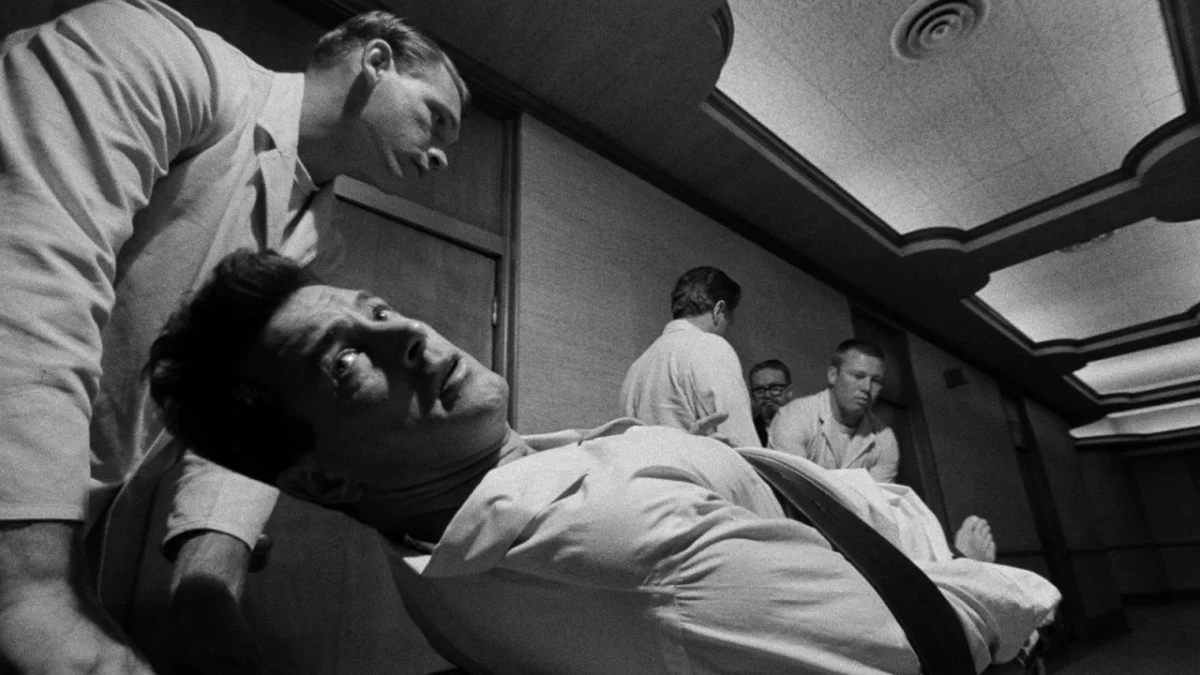
Frankenheimer famously noted that Hudson’s commitment was total. In the film’s harrowing final sequence, where Arthur is restrained by medical orderlies, the director utilized actual football players to handle Hudson, as the actor’s struggle to escape was so violent and authentic that traditional stunt performers were insufficient. Hudson himself later cited the film as his favorite work, lamenting that it was never given the fair hearing it deserved upon its release.
Implications for the Modern Era
The themes of Seconds are more relevant today than they were in 1966. We have moved from the era of the "company" that offers a new identity to the era of the "influencer" who constructs a digital avatar to escape the realities of their own aging process.
The Pyramid Scheme of Youth
The film’s most brilliant subversion is the revelation that the company operates as a pyramid scheme. Each "new" person must recruit another, essentially cannibalizing their social circle to perpetuate the organization’s existence. This reflects the modern cycle of status-chasing, where the wealthy and the desperate alike invest fortunes into longevity, only to find that their peers are doing the same, leading to a hollow, homogenized culture of "Instagram face."
The Death of the Dream
Perhaps the most haunting line in the film occurs when the founder asks Arthur if he has finally found his dream. Arthur’s response—"I guess I never had a dream"—is the ultimate indictment of the American consumerist experiment. It suggests that when we strip away the societal pressures to succeed, to look young, and to conform to an ideal of beauty, we are often left with a hollow center.
A Lesson in Mortality
Seconds serves as a grim reminder that there are no "seconds" when it comes to the human experience. While technology and medicine continue to offer the illusion of control over our biological clocks, Frankenheimer’s work insists that the pursuit of immortality is a futile, and often destructive, endeavor.
Today, Seconds stands as a masterpiece of psychological horror because it does not rely on monsters or supernatural entities to terrify. Its horror is derived from the mundane: the fear of being seen as you truly are, the desire to be someone else, and the eventual realization that no matter how much money you spend or how many times you reshape your face, you cannot run away from the fundamental truth of your own life. In a world that is still trying to buy its way out of the grave, Seconds is not just a film; it is a warning.
