
Behind Closed Doors: Inside Luca Guadagnino’s Tech-World Drama Artificial
Main Facts
Just months after Amazon committed a staggering $50 billion investment into artificial intelligence pioneer OpenAI, Amazon MGM Studios is preparing to release Artificial, a feature film directed by acclaimed Italian auteur Luca Guadagnino that dramatizes the tumultuous rise of the very organization now tied to its corporate partner.
The film chronicles the high-stakes narrative of OpenAI’s inception, tracing its trajectory through the major milestones that led to its current prominence. Central to the plot is the dramatic, widely publicized upheaval of November 2023, when OpenAI CEO Sam Altman was abruptly ousted by the company’s board of directors in a maneuver reminiscent of Steve Jobs’ historic exit from Apple, only to orchestrate a triumphant return just five days later.
Positioned as a spiritual successor to David Fincher’s The Social Network, Artificial swaps out the kinetic, high-octane thriller mechanics of Silicon Valley lore for a more intimate, stage-play-esque exploration of power dynamics. Written by Simon Rich, the screenplay pulls back the curtain on the San Francisco boardrooms and backchannels where engineers, developers, and visionaries forged a technology fundamentally reshaping modern society.
Despite the profound societal implications of exponential AI growth, the film steers away from deeply unpacking the technical mechanics of machine learning. Instead, it focuses heavily on the institutional chess match: corporate restructuring, shifting alliances, venture capital maneuvering, and the ethical gray areas of an unregulated technological frontier.
The project features a high-profile ensemble cast stepping into the shoes of modern tech icons. Mark Rylance portrays the "Godfather of AI" Geoffrey Hinton, Yura Borisov stars as co-founder and ethics-minded researcher Ilya Sutskever, Monica Barbaro takes on the role of Chief Technology Officer Mira Murati, and Ike Barinholtz makes a brief appearance as Elon Musk. However, the film anchors its narrative entirely on Andrew Garfield’s chilling, uncanny transformation into Sam Altman—a performance already generating substantial Oscar buzz following the film’s premiere at the 64th New York Film Festival. Artificial is scheduled for a wide theatrical release on December 25.
Chronology: From Napa Valley to the Silicon Valley Boardroom
Artificial employs a peculiar, episodic narrative structure, moving at a rapid and occasionally disorienting pace. Eschewing traditional cinematic transitions, Guadagnino’s film leaps forward by one, two, or four years at a time, punctuated by sparse, chapter-like title cards.
The chronology begins in the mid-2010s, establishing the formative years of OpenAI’s foundational team. Early sequences feature characters navigating the shifting philosophies of open-source research versus commercial viability. However, the film’s time-jumps frequently abandon traditional cause-and-effect storytelling. Titles such as “Recruitment, Napa Valley, 2015” drop audiences into specific coordinates without introducing new characters or depicting localized milestones, instead utilizing these settings simply as backdrops for dense, dialogue-driven philosophical and organizational debates.
As the timeline accelerates toward the late 2010s and early 2020s, the narrative shifts focus from conceptual research to the commercialization of generative AI. The chronology rapidly covers the scaling of large language models, the influx of massive corporate capital, and the widening ideological rifts between researchers prioritizing AI safety and executives driving aggressive commercial expansion.
The timeline culminates in the compressed, frantic events of late 2023. This climax captures the mounting internal friction that led to the sudden boardroom coup against Sam Altman, his brief departure, and the subsequent employee revolt that forced the board to reinstate him less than a week later—a sequence rendered not through action-thriller pacing, but through tense, claustrophobic exchanges in corporate offices.
Supporting Data and Production Details
While Artificial operates on a modest narrative scale compared to traditional blockbusters, its production scale and talent roster position it as a major holiday release.
- Investment Context: The film’s release arrives in the wake of Amazon’s historic $50 billion capital infusion into OpenAI, creating an unprecedented corporate paradox wherein a major studio is distributing an unauthorized, occasionally unflattering dramatization of its own multi-billion-dollar business partner.
- Festival Debut: Artificial held its world premiere at the 64th New York Film Festival, drawing immediate critical attention for its unique stylistic choices and central performances.
- Cast and Character Parallels:
- Andrew Garfield as Sam Altman: Hailed as the standout performance of the film. Garfield utilizes physical mannerisms, altered vocal cadences, and subtle behavioral styling—bolstered by prosthetic design and post-production touch-ups—to capture Altman’s singular, unsettling public persona.
- Yura Borisov as Ilya Sutskever: Portrays the brilliant, morally conflicted co-founder caught between scientific ambition and ethical boundaries.
- Monica Barbaro as Mira Murati: Delivers a grounded performance as the steadying operational force behind OpenAI’s technological breakthroughs.
- Mark Rylance as Geoffrey Hinton: Offers a characteristically meek and contemplative interpretation of the pioneering neural-network researcher.
- Ike Barinholtz as Elon Musk: Appears in a smaller capacity, depicting the mercurial early backer whose public persona looms large over the tech ecosystem.
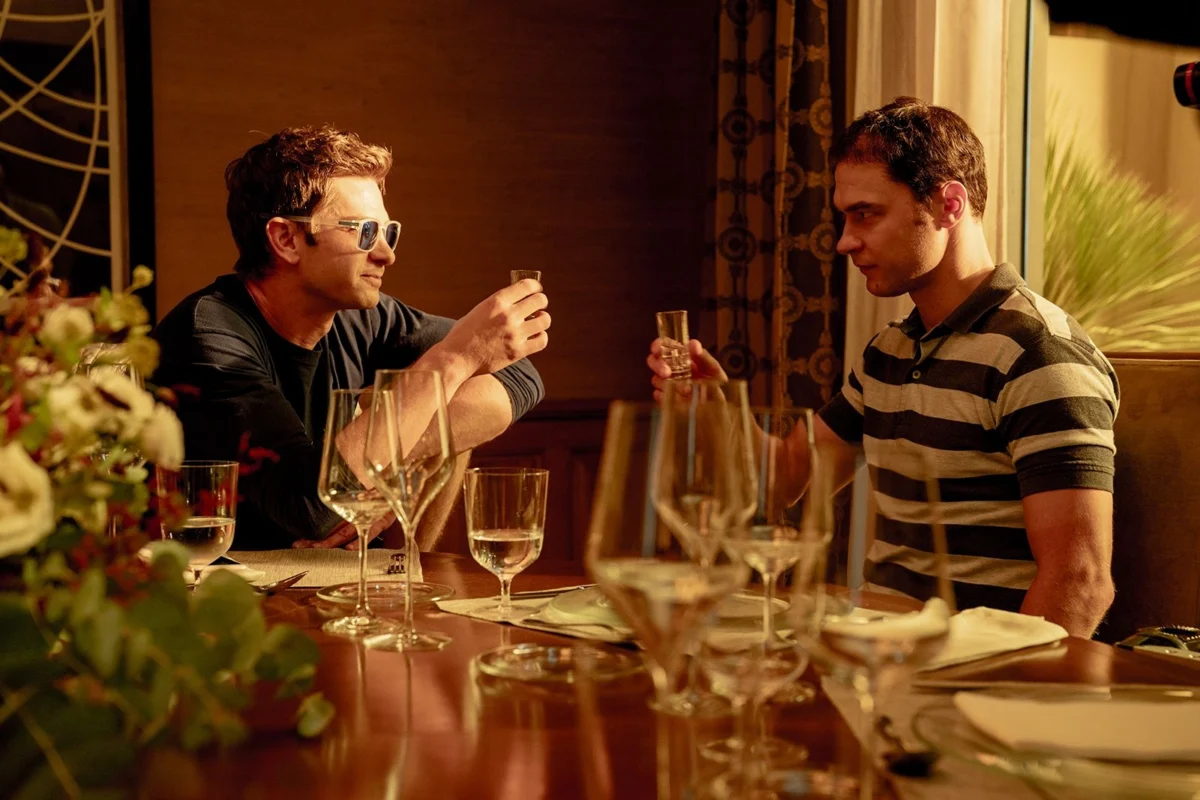
- Cinematic Craftsmanship: Directed by Luca Guadagnino, the film features cinematography that utilizes 180-degree shot-reverse framing during pivotal intimate discussions—notably hiding characters’ eyes behind reflective sunglasses—alongside dynamic tracking shots across the Golden Gate Bridge. The production is rounded out by an eccentric original score composed by Damon Albarn.
Official Responses and Corporate Dynamics
The convergence of tech industry giants and Hollywood studio politics has cast a unique shadow over Artificial. Amazon MGM Studios’ decision to distribute the film following Amazon’s massive financial stake in OpenAI has sparked widespread speculation regarding corporate sensitivity to the narrative.
Thus far, executives at OpenAI and major tech figures depicted in the film have maintained a largely restrained public posture. Unlike traditional biographical subjects who actively endorse or condemn cinematic adaptations, the current leadership of OpenAI has remained focused on commercial deployment and regulatory lobbying, offering no formal statement regarding the film’s characterizations or plot accuracy.
However, industry analysts have noted that the film’s release highlights Hollywood’s growing appetite for contemporary corporate exposés. The studio has positioned the project as a prestige title designed to capitalize on the cultural zeitgeist surrounding artificial intelligence, betting that public curiosity about the inner workings of Silicon Valley will outweigh any behind-the-scenes corporate hesitation.
Cast members and creative leads have defended the film’s tone, emphasizing that Guadagnino and screenwriter Simon Rich sought to capture the psychological atmosphere of a technological revolution rather than deliver a literal documentary. In interviews following the New York Film Festival premiere, the creative team stressed that the unsettling, uncanny tone of the film was a deliberate choice to mirror the disorienting pace at which AI development is reshaping human existence.
Implications: Art, Industry, and the AI Zeitgeist
Artificial arrives at a critical cultural juncture, serving as both a mirror and a critique of the current technological revolution. By framing the birth of advanced AI not as a sci-fi action epic, but as a series of hushed, high-stakes boardroom conversations, Guadagnino raises vital questions about who controls the future of human intelligence and under what ethical frameworks.
The Uncanny Valley of Tech Leadership
One of the film’s most striking implications lies in its characterization of Silicon Valley executives. Through Andrew Garfield’s portrayal of Sam Altman, Artificial explores a modern archetype: the charismatic, hyper-rational techno-optimist whose demeanor borders on the sociopathic. The performance evokes an "uncanny valley" sensation, suggesting a blurring of lines between human creators and the artificial minds they engineer. This thematic choice challenges audiences to consider whether the architects of AI are developing tools to serve humanity, or whether they themselves are being altered by the cold logic of algorithmic growth.
The Challenge of Translating Complexity to Cinema
From a cinematic standpoint, Artificial highlights the profound difficulty of dramatizing software development for a mass audience. By trading the kinetic energy of traditional thrillers for a stage-play format, the film risks alienating viewers seeking a fast-paced exposé. Yet, this very restraint forces the audience to confront the banal, bureaucratic reality of technological progress—reminding viewers that civilization-altering breakthroughs often occur not in dramatic explosions, but in quiet rooms behind closed doors.
Cultural Legacy and Box Office Expectations
As Artificial heads toward its December 25 theatrical release, its ultimate impact will likely extend far beyond box office returns. Luca Guadagnino has consistently carved out a niche in modern cinema—delivering provocative, stylish works that spark intense public debate even among those who have not seen the films themselves.
By tapping into the universal anxiety surrounding artificial intelligence, Artificial is poised to dominate holiday discourse. Whether viewed as an incisive portrait of modern ambition or an overly dry organizational history, the film ensures that the conversation surrounding the ethics, power structures, and human cost of the AI revolution remains at the forefront of the global cultural consciousness.
