
Sonic Stargazing: How Rob Simonsen Crafted the Intergalactic Soundscape of Pixar’s ‘Elio’
In the realm of modern animation, the score is often the invisible heartbeat of the narrative, bridging the gap between digital art and human emotion. For composer Rob Simonsen, whose resume includes the adrenaline-fueled soundscapes of Deadpool & Wolverine and the nostalgic, synth-heavy textures of Ghostbusters: Afterlife, his latest project presented a unique challenge: providing a musical identity to the vast, lonely, and awe-inspiring expanse of space in Pixar’s upcoming feature, Elio.
As the studio prepares for its highly anticipated June 20, 2025, theatrical release, the spotlight has turned toward how the film’s music anchors the story of an imaginative young boy who finds himself thrust into the heart of the "Communiverse." Through a blend of organic piano melodies and experimental, hacked-together synth technology, Simonsen has created a score that feels both intimate and infinite.
The Genesis of a Cosmic Score
The journey of Elio began with a collaboration between the composer and director Adrian Molina, later transitioning under the guidance of directors Madeline Sharafian and Domee Shi. For Simonsen, the transition between creative leads was a seamless evolution.
"They brought me up to Pixar, and I sat down and heard what the film was all about," Simonsen told IndieWire. "I was very moved; I felt very connected. I’m a huge alien and UFO nerd, and I think they were looking for a sound that they found in my work that had a lot of spaciousness and warm piano melodies, but with a sense of expansiveness."
The core of the film—a coming-of-age story centered on themes of loneliness and the search for belonging—required a delicate touch. The directors focused on the emotional arc of Elio, voiced by Yonas Kibreab, a young boy with an active imagination who is suddenly abducted by an interplanetary organization. While the directors expanded the world-building, they remained steadfast in protecting the emotional core that Simonsen established early on.

"I think in a lot of ways they expanded the world, but they held onto the heart that I felt was there at the beginning," Simonsen noted. "I wrote an ‘Elio’ theme after first seeing the film when I was hired, and that stayed through, which was really nice. Musically, we weren’t having to mess around with a lot of things. It was a fairly straight shot with Elio’s theme, and it drives the film from beginning to end."
The Architecture of a Theme
Simonsen’s approach to the score was rooted in the concept of the "aspirational leap." He relied on the use of a Major Seventh interval to capture the feeling of a child reaching for the stars.
"That Major Seventh just felt right," he explained. "Figuring out how to support it with the chords underneath was the next step. I gravitate towards simple piano melodies with a big, synth-fueled expansiveness around it. And it worked. Now it opens the film and we hear that theme as the Disney logo is playing."
Despite its prominence, the theme is used with surgical precision. It is notably held back until a specific, poignant moment: the scene in the planetarium where Elio watches the Golden Record Voyager leaving Earth.
"They have great instincts, those clever Pixar animators," Simonsen continued. "They’re very deep studies of human emotion, so they know exactly the frame to release a theme and have the music turn."

Chronology of Sound: From Earthly Signals to Galactic Bombast
The musical journey of the film follows the narrative trajectory of Elio himself. To represent the communication between Earth and the vast reaches of space, Simonsen devised a specific, one-note signal sound.
"The sound plays on a synth that I created, and it echoes out and reverberates into space," Simonsen said. "That then becomes a more fully realized musical motif when the signal from the universe comes back. It’s a similar synth sound but with more notes to it. The idea of this call-and-response of a signal is something that we played with throughout the film."
As the story progresses, the music shifts from these sparse, lonely signals to a full-blown orchestral explosion when Elio arrives at the Communiverse—a bustling, intergalactic hub populated by eccentric alien lifeforms.
"The signal sound gets turned into this large theme with full chordal support, with full orchestral support," Simonsen explained. "Everything gets unfurled, augmented with a lot of different synths and textures that are popping and floating around."
Innovation in the Scoring Stage: The Robot Choir
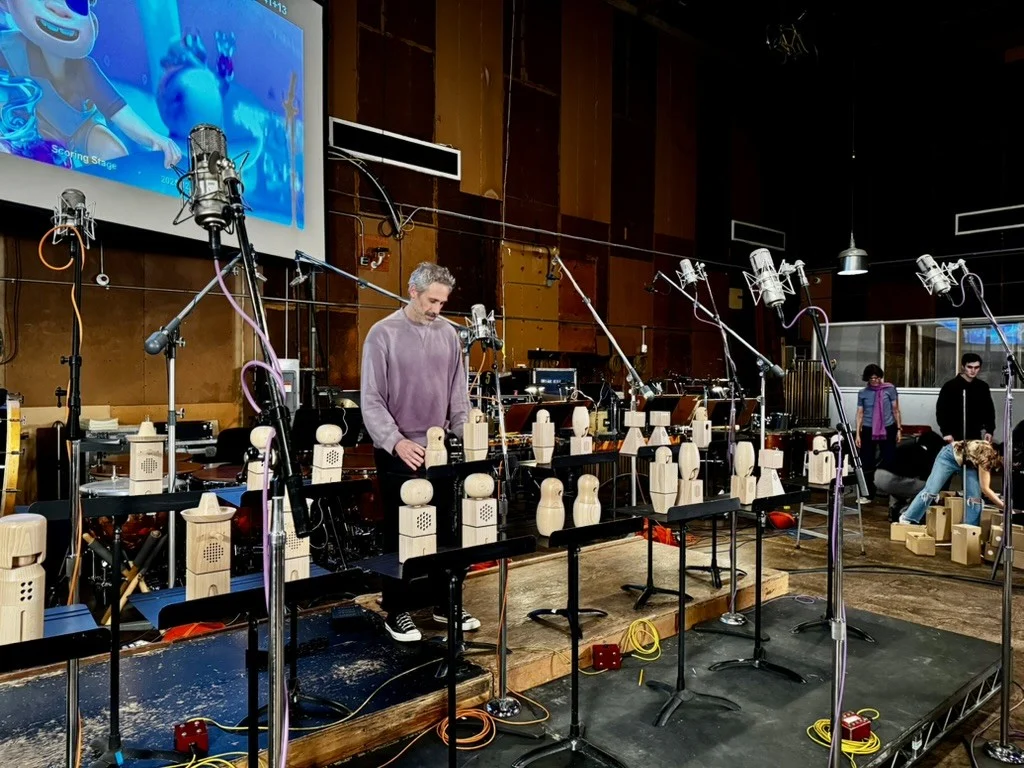
Perhaps the most unconventional aspect of the score is the "choir" that greets audiences in the Communiverse. Rather than utilizing a traditional human choir, which might have felt too grounded or orchestral, Simonsen looked toward Swedish design firm Teenage Engineering.

He utilized their "choir dolls"—small, wooden, hand-crafted speakers that function as individual vocal units.
"These little choir dolls have this very unique sound that I’ve never heard," Simonsen remarked. "They sound human, but clearly not human. The shape of the wood gives a shape for their voice, and they function like a choir."
However, using the dolls in a major studio film required technical ingenuity. Recognizing that the dolls had "limited functionality" out of the box, Simonsen’s assistant, Tiger Lily, took the lead in hacking the hardware.
"She’s a coding genius and was able to hack the dolls using Python," Simonsen said. "We created some custom functionality so we could use them in a more robust way. But we called Teenage Engineering to send us more dolls, and we ended up with a 30-voice choir. We put these tiny wooden dolls on this cavernous Sony scoring stage, singing their hearts out."
The result is an otherworldly texture that perfectly encapsulates the strangeness of the Communiverse. It is a testament to the collaborative, experimental spirit that has long defined the Pixar process.

Implications for the Future of Film Scoring
The process behind Elio underscores a broader shift in contemporary film scoring. As technology becomes more accessible, composers are increasingly blending traditional orchestral arrangements with bespoke digital instruments and hardware hacks. By choosing to use a "hacked" choir, Simonsen has provided a sonic palette that feels distinctly "alien," avoiding the tropes of standard sci-fi scores.
Furthermore, the stability of the creative process—where a central theme written at the very beginning remained the film’s heartbeat until completion—speaks to the strength of the film’s narrative vision. In an industry where projects are often subject to drastic revisions and "musical patchwork," the consistency of the Elio score suggests a highly disciplined production environment.
Conclusion: A Resonance of Belonging
As the release date of Elio approaches, the anticipation is not just for the stunning visuals that have become synonymous with the Pixar brand, but for the auditory experience that will guide audiences through the Communiverse.
Rob Simonsen’s work serves as a reminder that even in a story about massive, interplanetary organizations and complex alien ambassadors, the most important element remains the individual human—or in this case, the human boy—at the center of it all. By balancing the "big synth-fueled expansiveness" with the quiet, tear-streaked vulnerability of a boy in a planetarium, Simonsen has crafted a score that promises to resonate long after the final credits roll.
Whether it is the haunting resonance of a one-note signal or the rhythmic chirping of 30 wooden robots on a scoring stage, the music of Elio invites us all to look up, listen, and perhaps, find a sense of belonging among the stars.
