
The Mirror in the Sky: A History of First Contact in African Speculative Fiction

For generations, the "First Contact" narrative has served as one of science fiction’s most potent thought experiments. Whether through the cold, analytical lens of hard SF or the sociological inquiries of speculative drama, humanity has consistently used the prospect of extraterrestrial intelligence as a mirror to examine itself. These stories are rarely about the aliens; they are about the human condition—our fears, our colonial histories, our linguistic limitations, and our capacity for connection.
As a writer, my own work—specifically my novel The Fist of Memory—explores these themes through the distinct philosophical frameworks of Sankofa (the importance of learning from the past) and Ubuntu (the profound interconnectedness of humanity). In doing so, I have found that the evolution of African Speculative Fiction (SFF) offers a unique, often overlooked perspective on how we define "the other." By tracing the history of the genre, we can see how African writers have reclaimed the First Contact narrative, shifting it from a colonial metaphor to a sophisticated exploration of identity, spirituality, and our shared future.

Chronology: The Four Eras of African SFF
To understand the trajectory of African First Contact stories, we must categorize the history of African speculative literature. My research into African SFF (spanning 1931 to 2021) suggests a clear, four-stage evolution:
- The Early Period (1930s–1960s): Characterized by nascent works often mirroring the trauma of colonial encounters. These stories frequently cast extraterrestrial or technologically superior entities as analogues for European colonialists.
- The Post-Independence Flourish (1960s–early 2000s): As African nations navigated the complexities of sovereignty, literature began to grapple with internal politics, the clash between traditional belief systems and imported technology, and the search for a new, post-colonial identity.
- The Internet Age and Genre Boundary Expansion (early 2000s–2011): The rise of digital communication allowed for a cross-pollination of ideas, leading to more experimental, genre-bending narratives that moved beyond traditional realism.
- The Current Period of Global Recognition (2011–Present): A surge in international acclaim for African writers has brought these unique cosmological views to the global stage, blending high-concept science fiction with deep, culturally specific metaphysical inquiry.
Supporting Data: Five Pillars of the Genre
To understand how African literature has engaged with the "First Contact" trope, we must examine five pivotal works that redefine the genre.

1. Nnanga Kon by Jean-Louis Njemba Medou (1932)
Widely considered the earliest work of African speculative fiction, this novel—originally written in the Bulu language—captures the raw anxiety of the early colonial period. Translated as "White Ghosts," the story depicts the Bulu people encountering European missionaries whom they perceive as technologically advanced, almost supernatural beings. While the narrative is undeniably a product of its time—occasionally veering into colonial propaganda—it serves as a foundational text. It highlights the essential link between science fiction and the anthropological shock of the "first encounter."
2. Jazz and Palm Wine by Emmanuel Dongala (1982)
This collection represents the shift into the second era. The title story is a satirical masterpiece that uses First Contact as a vessel for sociopolitical critique. When aliens arrive in the Congo and are met with aggression, the global response is predictably militaristic. It is only when the Kenyan delegate proposes a meeting of human elders—and the aliens are ultimately "pacified" through the subversive, artistic power of Jazz (Sun Ra and John Coltrane) and palm wine—that the story finds its brilliance. It argues for art and culture as the ultimate diplomatic tools.

3. Lagoon by Nnedi Okorafor (2014)
Lagoon is a chaotic, post-modern, and distinctly "Africanfuturist" take on the genre. When an alien entity lands in the waters of Lagos, the city itself becomes the protagonist. Okorafor refuses to separate the scientific from the spiritual; in the Nigerian context, the arrival of extraterrestrials is treated with the same weight as the manifestation of local deities. By naming the alien Ayodele and integrating it into the fabric of the city’s complex, vibrant social hierarchy, the book moves beyond the "invasion" trope into a story of transformative synthesis.
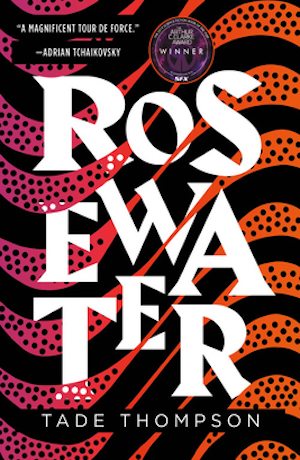
4. Rosewater by Tade Thompson (2016)
Thompson’s Rosewater is a genre-defying work that blends cyber-punk, biopunk, and a gritty, non-linear thriller aesthetic. The "alien" presence here is a subtle, pervasive biodome that has fundamentally altered the ecology and consciousness of a small Nigerian town. The introduction of the "xenosphere"—a telepathic network—reimagines First Contact not as a singular, dramatic event, but as an ongoing, invasive, and intimate relationship with the unknown. It is a masterclass in how to build a world around the permanent, lingering consequences of an extraterrestrial presence.
5. Triangulum by Masande Ntshanga (2019)
Perhaps the most enigmatic of the list, Triangulum is a "found manuscript" narrative that spans decades. It links the personal trauma of a young woman in post-apartheid South Africa to a cosmic event involving the Triangulum Galaxy. By weaving together corporate surveillance, techno-colonialism, and profound personal grief, Ntshanga uses the alien as a catalyst for existential reflection. It asks a haunting question: What if the arrival of the alien is not a rescue, but a mirror reflecting the destructive, cyclical patterns of our own history?
Official Responses and Thematic Implications
When we analyze these works collectively, a distinct pattern emerges regarding the "Official Response" to the alien. Unlike Western science fiction, which often focuses on the military-industrial complex’s response to a threat, African SFF consistently emphasizes the community-based, metaphysical, and artistic response.

- The Rejection of "Us vs. Them": In many of these narratives, the alien is not the enemy; rather, the enemy is the fear of the unknown or the rigid structures of the state. The "solution" to First Contact is almost always found through connection, negotiation, or the integration of the extraterrestrial into the existing spiritual landscape.
- The Legacy of Colonialism: There is a persistent, underlying current that equates extraterrestrial arrival with the historical trauma of European arrival. By acknowledging this, African authors are not just writing "alien stories"; they are conducting a necessary, post-colonial exorcism of the past.
- The Spiritual Science: A major implication of these works is the refusal to bifurcate science and spirit. In the African worldview presented in these novels, the "supernatural" is simply another facet of reality. Consequently, when an alien arrives, it is treated as a cosmological event as much as a scientific one.
Conclusion: Why the Future is African
The study of First Contact in African literature reveals a field that is far more concerned with the internal transformation of humanity than with the external mechanics of space travel. By utilizing concepts like Sankofa—looking back to the past to understand the future—and Ubuntu—recognizing that we are who we are through our relationships with others—these authors have expanded the genre’s vocabulary.
As we look toward the stars, or indeed toward the next century of literature, it is clear that the most fertile ground for the First Contact narrative is not in the cold vacuum of space, but in the complex, lived experiences of our own history. The mirror is held up, and for the first time, we are truly seeing ourselves—not just as survivors of the past, but as architects of a more inclusive, interconnected future. Whether through the rhythm of Jazz in the Congo, the chaotic energy of Lagos, or the telepathic pathways of the xenosphere, these stories remind us that the greatest mystery in the universe is not the alien, but the human soul.
