
The Cinematic Erasure of the Late-Thirties Woman: A Dual Study of Diane Lane’s Iconic Roles
At thirty-seven—the precipice of thirty-eight—a peculiar cultural phenomenon begins to take hold. It is the age at which women, particularly in the landscape of Hollywood cinema, begin to effectively "disappear." This transition between the mid-thirties and the late-thirties is often treated as a professional and narrative vacuum, a period where the industry stops reflecting the lived reality of women who are arguably in their most fertile moments of self-actualization.
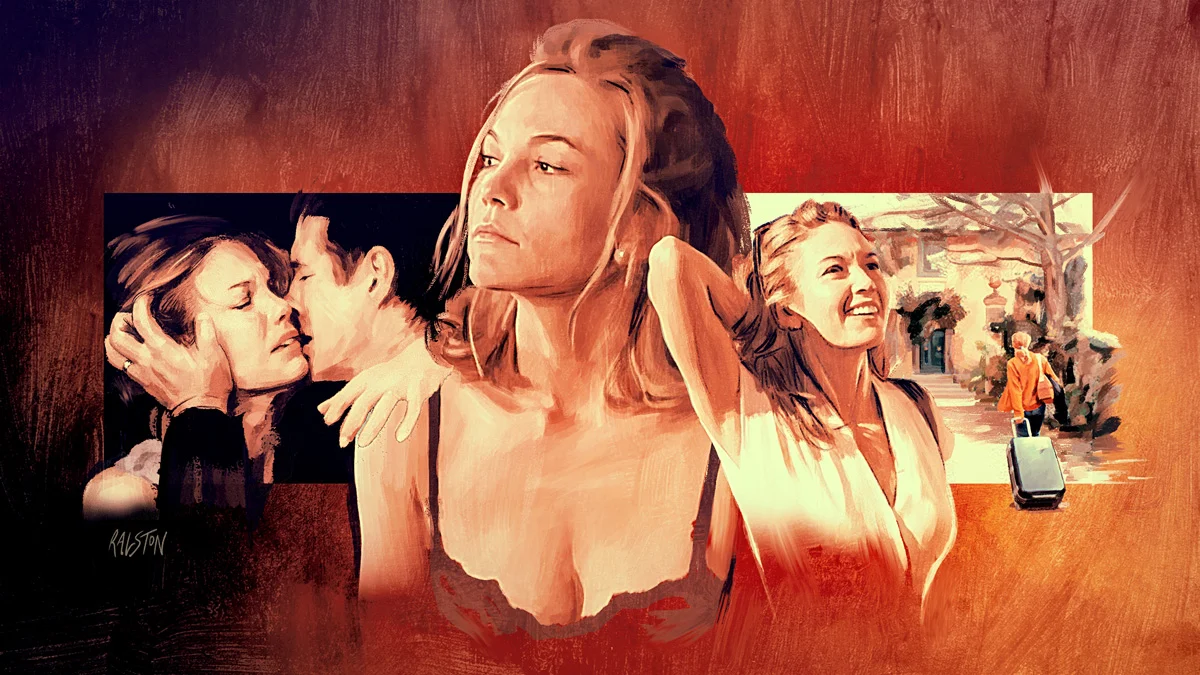
In this stage of life, the "hormonal hold" of youth begins to release, replaced by a clarity that filters out insignificant worries and external judgments. Yet, despite this internal ripening, our cultural artifacts—our movies—rarely capture this metamorphosis. Instead, we are left with a stark choice: the infantilized mess, the weary mother of teenagers, or the "psychopathic" woman on the brink of collapse. To explore why this erasure occurs, we must look back to a rare moment in the early 2000s when Hollywood dared to center two women at this exact turning point: Diane Lane, starring in Unfaithful (2002) and Under the Tuscan Sun (2003).
The Cultural Vacuum: Why Women "Vanish" at 38
The scarcity of stories centered on women in their late thirties is not merely a creative oversight; it is a systemic symptom of a film industry historically controlled by men who struggle to process female maturation. When a woman moves beyond the "ingenue" phase but hasn’t yet reached the "grandmotherly" caricature of later decades, she falls into a black hole of invisibility.
The Fear of Female Agency
Many industry analysts and critics suggest that the lack of nuanced representation for women in their late thirties stems from a deep-seated discomfort with female autonomy. Men in positions of power often struggle to bridge the gap between a woman who is sexually desirable and a woman who is intellectually and emotionally "out of fucks." When a woman reaches a point of radical self-acceptance, she becomes harder to categorize. By erasing these women from the screen, the industry avoids confronting the reality that a woman’s power often accelerates as she stops performing for the male gaze.
Chronology of a Metamorphosis: Connie vs. Frances
To understand the divergent paths of the late-thirties woman, we need only look at the two defining roles of Diane Lane’s career during that brief window. These films function as sibling narratives: one illustrating the destructive path of seeking external validation, and the other detailing the painstaking process of internal construction.
The Path of Destruction: Unfaithful (2002)
In Adrian Lyne’s Unfaithful, we meet Connie (Diane Lane), a woman living in the "grey-scale suburbia" of Westchester. Connie is the portrait of the "ideal" wife—beautiful, ordered, and privileged. However, her life is defined by a vacuum of meaning. When she encounters Paul, a younger rare-book collector, she finds a catalyst that disrupts her sterile existence.
Connie’s affair is not merely sexual; it is an attempt to reclaim the parts of herself that she surrendered to the "dictum of what she thinks she must do." The tragedy of Unfaithful is not just the infidelity; it is the realization that for many women at this age, the only way they feel "seen" is by inviting a destructive force into their lives. When the violence eventually erupts—when her husband Ed (Richard Gere) murders her lover—it serves as a grim metaphor for the cost of attempting to escape a stagnant life through the wrong channels.
The Path of Construction: Under the Tuscan Sun (2003)
Conversely, Under the Tuscan Sun offers a counter-narrative. Frances Mayes is also a woman at a crossroads, shattered by a divorce and the loss of her home. But rather than seeking a lover to fill the void, she buys a villa in Cortona. Here, the story shifts from the "ripping apart" of life to the "building up."
Frances’s journey is one of labor—both physical and emotional. She learns to "live spherically," a philosophy imparted by the character Katherine, which emphasizes looking in many directions at once. Unlike Connie, who seeks an escape, Frances seeks a foundation. She learns that her happiness is not contingent on a man, but rather on her community, her work, and her willingness to nurture her own dreams.
Supporting Data: The Representation Gap
The statistical reality behind this cinematic gap is stark. Research into gender roles in film suggests that female screen time peaks significantly earlier than that of their male counterparts. While men are allowed to age into "seasoned" leads, women are frequently moved into supporting roles as mothers or villains.
- Ingenue Bias: Studios prioritize women in their 20s for leading roles, citing "marketability" to younger demographics.
- The "Comeback" Narrative: Actresses often disappear from the screen between 38 and 48, only to be rebranded in their 50s as "ageless" icons, skipping the vital, messy, and real years of the late thirties entirely.
- Narrative Complexity: When women in their late thirties do appear, their stories are rarely about career, friendship, or personal evolution; they are almost exclusively about their relationship to their spouse or children.
Official Responses and Industry Shifts
While the industry has been slow to change, there has been a notable, if gradual, shift in how streaming platforms and independent studios approach female-led narratives. Recent discourse led by figures like Geena Davis (via the Geena Davis Institute on Gender in Media) has pressured studios to account for the "invisibility" of women over 35.
"We aren’t just asking for more roles," one casting director noted in a recent industry roundtable. "We are asking for roles where the woman’s primary conflict isn’t her age or her relationship status, but her own ambition and growth." Despite this, the "Connie" archetype—the woman who must be battered by a plot to be considered a protagonist—remains the default in many mainstream scripts.
Implications: Building the House
The implications of this erasure are profound. Without the art to tell us that the "metamorphosis" of the late thirties is normal, women are left to feel that their internal changes are symptoms of something gone wrong. We are conditioned to fear wrinkles as "stagnation" and to view stability as "boredom."
As the narrator in Under the Tuscan Sun poignantly reflects: "What are four walls, anyway? They are what they contain. The house protects the dreamer."
If we view ourselves as that house—a structure that we are currently renovating, painting, and gardening—the late thirties cease to be an end and become a beginning. The tragedy of the "Connie" in Unfaithful is that she never realized she had the agency to build her own villa; she felt she had to burn the old one down to find a spark. The triumph of the "Frances" in Under the Tuscan Sun is the realization that even if the path is built before the train is ready to arrive, the act of building is where the life exists.
For women approaching or currently navigating this age, the cultural absence of our stories is a call to action. We must become the architects of our own narratives, acknowledging that while the industry may not yet know how to film the beauty of a woman who has stopped performing, we are living it regardless. The late-thirties are not a disappearance; they are the foundation of everything that comes next. It is not an ending; it is the moment the sun actually begins to rise.
