
The Architect of Obsession: Deconstructing the Existential Mirror of Michael Mann’s Heat
In the landscape of modern American cinema, few works possess the gravitational pull of Michael Mann’s 1995 crime epic, Heat. More than a standard police procedural or a heist film, Heat functions as an exhaustive, melancholic meditation on the nature of obsession, the anatomy of midlife crises, and the tragic symmetry of two men tethered to opposing sides of the law. At its core, the film is a study of two archetypal figures: Vincent Hanna (Al Pacino), the relentless LAPD robbery-homicide detective, and Neil McCauley (Robert De Niro), the ascetic, hyper-disciplined career thief.
As they traverse the sprawling, grid-locked terrain of Los Angeles, they find themselves locked in a dance of mutual recognition. They are not merely hunter and prey; they are mirror images, each defined by a rigid code of conduct that renders them utterly incapable of functioning in the "ordinary" world they are supposedly protecting or exploiting.
The Chronology of a Collision Course
The narrative arc of Heat is driven by the relentless ticking of a clock—both the professional deadlines of a high-stakes heist crew and the internal, existential countdown of men who have realized their lives are, by any conventional metric, hollow.
The story begins with a botched armored car robbery. McCauley’s crew, operating with surgical precision, is disrupted by the volatile, sociopathic tendencies of their newest addition, Waingro. This initial failure acts as the catalyst for the entire film; it leaves behind a body count that draws the immediate, hyper-focused attention of Vincent Hanna.
Hanna is a man whose life is a "disaster zone," a phrase he admits to during a seminal moment in the film. He is haunted by the corpses of the unsolved, suffering from recurring dreams of a banquet table surrounded by the dead. This internal purgatory drives his professional life. He cannot "turn it off" because he fundamentally does not know how to be anything other than a hunter.
As the investigation progresses, the chronology of the film becomes increasingly claustrophobic. Mann masterfully cuts between the methodical, rhythmic preparations of the heist crew and the equally obsessive, process-driven surveillance of the police. The tension culminates in the now-legendary diner scene—a liminal space where, for a brief moment, the cat stops chasing the mouse. In this vacuum, they acknowledge their shared reality: they are both men who would sacrifice everything—marriages, safety, and longevity—for the "juice" of their respective crafts.
The Anatomy of Competence: A Professional Study
Michael Mann’s directorial signature is his portrayal of "hyper-competence." In Heat, characters do not waste time explaining their motives or their stakes; they simply act. The heist sequences are choreographed like ballets of violence, where the sound of a drill, the choice of explosives, and the tactical positioning of personnel are as vital as the dialogue.
The primary crew—Chris (Val Kilmer), Michael (Tom Sizemore), and Trejo (Danny Trejo)—are professionals in the truest sense. They treat crime not as a chaotic act, but as an engineering problem to be solved. However, the introduction of Waingro, an unpredictable liability, highlights the vulnerability inherent in their reliance on process. Waingro is the antithesis of the Mann protagonist: he lacks introspection, principles, and the burden of a conscience. His presence introduces the "heat" that eventually forces the characters into their final, fatal showdown.
The bank heist in downtown Los Angeles serves as the film’s central set piece. It is a moment where the plan fractures. Forced to adapt to changing variables, the crew experiences the friction between their carefully constructed methodology and the unpredictability of reality. The ensuing shootout, which spills onto the public streets, serves as a brutal reminder that when these men reach for their goals, the collateral damage is absolute.
The Weight of the Void: Existential Implications
While the film is a technical marvel, its enduring power lies in its exploration of the midlife crisis—not as a cliché of sports cars and affairs, but as a profound realization of emptiness.
The Domestic Failure
Both Hanna and McCauley are failures in their personal lives, though they handle their isolation differently. Hanna’s marriage to Justine (Diane Venora) is a slow-motion collapse. She views his inability to share his "angst" as a form of abandonment. Hanna, conversely, views his pain as a professional asset; he must "hold on to it" to remain sharp.
McCauley, meanwhile, attempts to break his own code of "no attachments" by initiating a relationship with Eady (Amy Brenneman). Yet, even as he tastes the possibility of a normal life, his fundamental nature as a man who "would not have a dog, a house, or a woman" he couldn’t walk away from in 30 seconds remains his guiding star. When he realizes the "heat" is around the corner, his abandonment of Eady is as swift as it is devastating.
The Blue Light of Loneliness
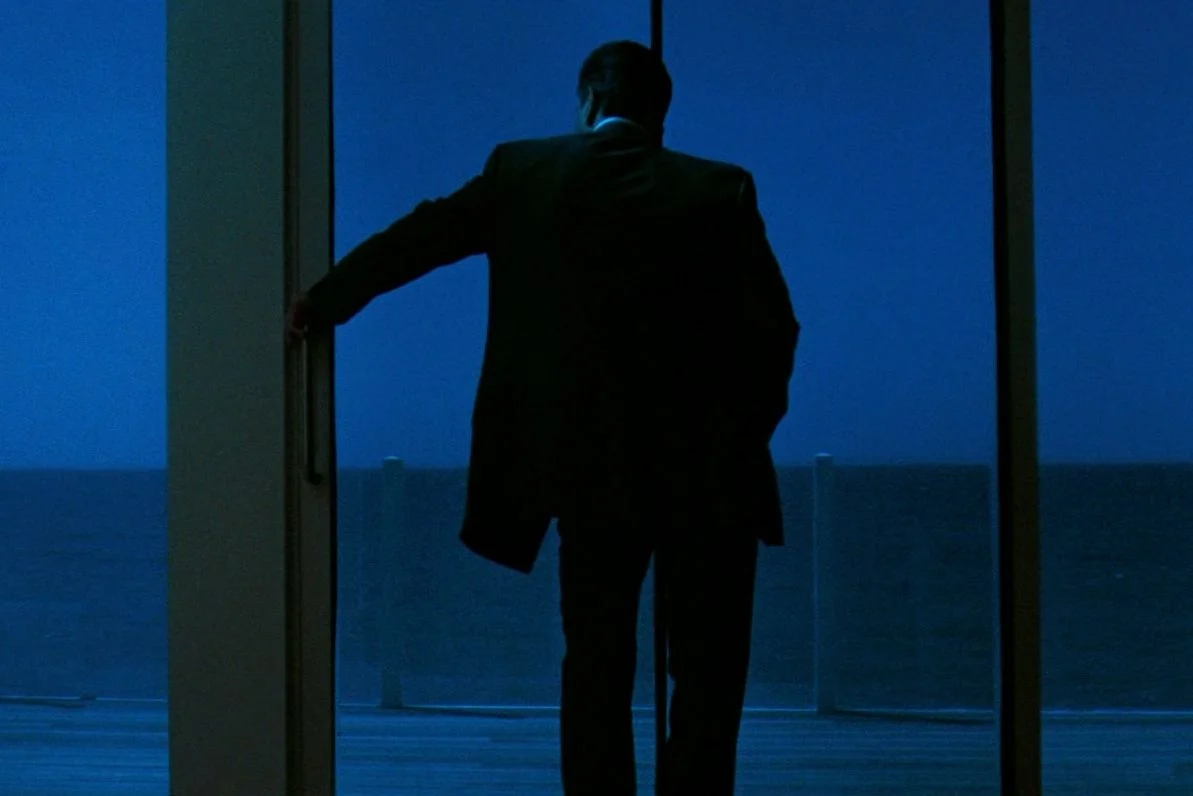
Mann uses color and lighting to emphasize this existential drift. The "hard, opaque shade of blue" that permeates McCauley’s empty, glass-walled house is reflected in the domestic tension of the Hanna household. The city lights of Los Angeles—which McCauley compares to the bioluminescent life in Fiji—are the bars of a cage. They are beautiful, distant, and ultimately unattainable for men whose lives are pinned to a grid of duty and criminality.
The Finality of the Runway
The climax at LAX is less a confrontation of enemies and more a meeting of inevitabilities. As they face each other in the dark, weed-choked fields surrounding the airport, the roar of jet engines serves as the soundtrack to their final exit.
When Vincent finally kills Neil, there is no sense of triumph. As Neil lay dying, reaching out to grasp Vincent’s hand, the two men share a moment of profound, wordless understanding. Vincent, the man who lives to solve the mystery of death, finally catches his prey, only to realize that he has simply reached the end of the only thing that gave his life meaning.
The film concludes with Moby’s "God Moving Over the Face of the Waters," a piece of music that underscores the "formless and void" nature of their existence. The battle is over, the criminals are neutralized, and the police work is done, but the void remains.
Conclusion: The Cost of the Code
The implications of Heat resonate long after the screen fades to black. It is a film that argues that true dedication to a craft—whether it is upholding the law or defying it—requires a total surrender of the self. By the time the credits roll, the audience is left with the realization that both Hanna and McCauley are, in their own ways, broken men.
They are the architects of their own isolation. Their "crisis" was not a fleeting state of mind but a life-long condition. By stripping away the domestic, the social, and the moral, Michael Mann reveals the core of these men: two souls, forever wandering the edge of the grid, forever chasing a horizon they can never reach, and forever defined by the heat of their own burning obsessions. In the end, they are just men passing through—leaving behind nothing but the echoes of their actions and the cold, blue light of a city that continues to turn, indifferent to their sacrifice.
