
The Eternal Echo of Pakeezah: A Cinematic Resurrection
On the night of February 3, 1972, the air outside Bombay’s Maratha Mandir cinema crackled with a fervor rarely seen in the history of Indian exhibition. As a ceremonial palanquin—carried by four horses—delivered the film reels to the theater, military bands played to a sea of thousands struggling against police barricades. Inside, the atmosphere was thick with a different kind of tension. Meena Kumari, the legendary star of Pakeezah and the muse behind its director, Kamal Amrohi, sat motionless, her fingers dug so deeply into her husband’s wrist that she drew blood.
For Tajdar Amrohi, the director’s son who sat nearby, the image remains etched in his psyche as if it occurred yesterday. His father, a man of profound artistic stoicism, did not flinch. He offered only a quiet, knowing smile—a moment of intimacy captured in the shadow of a cinematic monument. Today, more than five decades later, that haunting, labor-of-love masterpiece is being returned to the world in a pristine 4K restoration, proving that while stars may fade and celluloid may decay, the spirit of Pakeezah remains immortal.
A Legacy Reclaimed: The Restoration Effort
The Film Heritage Foundation (FHF), led by director Shivendra Singh Dungarpur, has undertaken the Herculean task of restoring Pakeezah. This was not merely a technical job; it was a race against time. When the FHF team opened the original camera negative in a Mumbai laboratory, they discovered a tragic state of neglect: the negative had melted, leaving no salvageable images.
“Meena ji went into a coma two days before her death, and the negative of Pakeezah had also gone into a coma,” Tajdar Amrohi poignantly observes.
The restoration process, a two-year odyssey of technical brilliance, required the team to reconstruct the film from an interpositive, a CinemaScope print, and a color reversal internegative held at the National Film Archive of India. The meticulous work was carried out at L’Immagine Ritrovata in Bologna. The challenges were immense—continuity errors from the decades-long shoot, fading color palettes, and fluctuating focus in optical sequences necessitated a forensic approach to filmmaking.
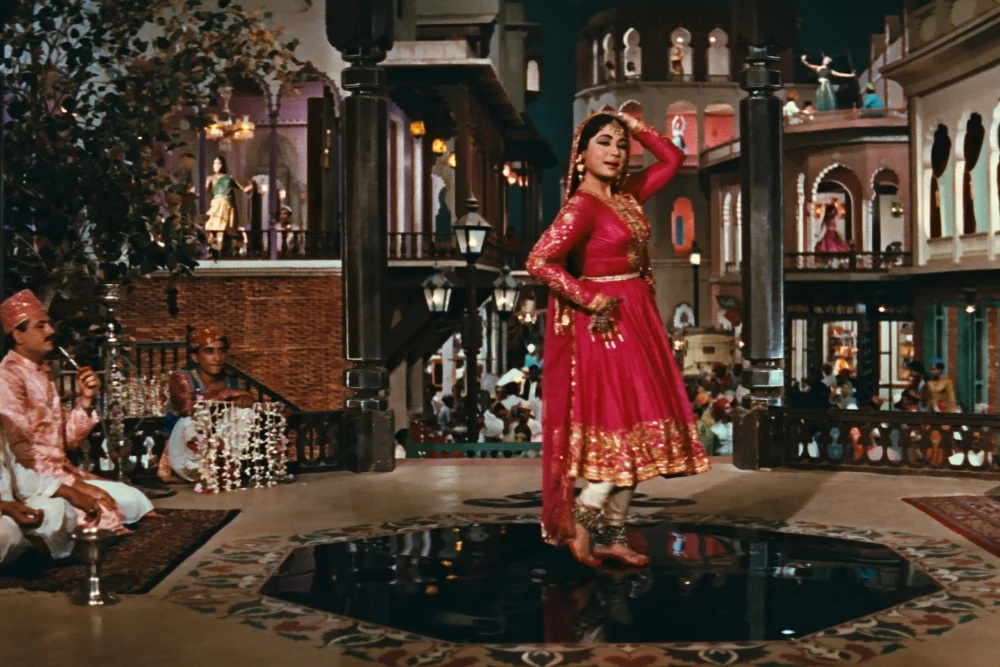
Perhaps the greatest triumph was the restoration of the film’s iconic color palette. The FHF team, working closely with Rukhsar Amrohi, who witnessed the original production, debated the hues of Meena Kumari’s costumes. By referencing the original lyrics—which explicitly mention a dupatta dyed pink—they were able to correct long-standing inaccuracies, finalizing a rich, deep magenta that now graces the screen. This restoration is more than a technical feat; it is an act of cultural preservation that ensures the film’s visual language remains faithful to Kamal Amrohi’s original vision.
A Chronology of Obsession: The Making of a Masterpiece
To understand Pakeezah, one must understand the cost of its creation. Conceived in the mid-1950s as a black-and-white feature, the film underwent a tortuous evolution into Eastmancolor and CinemaScope. Production officially began in 1956, but by 1964, the project stalled as the personal life of the director and his lead actress began to unravel.
The couple’s separation marked the beginning of a long silence for the film. The production became a black hole for the family’s finances and emotional bandwidth. Rukhsar Amrohi recalls a period where her father prioritized the film above all else. When she pressed him to replenish his wardrobe, which had worn thin, he would refuse, stating, “I’ll order all of this after Pakeezah—not 12, I’ll get 24—but let my Pakeezah get into theaters.”
The production was plagued by personal and professional losses. The film’s German cinematographer, Josef Wirsching, passed away before completion, as did composer Ghulam Mohammed. Despite the mounting pressure from financiers to replace the “old-fashioned” score with more contemporary composers, Kamal Amrohi remained steadfast. He sacrificed his wealth, his health, and his domestic stability to protect the integrity of his vision.
The film eventually returned to production in 1969, thanks in part to the intervention of industry peers like Sunil Dutt and Nargis, though the family maintains that it was ultimately Meena Kumari’s own resolve to finish the project that allowed the film to cross the finish line.
The Narrative Heart: The Tragedy of Sahibjaan
Set against the backdrop of a fading Lucknow, where the influence of the nawabs was rapidly evaporating, Pakeezah is a story of longing and social stigma. It tells the tale of Sahibjaan, a woman born in a graveyard to a courtesan spurned by her aristocratic family. Raised in the shadows of a brothel, she seeks dignity in a world that sees her only as an object of desire.
The plot hinges on a chance encounter: a forest officer, Salim (played by Raaj Kumar), discovers the sleeping Sahibjaan in a train compartment. Struck by the beauty of her feet, he leaves a verse of poetry and disappears. Their subsequent romance is a classic, albeit heartbreaking, exploration of the divide between love and societal expectation.
Official Responses and Global Premieres
The world premiere of the 4K restoration, presented by Thierry Frémaux at the Festival Lumière in Lyon, marks a significant milestone in global cinema appreciation. Following this, a gala screening at the BFI London Film Festival, introduced by the Amrohi family and Shivendra Singh Dungarpur, saw tickets vanish in mere moments.
Dungarpur views the restoration as the most important project of his career, a sentiment deeply tied to his grandmother, the Maharani of Dumraon, whose obsession with the film fueled his own. “It’s one of my most beautiful memories of restoration,” he states. The film’s journey continues to the Smithsonian and the Academy Museum, serving as a bridge between the Golden Age of Hindi cinema and a modern, global audience.
Implications: Preserving India’s Cinematic Soul
The plight of Pakeezah’s original negatives highlights a broader, systemic issue in Indian film history: the lack of investment in preservation. As Dungarpur notes, millions are spent on production, but a pittance is allocated to the care of the physical assets that define the nation’s cultural identity.
“So much money is spent on the production… but there’s very little money spent on preserving these elements. And that’s been quite a tragic story of India’s cinematic history,” he says.
The Film Heritage Foundation has made it their mission to change this narrative. By programming commercial landmarks alongside independent works, they are forcing a re-evaluation of what constitutes “world cinema.” This approach ensures that future generations will not be forced to watch degraded, flickering copies of masterpieces, but will instead experience them as they were meant to be seen.
The Final Verdict: An Immortal Union
Tajdar Amrohi still carries the sting of the film’s initial lack of awards, yet he finds solace in his father’s words: “All these people who are coming to watch the picture—that is my award.”
The burial of Kamal Amrohi beside Meena Kumari in 1993 stands as the final chapter of their story. To many, their union was tempestuous and plagued by the pressures of public scrutiny, but to their children, it was a love story that defied the constraints of reality. Whether one views Pakeezah through the lens of the “love child” of two creative forces or as a testament to a director’s uncompromising obsession, the film remains an undeniable landmark.
As the lights dim in cinemas across the world for this restored edition, the audience is not just watching a film. They are witnessing the final, grand gesture of a director who, like the Taj Mahal, sought to immortalize his beloved. Pakeezah is no longer just a movie; it is a monument, polished by time and restored to its original, breathtaking luster. The girl in the graveyard, the dancer in the haveli, and the love that couldn’t be contained by the screen have finally, and definitively, come home.
