
Wall Street Reacts as $110 Billion Skydance-Paramount-Warner Bros. Discovery Mega-Merger Closes, Bows on NYSE
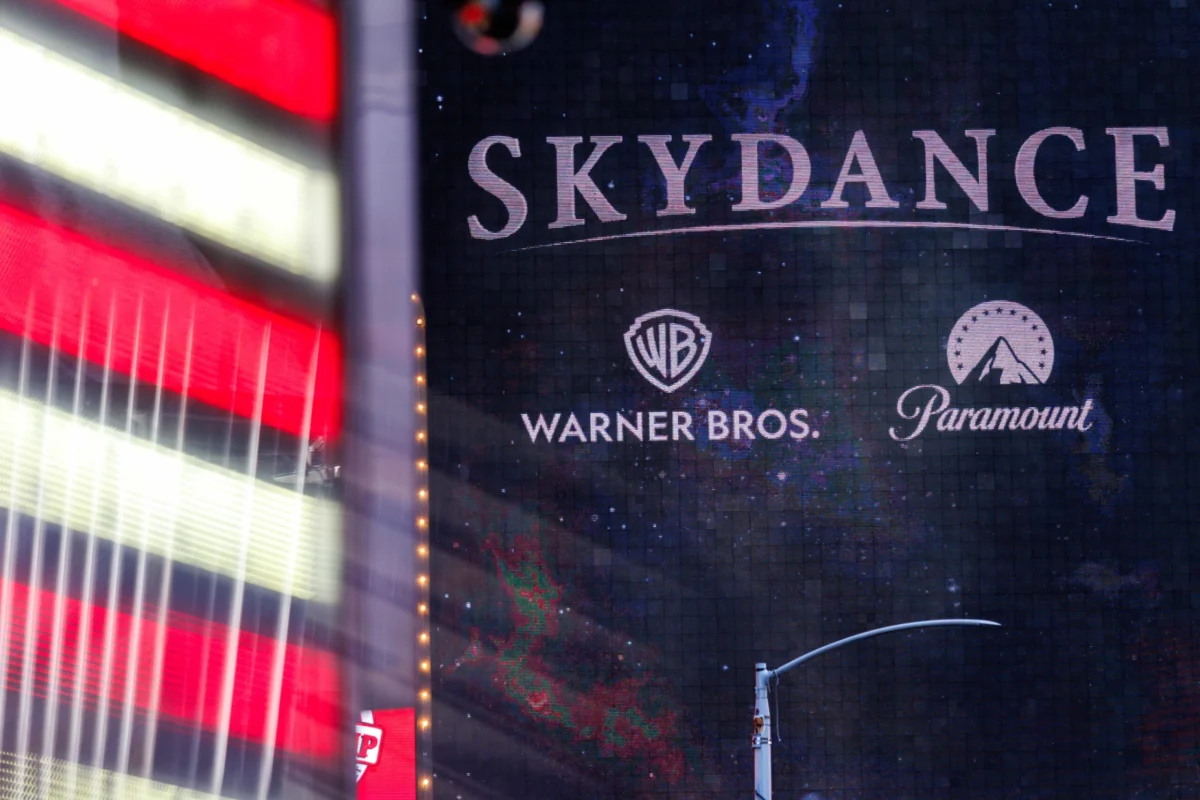
NEW YORK — In what marks a seismic, landscape-altering realignment of the global entertainment ecosystem, the monumental $110 billion mega-merger uniting Skydance Media, Paramount Global, and Warner Bros. Discovery officially closed on Tuesday morning. Trading under its brand-new ticker symbol SKYD on the New York Stock Exchange (NYSE)—a direct evolution from Paramount’s former PSKY designation—shares encountered immediate headwinds. Skydance stock slipped 3% during its debut session, closing at $9.51.
The retreat on Tuesday extends a broader downward trajectory for the equity, which has pulled back approximately 15% since the tripartite consolidation was first publicly floated in February. While market watchers note that historical comparisons are somewhat imperfect given that the stock previously traded on the Nasdaq, the overarching sentiment reflects a Wall Street community grappling with the immense operational complexities, towering debt loads, and structural industry challenges inherent in the newly formed media titan.
Despite the initial market hesitation, Tuesday’s completion of the transaction caps off months of high-stakes corporate maneuvering, eleventh-hour regulatory hurdles, and a historic reshaping of Hollywood’s power dynamics. The newly minted mega-company launches out of the gate with a staggering $70 billion in pro-forma annual revenue, commanding an unprecedented arsenal of iconic intellectual property, legendary film and television studios, and premier linear networks.
Main Facts: Anatomy of a New Entertainment Colossus
The finalized merger marries an extraordinary breadth of cultural touchstones and foundational entertainment assets under the singular banner of Skydance. The combined entity now boasts control over major Hollywood film and television production houses, including the historic Warner Bros. and Paramount studios, alongside a formidable television and cable footprint encompassing CBS, HBO, CNN, and Nickelodeon.
Under the leadership of CEO David Ellison, the combined enterprise aims to leverage this unprecedented scale to dominate both the traditional linear landscape and the fiercely competitive streaming arena. However, the path to this consolidation has been exceptionally rocky. The deal faced a dramatic eleventh-hour delay over the summer, brought on by a flurry of coordinated antitrust lawsuits filed by 12 state attorneys general and the Writers Guild of America (WGA), who expressed profound concerns over market concentration, labor impacts, and consumer choice.
Ultimately clearing these legal and regulatory roadblocks, the transaction crossed the finish line Tuesday morning just prior to the opening bell on Wall Street, instantly establishing Skydance as one of the most powerful—and heavily scrutinized—media corporations on the globe.
Chronology of a Mega-Deal: From February Proposal to NYSE Debut
The realization of the Skydance-Paramount-Warner Bros. Discovery consolidation represents one of the fastest and most aggressive corporate consolidations in modern media history:
- February: Whispers and formal proposals regarding the tripartite merger begin circulating through financial markets, pitching a bold vision to unite Skydance’s technology-forward production apparatus with the deep catalogs of Paramount and Warner Bros. Discovery. Initial market reactions immediately begin pricing in the massive scale—and corresponding complexity—of the transaction.
- Spring to Early Summer: As corporate teams draft the intricate terms of the combination, regulatory scrutiny mounts. Antitrust concerns ignite across the country, culminating in legal challenges spearheaded by 12 states alongside the Writers Guild of America, temporarily throwing the summer closing timeline into severe jeopardy.
- Late Summer: Legal teams work furiously to navigate the multi-state antitrust hurdles and labor objections, ultimately clearing a path forward for the corporate integration. Preparations begin in earnest to migrate stock listings and rebrand operations.
- Tuesday Morning (Pre-Market): The $110 billion mega-merger officially closes, bringing an end to months of speculation and establishing a $70 billion pro-forma revenue giant.
- Tuesday Trading Session: Skydance officially debuts on the New York Stock Exchange under the ticker symbol SKYD, transitioning from its historical Nasdaq footprint. Shares drop 3% on Day One to finish at $9.51, reflecting a cautious investor reception amid broader debt and integration concerns.
Supporting Data: Debt, Leverage, and the Balance Sheet
While the strategic vision behind the merger is grand in scale, the financial architecture underpinning the deal has raised immediate red flags among credit markets and institutional investors. The transaction initially saddles the newly formed corporate giant with an eye-watering $80 billion in debt.
With a leverage ratio dangerously approaching seven times EBITDA (Earnings Before Interest, Taxes, Depreciation, and Amortization), the financial community has been quick to assess the vulnerabilities. Mirroring these anxieties, credit ratings agency Fitch slashed Skydance’s debt rating on Tuesday, pointing explicitly to the massive debt burden. Fitch’s downgrade advisory highlighted a combination of systemic pressures, including:
- Ongoing, structural declines in linear television revenues.
- Relentless, margin-shrinking competition within the global streaming ecosystem.
- The inherent financial volatility and "hit-driven content risk" associated with major motion picture and television production.
Furthermore, analysts and institutional portfolio managers have yet to issue definitive consensus reports. Because CEO David Ellison and his executive team spent Tuesday managing internal morale—meeting with employees on the Warner Bros. lot in Burbank and holding press events across town at Paramount—management has not yet delivered its comprehensive, formal pitch to Wall Street. Consequently, equity analysts are still poring through newly filed SEC documents, adjusting financial models, and recalibrating price targets for the newborn stock.
Official Responses and Stakeholder Perspectives
Facing immediate scrutiny over the company’s leverage and market debut, key architects of the deal have stepped forward to defend the long-term viability and transformational upside of the consolidation.
Gerry Cardinale, founder of RedBird Capital and a prominent Skydance board member, has emerged as one of the most vocal champions of the merger. Acknowledging the undeniable scale of the $80 billion debt load, Cardinale has aggressively signaled his confidence by personally injecting $4 billion of capital into Skydance.
Speaking at a recent Bloomberg conference in Los Angeles, Cardinale framed himself unapologetically as "a growth guy." He maintained that he is "all in" on the transaction, arguing that the combination of elite intellectual property, globally recognized brands, and an advanced technology-forward strategy will generate substantial organic revenue growth capable of overcoming broader industry headwinds. According to Cardinale, traditional debt metrics fail to capture the unique compounding value of uniting these legacy libraries under modern production methodologies.
On the operational front, leadership has prioritized internal stabilization. CEO David Ellison, alongside key members of his executive team, used Tuesday’s milestone to engage directly with the workforce. Town hall meetings held on the Warner Bros. studio lot sought to calm anxieties surrounding anticipated corporate restructuring, workforce reductions, and cultural integration following months of merger-related turbulence.
Industry Implications: A New Era for Hollywood and Wall Street
The successful closure of the Skydance-Paramount-Warner Bros. Discovery merger signals a decisive turning point in the modern entertainment era. For years, legacy media companies have struggled to adapt to the financial gravity of the streaming transition, suffering from bleeding linear cable revenues and soaring content production costs. By welding these three giants together, the leadership team is betting that sheer mass, cost-synergies, and a diversified portfolio spanning theatrical film, prestige television, and global news will provide the necessary defensive moat.
However, the immediate 3% drop in SKYD stock and the swift debt downgrade by Fitch serve as a stark reminder that Wall Street’s patience will not be infinite. The honeymoon phase for the new management team is exceptionally short.
Moving forward, the primary test for David Ellison and his executive cadre will not merely be creative—managing legendary franchises like Star Trek, Mission: Impossible, DC Universe, and the HBO prestige slate—but financial. To win over skeptical institutional investors and stabilize the equity, Skydance must successfully execute aggressive cost-integration strategies, service its towering debt obligations without triggering further credit downgrades, and prove that a $110 billion corporate marriage can thrive in an unforgiving, digitally disrupted media landscape.
