
Julianne Moore to Receive Lifetime Achievement Honor at Rome Film Festival Amid Acclaim for ‘The Debut’
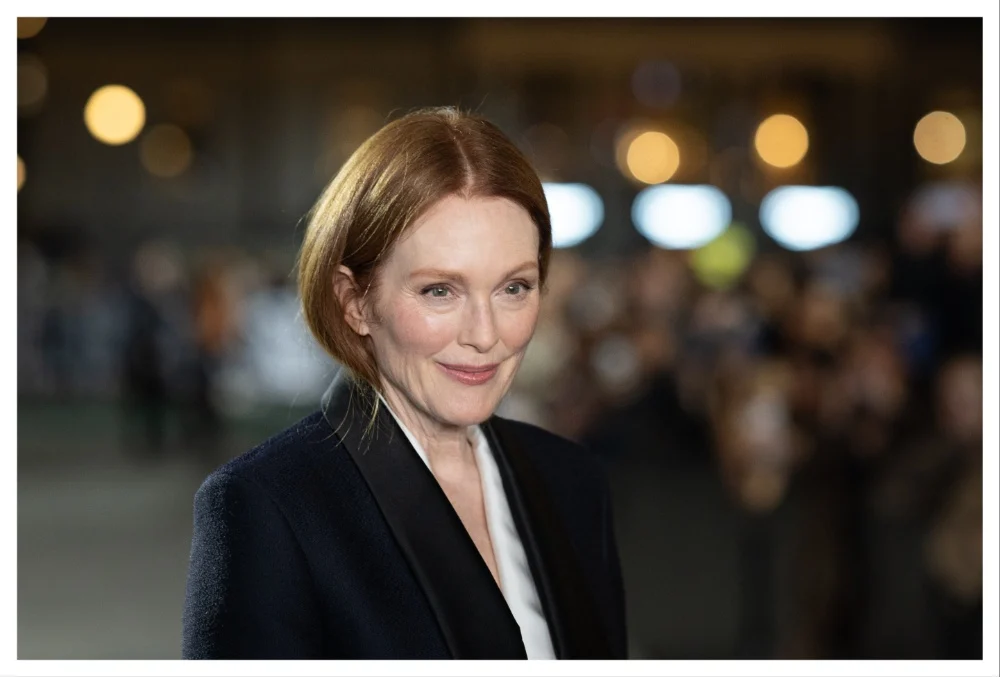
The Rome Film Festival has announced that Academy Award-winning actress Julianne Moore will be the recipient of its prestigious Lifetime Achievement Award at this year’s edition of the festival, which runs from October 13 to October 25. The accolade serves as a capstone to a career defined by fearless artistic choices, transformative performances, and a rare ability to bridge the gap between high-concept independent cinema and mainstream acclaim.
The announcement, delivered by Salvatore Nastasi, president of the Fondazione Cinema per Roma, underscores the festival’s commitment to honoring figures whose bodies of work have fundamentally reshaped the landscape of modern acting. Moore, a performer known for her chameleon-like ability to inhabit characters ranging from the fragile to the formidable, will be present in Rome to accept the award. In a gesture that highlights her ongoing creative partnership with filmmaker Jesse Eisenberg, the prize will be presented by the director himself during the Italian premiere of their latest collaboration, The Debut.
A Partnership Forged in Creative Ambition
The presentation of the award by Jesse Eisenberg is more than a formal ceremony; it marks the evolution of a burgeoning directorial partnership. The Debut, which serves as Eisenberg’s third feature film as a director, represents the second time he has cast Moore in a lead role. The pair first collaborated on Eisenberg’s 2022 directorial debut, When You Finish Saving the World, a film that established a distinct, wry, and deeply humanistic tone that has clearly matured in their latest outing.
In The Debut, Moore portrays Mona Friedman, a character who initially appears as a shy, unassuming housewife. However, the film tracks a startling metamorphosis as Mona is cast in a bit part at a local community theater. What begins as a modest creative endeavor quickly descends into a battle for artistic supremacy. Mona, embracing a zealous, uncompromising form of Method acting, becomes determined to protect the integrity of her marginal role, ultimately waging an escalating war against the show’s domineering director.
The film has already begun to generate significant buzz on the international circuit. Following its rapturous premiere at the Telluride Film Festival, The Debut made its international debut at the Zurich Film Festival in September, where Moore was simultaneously honored with the Golden Icon Award. The dual recognition across European festivals cements her status as an enduring icon of international cinema.
Critical Reception and the “Blooming” of Mona Friedman
The critical response to The Debut has been overwhelmingly positive, with particular focus placed on Moore’s ability to navigate the complex psychological terrain of her character. Variety chief film critic Owen Gleiberman, in his review, lauded the film as a "twisted love letter to the glory of community theater."
Gleiberman noted, "What holds it together is the suppleness of Eisenberg’s voice as a writer-director (the wit that singes, the story that never stops poking around corners), and the utterly astonishing performance of Julianne Moore, who plays a crumpled wallflower in dire need of blooming. Oh, does she bloom."
This "blooming" of the character is indicative of the depth Moore brings to even the most unconventional scripts. By channeling the neuroses of a suburban housewife into the hyper-fixated intensity of an uncompromising performer, Moore provides a performance that is both comedic and profoundly unsettling. Her willingness to play against type—or rather, to subvert the expectations of her typical "crumpled" characters—has been the hallmark of her career for over three decades.
A Legacy of Excellence: A Chronological Overview
Julianne Moore’s career is a masterclass in versatility. Her journey to becoming one of the most decorated actresses in the history of the medium is characterized by a refusal to be pigeonholed.
The Rise to Prominence (1990s)
Moore first captured the attention of audiences and critics in the mid-1990s. Her breakout role in Robert Altman’s Short Cuts (1993) demonstrated an immediate ability to convey raw, unvarnished emotion. This was quickly followed by her tour-de-force performance in Paul Thomas Anderson’s Boogie Nights (1997), for which she received her first Oscar nomination. Her portrayal of Amber Waves—a porn star struggling with the desire for a traditional family—remains a seminal performance in American cinema, balancing heartbreak with a desperate, maternal longing.
The Peak of Acclaim (2000s)
The early 2000s saw Moore become the first actress in history to receive two Academy Award nominations in the same year for separate films: Far From Heaven and The Hours (2002). Her work in Far From Heaven earned her the Best Actress award at the Venice Film Festival, while her performance in The Hours won her the Silver Bear at the Berlin International Film Festival. These roles solidified her reputation as an actress who could carry the weight of period pieces while infusing them with contemporary emotional stakes.
Continued Mastery and the Oscar Win (2010s–Present)
The pinnacle of her awards success came in 2015 when she won the Academy Award for Best Actress for her harrowing, empathetic portrayal of a linguistics professor battling early-onset Alzheimer’s in Still Alice. Prior to that win, she had already been honored at the Cannes Film Festival for her work in David Cronenberg’s Maps to the Stars (2014), making her one of the few actors to have been awarded Best Actress prizes at all three of the “Big Three” European film festivals (Cannes, Venice, and Berlin).
Implications for the Industry
The decision by the Rome Film Festival to honor Moore at this stage in her career speaks to the evolving nature of “lifetime achievement” recognition. Rather than marking the end of a career, such awards in the modern era serve to highlight an artist who is actively participating in the current cultural conversation.
By pairing the honor with the premiere of The Debut, the festival is effectively highlighting the bridge between the established masters of the craft and the next generation of visionary directors like Jesse Eisenberg. For Eisenberg, having a performer of Moore’s caliber anchor his work provides the necessary weight for his idiosyncratic scripts to resonate with wider audiences.
Furthermore, the focus on The Debut—a film about the struggles of community theater—serves as a meta-commentary on the nature of acting itself. Moore’s career has often been defined by her ability to elevate material through sheer force of will, much like the character of Mona Friedman. This thematic alignment is likely not lost on the programmers at the Rome Film Festival, who are positioning the event as a celebration of both the history of cinema and its ongoing, unpredictable future.
Official Responses and Festival Outlook
The announcement from Salvatore Nastasi, representing the Fondazione Cinema per Roma, was met with widespread approval from the global film community. "Julianne Moore is an actress who defines the very essence of the craft," the statement read. "Her ability to inhabit disparate personas while maintaining a core of unmistakable authenticity is rare. It is our distinct honor to recognize her contributions to the art form in Rome."
As the festival prepares for its October 13 start date, anticipation is building not just for the awards ceremony, but for the impact The Debut will have on the awards season conversation. With a premiere schedule that has taken the film from the mountains of Telluride to the urban centers of Zurich and now to the historic theaters of Rome, the film is clearly being positioned as a serious contender for critics’ year-end lists.
For Julianne Moore, the Rome Film Festival honor serves as a testament to a career built on the pursuit of artistic truth. Whether playing a housewife seeking self-actualization or a woman losing her memory, Moore has consistently invited audiences to look closer, to empathize deeper, and to appreciate the transformative power of the screen. As she stands on the stage in Rome, accepting the accolades of her peers, she remains, as ever, an actress in the prime of her blooming.
