Directing the Algorithm: How Autodesk Flow Studio is Transforming AI Video from Guesswork into Precision Filmmaking
Main Facts
The landscape of generative artificial intelligence in media production is undergoing a tectonic shift. Autodesk is moving beyond simple, prompt-driven video generation with the introduction of its FlowStudio and its flagship 3D Editor + Canvas workflow.
Rather than relying on a black-box text prompt to synthesize a complete video from scratch—a method that frequently yields unpredictable results—Flow Studio bridges the gap between traditional 3D computer graphics (CG) and modern generative 2D video models. It grants filmmakers direct, spatial control over camera placement, actor blocking, and scene layout.
Unveiled and discussed extensively in a recent fxpodcast featuring Nikola Todorovic—co-founder of Wonder Dynamics and now a key figure at Autodesk following the company’s strategic acquisition—Flow Studio is engineered to solve one of generative AI’s most persistent flaws: the lack of granular, director-level control.
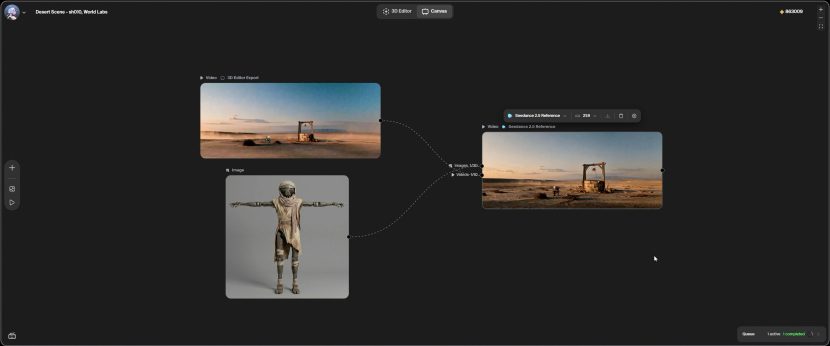
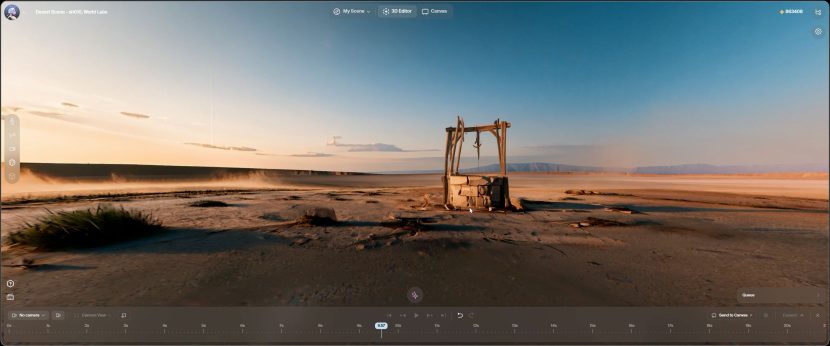
The platform combines interactive 3D scene construction with advanced 2D node-based generative environments. Artists can layout scenes using characters, animation, motion-capture data, camera tracks, and spatially coherent environments—such as Gaussian splat-based worlds created with World Labs’ Marble. Once the spatial composition, performance timing, and camera moves are locked down, the system leverages state-of-the-art AI video models to handle the final 20 percent of production: lighting integration, atmospheric simulation, physics effects, and cinematic texturing.
Designed as a cloud-based application, Flow Studio scales from individual creators and lean creative teams of three to five people up to major visual effects (VFX) facilities and film studios.
Chronology
To understand how Autodesk Flow Studio arrived at this technical breakthrough, it is helpful to trace the technological trajectory of AI-assisted filmmaking over the past several years:
The Rise of Text-to-Video (2022–2024): Generative video models captured the public and industry imagination by converting text prompts into hyper-realistic 2D video snippets. However, these tools proved notoriously difficult to direct. Filmmakers could not easily change a camera angle, move an object, or adjust an actor’s posture without regenerating the entire clip, leading to widespread industry criticism regarding random outputs and generic "AI slop."
The Wonder Dynamics Foundation: Concurrently, Wonder Dynamics pioneered AI tools designed to automate the integration of CG characters into live-action footage. The platform cleverly combined roughly 25 distinct machine learning, computer vision, and generative systems behind a streamlined interface.
The Autodesk Acquisition and Integration: Autodesk recognized the potential of combining precise pipeline control with AI acceleration. Bringing Nikola Todorovic and the Wonder Dynamics team onboard set the stage for a new architecture.
The Introduction of Flow Studio (2026): Autodesk officially launched Flow Studio, shifting the industry narrative from "prompt-and-pray" video generation to a hybrid 3D/2D workflow. By introducing the 3D Editor alongside the node-based Canvas, the company provided creators with a sandbox where traditional cinematic principles dictate generative AI outputs.
Supporting Data & Technical Architecture
Flow Studio’s architecture breaks down the filmmaking process into distinct, manageable layers, addressing the complex mathematics of digital production without requiring the user to master every underlying algorithm.
The 80/20 Rule of Generative AI
Todorovic highlights a foundational industry challenge known as generative AI’s "80/20 rule." Modern AI models can generate the first 80 percent of an image or sequence with astonishing speed and visual fidelity. The bottleneck occurs during the final 20 percent—when a director requests a precise revision, such as shifting an object two inches to the left, altering an emotional beat in a performance, or tweaking a specific curve in a camera track. Prompt-only systems usually fail at this stage because they lack an underlying spatial coordinate system. Flow Studio resolves this by anchoring the generation process inside a real 3D environment.
The Dual-Environment Workflow: 3D Editor + Canvas
The 3D Editor: Creators assemble shots spatially. They can position cameras, block character movements, and import motion-capture data. Camera paths can be keyframed manually or derived from reference tracks. Environments can be constructed using cutting-edge tools like World Labs’ Marble, generating fully interactive, spatially coherent Gaussian splat worlds.
The Canvas: Once the blocking and camera choreography are established in 3D, artists move into Canvas, a node-based 2D environment. Here, state-of-the-art AI video models contribute what they do best: texturing, atmospheric lighting, particle simulations, and hyper-realistic rendering. Crucially, the 3D scene does not always need to output final pixels; its primary purpose is to act as an unyielding structural skeleton that guides the generative result.
Performance Before Prompting
A major point of emphasis in Flow Studio’s philosophy is the primacy of recorded human performance. While text-to-video tools and audio-driven animation can generate movement, they frequently result in generalized gestures and flattened emotional expressions. Todorovic argues that distinctive acting requires human intent. Flow Studio’s workflow encourages creators to begin with recorded video and audio of an actor. This performance data drives the digital character, preserving exact timing and emotional nuance before generative models step in to refine the final visual aesthetic.
Cloud Scalability and Performance
Operating entirely in the cloud, Flow Studio maintains high interactivity within its 3D Editor. While canvas generation times vary based on the chosen AI model, shot length, and target resolution—and world-generation processes currently require several minutes to compile—the infrastructure is built to scale fluidly according to the user’s demands.
Official Responses and Industry Perspectives
The philosophy driving Autodesk Flow Studio centers on empowering creators rather than replacing them. Speaking on the fxpodcast, Nikola Todorovic drew parallels to historical technological shifts in filmmaking:
"New filmmaking technologies begin in social content and experimentation, then move through commercials, music videos and independent productions before reaching major studio pipelines."
Todorovic emphasizes that traditional computer graphics pipelines often force artists to over-build assets—constructing entire digital sets far beyond what the camera lens will ever capture, just in case a director changes their mind during editing. AI-assisted workflows alter this dynamic by shifting technical complexity into the background.
Furthermore, Todorovic addresses the common fear that AI will replace human artistry with automated shortcuts:
"This is not about replacing filmmaking with a prompt. Filmmakers have always relied on specialists without personally solving every physical equation involved. The opportunity is to give more storytellers access to complex techniques without requiring mastery of every layer of the underlying mathematics."
By allowing directors to focus on staging, composition, and performance rather than low-level technical execution, Flow Studio aims to democratize high-end visual storytelling.
Implications for the Future of Filmmaking
The commercial and creative release of Autodesk Flow Studio marks a pivotal maturation point for generative media tools. Several key implications emerge for the film, television, and advertising industries:
1. The Death of "AI Slop"
As audiences grow fatigued by the generic, unpolished look of early generative video, tools that offer meticulous creative control will become mandatory. By forcing generative models to adhere to rigid 3D spatial parameters, camera tracks, and human-driven performances, studios can eliminate the uncanny, drifting artifacts characteristic of unguided text-to-video applications.
2. Democratization of High-End VFX
Independent filmmakers and small teams of three to five people now possess access to workflows that previously required massive pipeline infrastructure and armies of technical directors. By abstracting the heavy mathematical lifting into cloud-based AI models while retaining traditional 3D layout tools, Autodesk is lowering the barrier to entry for cinematic world-building.
3. A Familiar Adoption Curve
As Todorovic predicted, the integration of tools like Flow Studio will likely permeate the industry from the bottom up. Independent creators, music video directors, and commercial houses will spearhead experimentation, refining the collaborative and operational protocols before major motion picture studios adopt the software for tentpole feature films.
4. Redefining the Role of the Artist
The rise of hybrid 3D/AI tools does not diminish the value of the artist; rather, it elevates the director and layout artist to higher levels of creative decision-making. When technical bottlenecks are cleared away by intelligent background systems, the core currency of filmmaking shifts back to what it has always been: strong performances, precise composition, and compelling visual storytelling.