‘KPop Demon Hunters’ Built a Soundtrack to Slay Global Pop Charts
When directors Maggie Kang and Chris Appelhans set out to helm Netflix’s original animated musical feature KPopDemonHunters, they weren’t merely aiming to construct a standard, family-friendly cartoon with catchy tunes. Instead, they envisioned an authentic cultural convergence—a project where world-class animation meets the high-gloss, ultra-competitive universe of modern K-pop.
The gamble has more than paid off. Since its surprise summer debut on Netflix on June 20, the film has proven to be an unstoppable juggernaut, slicing through the streaming competition with the precision of its lead characters’ demon-slaying blades. Blending chart-topping pop anthems with a whimsical fantasy premise, KPop Demon Hunters has transcended its medium to become a genuine global pop-cultural phenomenon.
The Main Facts: A Dual Threat on Screens and Charts
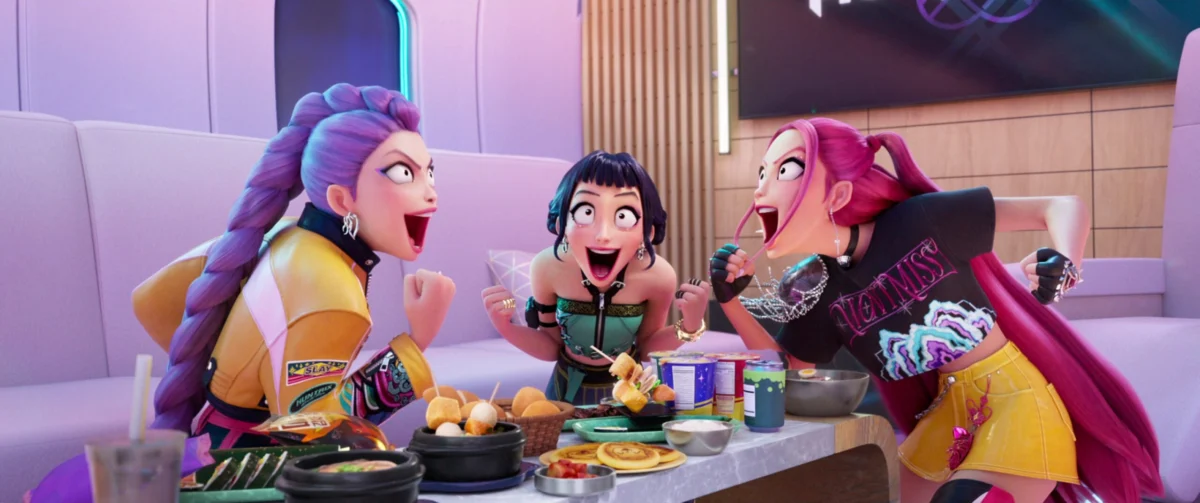
At its core, KPop Demon Hunters follows Huntr/x, a fictional K-pop powerhouse trio consisting of Rumi (voiced by Arden Cho), Mira (May Hong), and Zoey (Ji-young Yoo). By day—and often by night—they rule the international pop charts. However, their true, blood-sworn calling is far more perilous: protecting humanity from supernatural forces as elite demon hunters.
Their worlds collide catastrophically with the arrival of the Saja Boys, a rival boy band that quickly captures the hearts of millions—only for the girls to discover that the heartthrobs are, in fact, demons in disguise. The girls remain humanity’s sole line of defense.
Yet, the fiction mirrors reality. Just as Huntr/x dominates their fictional industry, the film itself has dominated real-world metrics. According to Netflix’s internal data for the week ending July 13, KPop Demon Hunters spent its fourth consecutive week in the Netflix Global Top 10 (English language). It secured 40,400,000 hours viewed, proudly reclaiming the #1 position after briefly being bumped to #2 the previous week by the high-profile release of Charlize Theron’s action sequel, The Old Guard 2.
Beyond streaming numbers, the project’s accompanying music has achieved what few movie soundtracks ever manage: it has conquered the actual music industry. The film’s breakout single, “Golden,” currently sits at #1 on both the Billboard Global 200 and the Billboard Global Excluding U.S. charts—a feat that has prompted Netflix to formally position the track for major awards-season consideration. Meanwhile, the Saja Boys’ track “Your Idol” recently soared to the top of the U.S. Spotify chart, officially making them the highest-charting K-pop group in Spotify history, outperforming even real-life juggernauts like BTS. Furthermore, the complete film soundtrack holds firm at #2 on the Billboard Global 200.
Chronology: From Concept Camps to Global Domination
The journey of KPop Demon Hunters to the top of the cultural zeitgeist was a meticulous, years-long multi-stage process that challenged traditional Hollywood animation workflows.
Pre-Production and World-Building (2023–2024): Long before a single note of music was recorded or a frame of animation was rendered, directors Maggie Kang and Chris Appelhans spent a full year collaborating closely with producer Michelle Wong and the creative team. The goal was to establish a seamless marriage between a compelling narrative and authentic pop-music structure.
The Songwriting Camps (Mid-to-Late 2024): Rejecting the traditional Hollywood approach of hiring a single composer to write "in the style of" K-pop, Sony and the production team assembled a veritable dream team of real-world K-pop hitmakers. Partnering with major South Korean entities like The Black Label, writers such as Stephen Kirk, Jenna Andrews, Lindgren, EJAE, and Mark Sonnenblick were brought together in collaborative song camps.
Iterative Refining (Late 2024): Unlike standard cinematic scoring, the team produced full album versions of the songs first, treating them as standalone commercial records before "slicing and dicing" them to fit specific narrative beats in the script. Tracks like the pivotal anthem "Golden" went through an intensive creative crucible, spanning five different writers and seven distinct iterations before the final version was locked in as late as December—an exceptionally late stage for feature animation.
The Premiere and Global Rollout (June 20, 2025): The film premiered quietly on Netflix on June 20, immediately capturing critical acclaim and a massive word-of-mouth following.
Chart Ascendancy (July 2025): By mid-July, the soundtrack singles began breaking records globally. "Golden" secured the top spot on Billboard, while the Saja Boys broke streaming milestones on Spotify, culminating in viral dance covers, YouTube covers, and a surprise livestream shout-out from members of BTS.
Supporting Data: By the Numbers
To understand the sheer magnitude of the KPop Demon Hunters phenomenon, one must look at the hard data:
40.4 Million: The total hours viewed globally for the week ending July 13 alone, propelling the film back to the #1 spot on Netflix’s English-language film list.
4 Weeks: The duration the film has maintained a stronghold in the Netflix Global Top 10.
#1: The current ranking of the breakout single “Golden” on both the Billboard Global 200 and Billboard Global Excluding U.S. charts.
#2: The chart position of the complete KPop Demon Hunters official soundtrack on the Billboard Global 200.
30+: The total number of fully realized songs written and considered before the creative team finalized the core musical lineup for the film.
7: The number of distinct iterations the flagship track "Golden" underwent before achieving its final, chart-topping form.
Official Responses: Inside the Musical Mastermind
In an exclusive interview with IndieWire, Executive Music Producer Ian Eisendrath opened up about the intensive process required to bring the sound of KPop Demon Hunters to life. He discussed the core directive given to the creative team: to build an authentic K-pop album that could stand entirely on its own outside the theater walls.
“The directive was very much, ‘We want to create a soundtrack of real K-pop hits,’” Eisendrath told IndieWire. “This is not one of those films where it’s like, ‘Let’s hire some people to write in the style of it.’ This soundtrack needs to land and exist as a K-pop album, but also work within the film and cover the narrative territory it needs to cover and fit in the mouths of each of the characters, which is not something that K-pop traditionally does.”
Eisendrath also detailed the unique cross-pollination model used during production, mirroring the real-world creation process of modern pop hits rather than relying on a solitary studio composer.
“Sony had assembled an army of K-pop writers… There was so much cross-pollination. It was truly an ensemble of writers, which happens in pop music. There are song camps where everyone gets together and collaborates, but usually not in film.”
Reflecting on the grueling, multi-iteration development of the film’s defining anthem, "Golden," Eisendrath highlighted the immense narrative heavy lifting the track had to perform:
"It had to serve the function of what in most film musicals is called the ‘I want song,’… At the same time, it had to somehow uncover Rumi’s deeper need and want, which is to erase the demon patterns, which is the moment the audience realizes, Oh, my gosh, she’s a demon. It had to do all those things."
The emotional reward, according to Eisendrath, has been witnessing the global embrace of the music—particularly from Korean fans and real-life K-pop royalty like BTS, who recently riffed on the track "Soda Pop" during a live broadcast.
"To see singers on YouTube doing covers and even dancers doing the moves… I don’t think there’s any greater sort of reward from doing this project. Also, this project is Maggie Kang’s. This is so deeply from her brain and heart. She loves K-pop, and that was such a driving force."
When asked about the prospect of returning to the universe for a follow-up, Eisendrath didn’t hesitate:
"I would love it. It would be a dream. I could do this forever."
Implications: A New Paradigm for Animated Musicals
The unprecedented success of KPop Demon Hunters signals a major shift in how Hollywood approaches animated musicals, transmedia storytelling, and cross-cultural representation.
For decades, animated features—even those with successful musical components—treated soundtracks as ancillary marketing products designed to support the film. KPop Demon Hunters has flipped this script entirely. By treating the music as a primary commercial release first and a cinematic score second, Netflix and the film’s producers have unlocked a blueprint for organic, multi-platform engagement. The songs do not merely service the plot; they live, breathe, and compete on equal footing with real-world pop acts in the global music ecosystem.
Furthermore, the project validates the deep, authentic creative leadership of diaspora and international creators. Conceived from the personal passion of director Maggie Kang and executed through genuine collaboration with South Korean hitmakers, the film avoids the hollow pastiche that often plagues Western depictions of foreign pop cultures. Instead, it respects its subject matter, earning the ultimate stamp of approval from both global listeners and the very real-life icons of the K-pop industry.
As Netflix prepares its awards-season push—particularly for power-anthem "Golden"—the conversation is no longer just about whether KPop Demon Hunters is a successful streaming title. The industry must now reckon with a new reality: animated characters can trade blows with real pop superstars, and the global box office and the music charts are no longer separate domains.
KPop Demon Hunters is currently streaming worldwide on Netflix.