
Major Price Drop: Nikon Z8 Mirrorless Camera Receives a Substantial $1,000 USD Discount
By Matthew Allard ACS
Published for photography and cinematography professionals worldwide.
Main Facts: The $1,000 Nikon Z8 Price Reduction
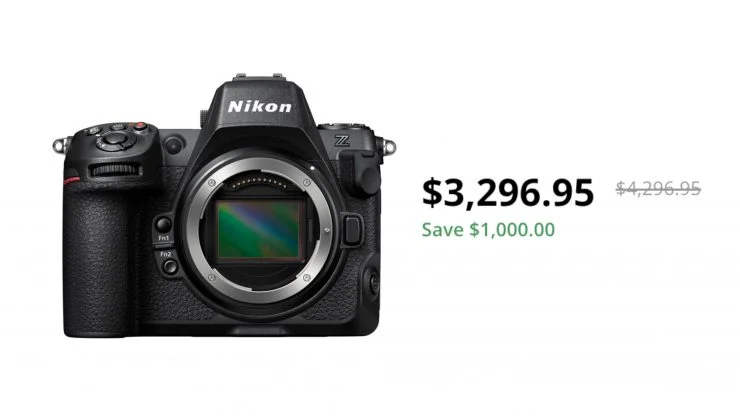
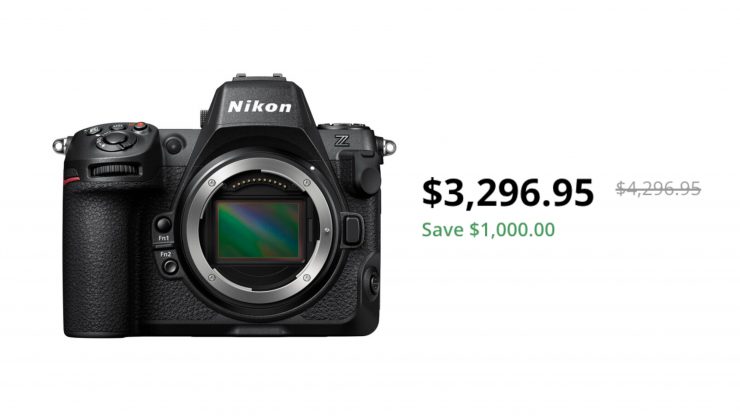
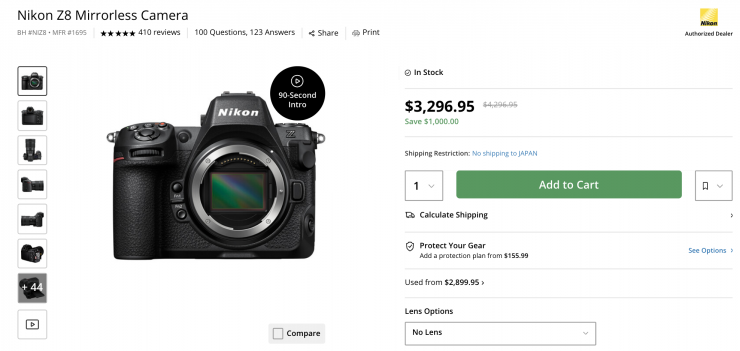
For photographers and videographers looking to upgrade their production kits without breaking the bank, a major retail promotion has just dropped the cost of entry for one of the industry’s most acclaimed hybrid systems. For a limited time, buyers can secure a massive $1,000 USD discount on the acclaimed Nikon Z8 Mirrorless Camera, bringing its purchase price down to $3,296.25 USD.
The Nikon Z8 has long been celebrated as a powerhouse in the modern content creation landscape. By distilling the raw capabilities of Nikon’s flagship Z9 into a significantly smaller, lighter, and more ergonomically agile body, the Z8 bridges the gap between high-end cinema production and fast-paced field photography. This rare four-figure price slash represents one of the most significant promotional discounts seen for the Z8 since its initial market launch, making it an exceptionally attractive proposition for independent creators, wedding shooters, documentary filmmakers, and studio professionals alike.
Chronology: The Evolution and Market Journey of the Nikon Z8
To understand the significance of this current price drop, it is helpful to examine the timeline of how Nikon engineered and rolled out its cutting-edge mirrorless ecosystem.
The Flagship Foundation (Late 2021)
The story of the Z8 truly begins with the introduction of the Nikon Z9. Released to widespread critical acclaim, the Z9 broke convention by completely eliminating the mechanical shutter, relying entirely on an ultra-fast electronic shutter paired with a stacked CMOS sensor. While the Z9 revolutionized high-speed sports and wildlife photography alongside internal 8K video capture, its bulky, integrated vertical-grip design was not favored by everyone. Travel photographers, gimbal operators, and run-and-gun documentary crews demanded the same imaging horsepower in a more traditional, streamlined form factor.
The Arrival of the Z8 (May 2023)
Answering the demands of the global creator community, Nikon officially announced the Z8 in the spring of 2023. Billed as the "ultimate hybrid camera," the Z8 inherited virtually all of the core technologies of the Z9—including the same 45.7-megapixel stacked sensor, the lightning-fast EXPEED 7 image processor, and the sophisticated deep-learning autofocus system—housed in a body that was roughly 30% smaller than the Z9 and 15% smaller than the legendary D850 DSLR.
Market Stabilization and Maturation (2023–2025)
Following its launch, the Nikon Z8 steadily carved out a dominant market share among hybrid shooters. Through a series of major firmware updates, Nikon continuously enhanced the camera’s capabilities, adding features such as dedicated pixel-shift shooting, enhanced subject-tracking modes, and optimized video codecs. Despite its high initial demand, market competition and supply chain normalization eventually paved the way for periodic promotional incentives.
The Current Milestone (Late 2026)
Culminating in the current retail landscape, major authorized dealers have introduced this unprecedented $1,000 USD price reduction. This strategic move signals a concerted effort to capture an even broader segment of the professional imaging market, putting top-tier cinematic and photographic tools directly into the hands of budget-conscious creators.
Supporting Data and Technical Specifications
The Nikon Z8 is not merely a downsized Z9; it is an engineering marvel that punches well above its weight class. A closer look at the core specifications reveals why this $1,000 discount is creating such a stir among industry professionals:
- Sensor & Processing: 45.7-megapixel FX-format stacked CMOS sensor paired with the EXPEED 7 image processor, delivering virtually zero rolling shutter distortion and lightning-fast readout speeds.
- Autofocus Performance: Advanced deep-learning AF system capable of simultaneously detecting and tracking nine distinct subject types (people, dogs, cats, birds, airplanes, cars, motorcycles, bicycles, and trains), even in low-light conditions down to -9 EV (with Starlight View mode).
- Video Capabilities: Internal recording of up to 8K/30p video in N-RAW, ProRes RAW HQ, 10-bit Apple ProRes 422 HQ, and 8-bit/10-bit H.265. It also supports 4K capture at up to 120p for ultra-smooth slow-motion playback.
- Physical Design: A rugged, weather-sealed magnesium alloy chassis that is significantly lighter and more compact than the Z9. Its reduced footprint makes it vastly superior for extended handheld shoots, drone integration, and multi-axis gimbal balancing.
- Viewfinder and Display: A bright, blackout-free Real-Live Viewfinder and a 4-axis tilting touchscreen LCD that offers flexible viewing angles whether shooting in horizontal or vertical orientations.
- Storage and Connectivity: Dual card slots (one CFexpress Type B / XQD slot and one SD UHS-II slot) alongside robust wireless connectivity options for seamless tethering and file transfer.
Official Responses and Industry Reception
Industry analysts, professional reviewers, and working cinematographers have overwhelmingly praised Nikon’s market strategy and the enduring performance of the Z8 ecosystem.
When the camera was first introduced, executive spokespersons from Nikon emphasized that the Z8 was designed to listen directly to the creative community. “We set out to deliver the uncompromising performance of our flagship technology in a form factor that addresses the mobility and agility required by modern multimedia storytellers,” noted representatives during the initial global rollout.
Independent reviews from respected platforms like Newsshooter have consistently highlighted the Z8’s remarkable balance between high-resolution photography and professional-grade cinema features. Cinematographers utilizing the Z8 on commercial and documentary sets have frequently pointed out that the inclusion of internal RAW recording formats, coupled with the camera’s reliable thermal management and battery efficiency, makes it one of the most cost-effective B-cameras or primary A-cameras available.

With the current $1,000 price drop, retail partners and industry insiders note that consumer response has been overwhelmingly positive. Demand has surged across major photographic supply outlets, reflecting the high value proposition of acquiring flagship-level gear at a heavily discounted price point.
Implications for Photographers, Videographers, and the Industry
The introduction of a $3,296.25 USD price tag for a camera of this caliber carries significant implications for the broader digital imaging market.
1. Lowering the Barrier to Entry for High-End Production
For freelance videographers, emerging filmmakers, and dedicated hobbyists, investing in high-end cinema-grade tools has traditionally required a prohibitive financial commitment. By reducing the price of the Z8 by $1,000, professional-grade 8K video capture, high-speed burst shooting, and advanced autofocus tracking are suddenly brought within reach for a wider demographic of creators.
2. Intensifying Competition in the Hybrid Camera Market
Camera manufacturers are locked in an intense war of attrition to capture the wallets of the modern hybrid creator—individuals who demand equal proficiency in still photography and high-end video production. Price adjustments of this magnitude force competing brands to re-evaluate their pricing strategies, promotions, and feature sets, ultimately benefiting the end consumer through better technology at more competitive price points.

3. Maximizing Investment in the Z-Mount Ecosystem
For Nikon, discounting the Z8 serves as an effective gateway to expand its broader Nikkor Z-mount lens ecosystem. Once a creator invests in a high-end camera body like the Z8, they naturally look to pair it with high-performance glass, ranging from versatile f/2.8 zoom lenses to ultra-sharp prime lenses. This hardware promotion helps solidify brand loyalty and encourages long-term system adoption.
4. Exceptional Value Retention and Longevity
Because the Z8 shares its core processing architecture and sensor technology with the professional Z9, its functional lifespan in the field is remarkably long. Firmware updates continue to inject new life and features into the body, ensuring that buyers taking advantage of this $1,000 discount today are investing in a tool that will remain relevant and competitive for years to come.
Conclusion
The decision to slash $1,000 off the retail price of the Nikon Z8 represents a rare and fleeting opportunity for media professionals to acquire a true hybrid powerhouse at an unbeatable value. Whether you are transitioning from older DSLR systems, expanding your documentary toolkit, or seeking a lightweight yet uncompromising companion for commercial shoots, the Z8 at $3,296.25 USD stands out as one of the most compelling investments in contemporary digital imaging.
Interested buyers should check authorized retail partners like B&H Photo Video promptly, as promotional pricing and stock availability are strictly limited.
