
Atomos Unveils Next-Generation Monitoring: The Shogun AV-19M and Shinobi 7 II
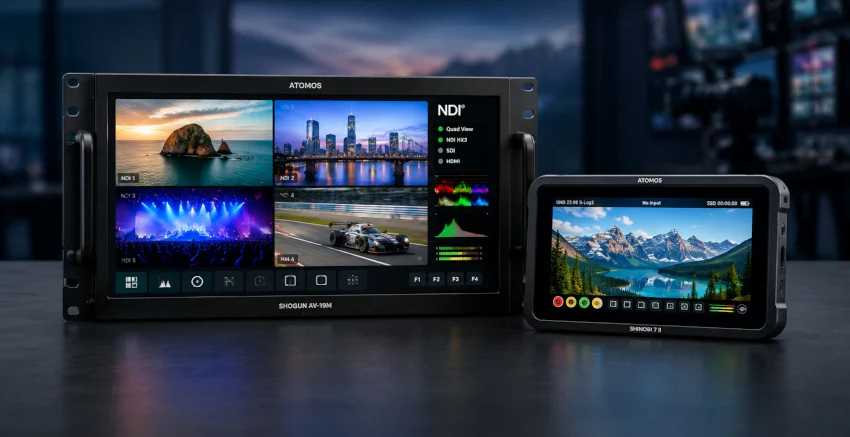
Following the conclusion of IBC 2026 in Amsterdam, the broadcast and cinema technology sector is buzzing with the latest hardware announcements from Atomos. Known for bridging the gap between professional-grade monitoring and accessible, high-performance recording solutions, Atomos has officially unveiled two new pillars of their monitoring lineup: the Shogun AV-19M and the Shinobi 7 II.
These two devices represent a strategic bifurcation in the company’s product roadmap, simultaneously catering to the high-density demands of IP-based broadcast infrastructure and the rugged, high-visibility requirements of modern on-set cinematography.
Main Facts: The New Monitoring Standard
The announcements address two disparate ends of the production spectrum. The Shogun AV-19M is a 19-inch 4K HDR rackmount monitor designed for the rigors of control rooms, outside broadcast (OB) trucks, and studio galleries. It integrates the latest in IP-based connectivity with traditional physical inputs, positioning itself as a "Swiss Army knife" for complex, hybrid workflows.
Conversely, the Shinobi 7 II is a refined, ultra-bright 7-inch touchscreen monitor designed for the camera operator and the solo shooter. With a staggering 2800-nit peak brightness, it is built to combat the most challenging outdoor lighting conditions while providing sophisticated camera control features that were once the domain of much larger, more expensive studio setups.
Chronology of the 2026 Product Launch
The unveiling at IBC 2026 served as the climax for months of speculation regarding how Atomos would adapt its ecosystem to the growing dominance of NDI (Network Device Interface) and the increasing reliance on USB-C integration for on-set camera management.
- Early September 2026: Atomos teases "Next-Generation Visual Clarity" in a social media campaign leading up to the IBC conference.
- September 15-18, 2026 (IBC 2026): Atomos officially debuts the Shogun AV-19M and Shinobi 7 II to live demonstrations at their Amsterdam booth, highlighting real-time quad-view NDI monitoring and sunlight-viewable camera control.
- Late September 2026: Pre-orders open for the Shinobi 7 II, with a targeted retail release for the end of the month.
- October 2026: The Shogun AV-19M is slated to begin shipping, targeting studio integrators and production houses looking to refresh their rack infrastructure.
Supporting Data and Technical Specifications
The Shogun AV-19M: A Hub for IP and Conventional Workflows
The Shogun AV-19M is fundamentally about consolidation. By integrating NDI HX3, 12G-SDI, and HDMI into a single 19-inch chassis, Atomos is acknowledging that modern production houses are rarely using a single signal standard.

- Connectivity: The inclusion of NDI HX3 reception allows users to tap into local area networks to pull video feeds directly into the monitor, reducing the need for lengthy, expensive cable runs.
- Display Capabilities: The 4K HDR DCI-P3 panel ensures that color-critical work—essential for broadcast and color grading—is accurate.
- Quad-View Functionality: The ability to monitor up to four NDI sources simultaneously is a massive efficiency booster for directors and technical directors who need to keep a pulse on multiple camera angles or transmission feeds without needing a separate multiviewer processor.
- Physical Infrastructure: At 19 inches, it is the perfect fit for standard server and equipment racks, with an optional ruggedized flypack for mobile units, ensuring that this monitor can move from the studio to a remote location without damage.
The Shinobi 7 II: Brightness Meets Control
The Shinobi 7 II is an evolution of the highly successful original Shinobi, but it addresses the most common request from the field: brightness and camera integration.
- Peak Luminance: With a 2800-nit panel, this monitor is designed to be visible even in direct, high-noon sunlight, where standard monitors often fail.
- USB-C Camera Control: This is the headline feature. By allowing the monitor to control aperture, shutter speed, ISO, and white balance, Atomos is shrinking the distance between the operator and the camera’s internal menu.
- Exposure and Focus Analysis: The inclusion of professional-grade tools like EL Zone, false color, and waveform, alongside 3D LUT support, allows for real-time visualization of Log-encoded footage, ensuring that the cinematographer’s vision is captured correctly on the sensor.
Official Perspectives from Atomos
In a statement following the IBC keynote, an Atomos representative noted that the company’s focus for the 2026-2027 cycle is "workflow fluidity." The goal of the Shogun AV-19M is to remove the "fear of the network," allowing broadcast engineers to trust NDI with the same reliability as physical SDI cabling.
Regarding the Shinobi 7 II, the company emphasized that "the best monitoring is the kind that doesn’t get in the way of the shot." By providing camera control, they aim to reduce the number of times an operator needs to touch the camera body, thereby reducing vibrations and accidental framing shifts during critical shots.
Implications for the Industry
The Shift Toward NDI-Centric Studios
The Shogun AV-19M is a clear signal that NDI is no longer an "emerging" technology; it is now a core requirement. By including quad-view monitoring, Atomos is effectively replacing small, rack-mounted multi-viewers. For production companies, this means less power draw, less heat in the server room, and a more streamlined path to 4K broadcast.
The "Camera-as-a-Platform" Concept
With the Shinobi 7 II, the monitor is no longer just a passive display. It is becoming the primary interface for the camera. As more manufacturers open their APIs for USB-C control, we can expect the monitor to become the "dashboard" of the production. This trend is likely to continue, with future updates potentially allowing for more advanced control, such as lens metadata injection and remote focus pulling directly from the monitor’s touch interface.
Economic Accessibility
At $1,899 for the Shogun AV-19M and $499 for the Shinobi 7 II, Atomos is maintaining its aggressive pricing strategy. These price points sit at a "pro-sumer to professional" sweet spot, making high-end monitoring accessible to independent creators and mid-sized production firms alike.

Conclusion
The release of the Shogun AV-19M and the Shinobi 7 II confirms that Atomos remains at the forefront of monitoring technology. By addressing the specific pain points of two very different user bases—the broadcast engineer needing a central nervous system for their signals, and the filmmaker needing a high-visibility, high-control partner for their camera—Atomos has solidified its market position.
As we move deeper into the 2026 production season, these monitors will likely become ubiquitous on sets ranging from high-budget commercial shoots to regional broadcast news. The integration of NDI into the rackmount form factor and USB-C into the portable form factor isn’t just an incremental update; it is a fundamental shift in how we monitor, control, and execute visual storytelling.
For those interested in upgrading their gear, the Shinobi 7 II is available for order immediately through authorized resellers, with the Shogun AV-19M following closely in October. As production workflows become increasingly digital and interconnected, tools like these will be the difference between a seamless broadcast and a technical bottleneck.
Disclaimer: This article contains information based on product releases from Atomos as of September 2026. Pricing and availability are subject to change based on local distribution and taxes.
