
The High-Concept Gamble: A Critical Post-Mortem of Star Trek: Strange New Worlds Season Four
In the year marking the 60th anniversary of the Star Trek franchise, Strange New Worlds (SNW) has arrived at a curious, perhaps inevitable, crossroads. By attempting to honor the legacy of the original series while simultaneously pushing the boundaries of modern television storytelling, the show’s fourth season served as a mirror for the current state of the franchise: brilliant, experimental, occasionally frustrating, and deeply ambitious. As the series moves toward its final season, the discourse surrounding its recent output provides a fascinating case study in the evolution of the procedural format in the streaming era.
The Shift to Leaner Seasons: A Double-Edged Sword
The modern industry trend toward shorter, more concise television seasons has been met with both applause and skepticism from critics and fans alike. Proponents argue that moving away from the grueling twenty-plus-episode production schedules of the 1990s—which often led to creative burnout and "filler" episodes like Deep Space Nine’s infamous "Prodigal Daughter"—allows for higher production values and more consistent writing quality. Furthermore, shorter commitments significantly increase the flexibility of talent acquisition, enabling high-profile guest stars and busy lead actors to commit to arcs that prioritize quality over quantity.
Serialization has also been a primary beneficiary of this trend. While older Trek shows like Enterprise often struggled to sustain momentum during extended story arcs—such as the Xindi arc of the third season—modern SNW seasons have utilized their limited episode counts to deliver tighter, more focused narratives. However, this brevity brings a distinct challenge: when relying on a "standalone" or "monster-of-the-week" format, the risk of repetitive tropes becomes acute. The writers are forced to innovate constantly to avoid retreading ground covered in the first two seasons.
A Season of Uneven Peaks
Following the disruption of the industry-wide writers’ and actors’ strikes, the third season of SNW felt somewhat disjointed, lacking the singular, standout episodes that defined the show’s early success. The fourth season, by contrast, has clearly avoided this lack of identity. It is a season defined by "big ideas," though these ideas were not always executed with the same level of narrative precision.
The season opened and closed with strong, high-stakes narratives. "Valles Marineris" and "Tomorrow’s Enterprise" tackled the complex moral consequences of time travel, though both were occasionally hampered by questionable scientific logic—a recurring sticking point for hard-science fiction enthusiasts.
Mid-season highlights included "The Griffin Incident," a visceral and effective horror outing, and "A Case of Chiaroscuro." While the latter was laden with stylistic flourishes—black-and-white cinematography, legacy character cameos, and noir tropes—it succeeded primarily as a character study for Number One (Una Chin-Riley). By positioning the episode as an allegory for resistance against fascism, the writers successfully tapped into the core ethos of Star Trek. Similarly, "Off-Hour" emerged as a masterclass in tension, providing much-needed depth for Scotty, Dr. M’Benga, and Chapel.

The Voyager Problem: Ideas vs. Execution
Perhaps the most significant criticism leveled at the fourth season is its reliance on high-concept gimmicks at the expense of grounded storytelling. This is a trap that Star Trek: Voyager famously fell into during its later years, under the stewardship of Brannon Braga. The recurring critique of Voyager—that the writing team often prioritized "the idea" over "the story"—is a ghost that haunts Strange New Worlds today.
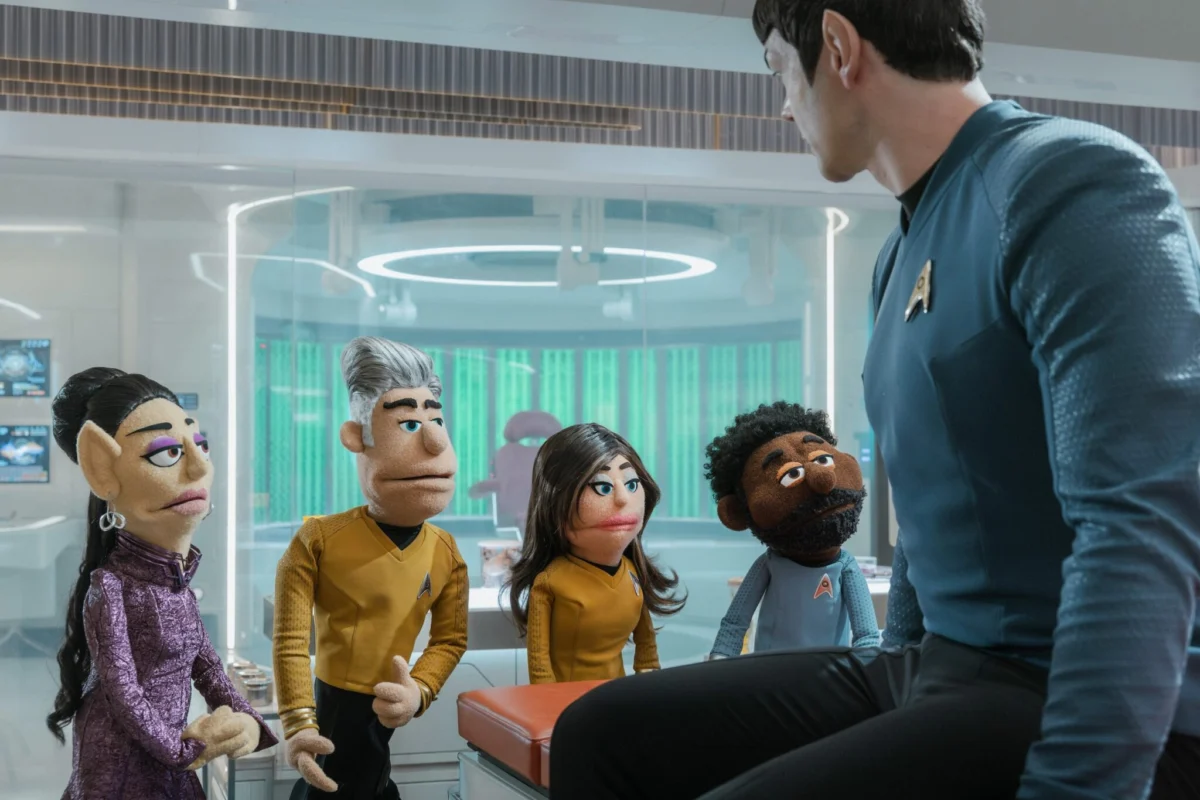
In the fourth season, the brainstorming sessions clearly yielded a wealth of concepts: the Enterprise as the architect of the asteroid belt, a haunted ship, a noir pastiche, a puppet-focused episode, and a Hangover-inspired comedy. While "Level-Five Transporter Accident" used the Muppet-style puppetry as a clever lens for Spock’s subconscious anxieties, others felt less integrated. "Once La’an a Time," while brimming with Princess Bride-esque whimsy, suffered from a lack of narrative cohesion, feeling more like an unpolished first draft than a finished product.
When the gimmicks work, they serve to deepen character development. When they fail, they act as barriers to the audience’s emotional investment. The challenge for the final season, which is set to be truncated to just six episodes, will be to marry these high-concept hooks with the emotional resonance that made the show’s best episodes—like "Ad Astra per Aspera"—so memorable.
The Ensemble: Bridging the Gap to 1966
Despite the unevenness of the plot mechanics, the fourth season excelled in one of the show’s most important tasks: bridging the gap between the Strange New Worlds era and the original 1966 series.
The development of the core cast has been particularly noteworthy:
- Spock: The season marks a definitive transition for Spock, who moves from struggling with his humanity to a more rigid, logic-driven Vulcan persona. It is a subtle, heartbreaking trajectory that provides necessary context for his demeanor in the original series.
- Uhura: Celia Rose Gooding has done exceptional work in evolving her version of Uhura. Moving away from the hesitant, uncertain character of the first season, she is steadily growing into the command-track officer that fans recognize.
- The Kirk Brothers: Paul Wesley’s James T. Kirk and Dean Jeannotte’s Sam Kirk provide a grounded, complex look at the Kirk family history. By moving past the reductive, tragedy-based characterizations seen in the reboot films, SNW has managed to provide a richer, more nuanced look at the sibling dynamic and the professional path of the future Admiral.
A Roster of Exceptional Guest Talent
One cannot discuss the season without acknowledging the high caliber of guest performances. Joe Morton’s turn in "Orders of Magnitude" was a standout, bringing gravitas and complexity to a role that could have easily devolved into a trope. Other notable contributors included Saffron Burrows, whose performance in "Valles Marineris" anchored the episode’s emotional weight, and Rachael Harris, who brought a delightful energy to her portrayal of an Orion pirate. The inclusion of legacy-adjacent performers like Deidre Hall and Brian Markinson served to honor the history of the franchise while grounding the new, experimental episodes.

Implications for the Final Season
The news that the fifth and final season will consist of only six episodes presents a significant, final challenge. With limited screen time, the writing staff must abandon the temptation of "gimmick-heavy" episodes in favor of resolving the long-standing character arcs of Pike, Spock, and the rest of the crew.
The fourth season proved that the show is still capable of greatness—"Orders of Magnitude" stands as a testament to the show’s potential to produce top-tier science fiction. However, it also served as a warning that without a firm grip on story structure, even the most creative ideas can become diluted.
Housekeeping Note: The Starfleet Academy Dilemma
In light of the complex and often polarized online discourse surrounding the Starfleet Academy series, there will be no individual season-one review. The sheer volume of often contradictory "fan discourse" has proven to be an exhausting barrier to critical analysis. Consequently, a comprehensive review of the entire project will be published following the conclusion of the show’s second season, providing a more balanced and holistic perspective on its contribution to the Trek canon.
Conclusion
Strange New Worlds remains one of the most vital entries in the modern Star Trek library. While its fourth season was marked by a struggle between high-concept experimentation and narrative discipline, it succeeded in its primary goal: providing a bridge between the past and the future of the franchise. As the Enterprise prepares for its final voyage, the hope remains that the writers will lean into the character-driven drama that first endeared this crew to the audience, ensuring that the legacy of Strange New Worlds ends on the high note it so richly deserves.
